Your learning plan · Continue · Review →
Reported speech
IntroducedYour saved position stays in this browser. Resuming does not complete the lesson or answer its questions.
Telling people what others said
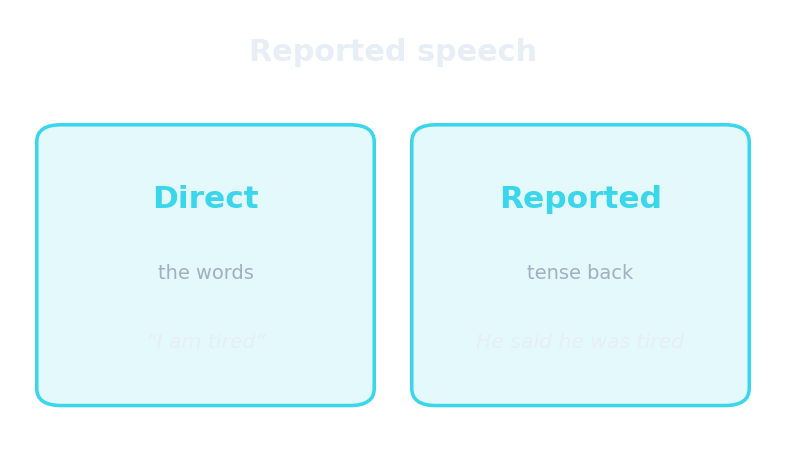
- Indirect speech reports a message without presenting it as an exact quotation: He said he was tired. Direct speech quotes the words: “I am tired,” he said.
- Preserve who said what, to whom and when. A tense substitution by itself cannot do that job.
- Outcome: report a message with clear people and time references. Start with past and present reference. Starting check: if you repeat your own earlier words, does I need to become she? The referent is still you.
He said he was early. The clock reported a different story.
say and tell
- In this statement pattern, use say (that) … or tell someone (that) …: She said she was busy. She told me she was busy. That is often optional.
- A listener can follow say to: She said to me that she was busy. Do not use said me for this meaning.
- These are patterns for reporting statements. Tell a story and tell the truth are also grammatical without a named listener.
Complete with the past-simple form of “say” or “tell”: “He ___ me that he was busy.”
Difficulty 1/5 · 100 coins + a small bonus on first completion today
Told me fits tell + listener. Say can name the listener with to: “He said to me that he was busy.” Do not use said me in this reporting pattern.
Use the past simple of “tell”: “The caretaker ___ us that the room was ready.”
Difficulty 1/5 · 100 coins + a small bonus on first completion today
Told us fits tell + listener + reported statement. The listeners are us.
Which sentence uses say with an explicitly named listener?
Difficulty 1/5 · 100 coins + a small bonus on first completion today
Said to me supplies say + to + listener. Told me is another valid frame; told to me is not that statement-reporting pattern.
Backshift is a viewpoint choice
- After a past reporting verb, a report often uses backshift: is → was, will → would, can → could. Past simple can become past perfect when looking back from that report; past perfect already marks an earlier viewpoint and does not shift again.
- Backshift is not compulsory when the information is still true or relevant: Mina said she works at the museum can report a job she still has. Mina said she worked there is also possible; the past form does not by itself prove she has left.
- A task may ask you to practise a backshifted version. Follow that requested form without calling every unchanged tense ungrammatical.
Direct → reported speech
Practise one backshifted report, preserving speaker and recipient. Backshift and reference changes depend on the reporting context.
She said to me, “I will help you.” Practise reporting this with backshift, from my viewpoint. Which option supplies that form?
Difficulty 1/5 · 100 coins + a small bonus on first completion today
Would supplies the requested backshift of will. She is the original speaker and me is the original recipient reporting it. Will can remain grammatical when the offer is current; this task specifically requests backshift.
Translate into English: 他说他累了。
Difficulty 3/5 · 200 coins + a small bonus on first completion today
He said he was tired is one possible report. An unchanged is can also report a currently relevant state; was does not by itself prove that the tiredness ended.
Use the requested backshift of “will”: “She said to me, “I will wait.” → She said she ___ wait.”
Difficulty 1/5 · 100 coins + a small bonus on first completion today
Would is the requested backshift of will. This form reports the statement; it does not prove she waited.
Track people, place and dates
- Pronouns follow their actual referents. On Monday, Sara tells Ben, “I’ll send you my notes tomorrow.” Ben reports on Wednesday: Sara told me she would send me her notes on Tuesday.
- I → she because Sara is the original speaker; you → me because Ben is reporting the words addressed to him. Another reporter might need him, not me.
- Tomorrow means the day after the original speech, not automatically the day after the report. If the report is still on Monday, tomorrow can remain accurate. Use a named day when the reference might be unclear.
In reported speech, does “tomorrow” often change to “the next day”?
Difficulty 1/5 · 100 coins + a small bonus on first completion today
Yes, often — especially when reporting on a later day. But tomorrow can remain if it still refers to the intended day at the time of reporting. Track dates rather than changing every time word mechanically.
On Thursday, a guide says “The tour starts tomorrow.” You report those words on Sunday. Which named day preserves the intended start?
Difficulty 1/5 · 100 coins + a small bonus on first completion today
The original tomorrow points to Friday, the day after Thursday. It does not become Monday merely because you report on Sunday.
Repair the message, not just its tense
- She asked me where did I live needs statement order in the embedded question: She asked me where I lived. A yes/no report can use if/whether: She asked me if I was busy.
- He said he will come tomorrow can be grammatical if the plan remains relevant and tomorrow still names the intended day. Reporting an old promise later may instead need would and an explicit past date.
- Near miss: Ben’s Wednesday report Sara told me she would send you my notes tomorrow changes the recipient, owner and day. Repair those references first; a correct would cannot rescue a wrong message.
For these examples, match each quotation to the supplied backshifted report, using he for the original speaker. This practises one reporting viewpoint.
Difficulty 2/5 · 140 coins + a small bonus on first completion today
These supplied reports use am → was, will → would and can → could. Unchanged tenses may also be grammatical when information remains current; these matches are not a universal transformation rule.
He asked me, “Are you busy?” Choose the standard indirect yes/no report with backshift.
Difficulty 1/5 · 100 coins + a small bonus on first completion today
If/whether introduces an indirect yes/no question, followed by statement order: “He asked me if I was busy.” If here means whether, not a condition.
“The receptionist said she worked at the hostel.” by itself proves that she no longer works there.
Difficulty 1/5 · 100 coins + a small bonus on first completion today
Worked can be a backshifted report of a continuing job. You need additional information before concluding that the job ended.
- Choose said (to someone) or told someone for this reporting pattern.
- Check whether backshift suits the viewpoint; do not infer that a backshifted state has necessarily ended.
- Separate reported words from confirmation that a promised action happened. A report can preserve the message without proving its truth or its later outcome.
Invent something a friend said earlier. Report it in one English sentence using “said” or “told” with backshift, as specifically requested in this exercise.
Difficulty 3/5 · 200 coins + a small bonus on first completion today
Example: “My friend told me she had passed the exam.”
On Monday, Leila tells Omar, “I’ll email you the map tomorrow.” Omar reports this to a colleague on Thursday. Which report preserves the original speaker, recipient and intended day, without claiming that the email was actually sent?
Difficulty 1/5 · 100 coins + a small bonus on first completion today
The original tomorrow is Tuesday, the day after Monday. Leila remains the sender; Omar, now speaking as I/me, remains the recipient. The wording “told me she would” reports the promise without confirming delivery. If you chose Friday or reversed the people, write the original date/sender/recipient first, then reconstruct the report.
Original message: on Tuesday, Ivo tells you, “I can bring my spare key tomorrow.” On Friday you pass that message to a housemate. Write one or two English sentences preserving the intended day, whose key it is and who offered to bring it. Do not invent whether the key arrived. After comparing, revise one reference that could mislead the housemate.
Compare the intended meaning and the relevant clause/form choices. Revise one supported issue; this local self-review does not award correctness or proficiency.
Worked contrasts: map the viewpoint
- Your own earlier words: on Monday you say I am repairing my bicycle. Later you report I said I was repairing my bicycle. You remain the speaker and owner, so I/my stay. Backshift changes the viewpoint; it does not turn you into a different person.
- A different place and day: at a studio on Tuesday, a tutor says I’ll leave the frames here tomorrow. You report from a café on Friday: The tutor told me she would leave the frames at the studio on Wednesday. Naming the place and day prevents here/tomorrow from moving the original message to the café or Saturday. The report does not confirm that the frames arrived.
- A current fact, two forms: you know a friend still lives by the harbour. She said she lives by the harbour highlights that current information; she said she lived by the harbour can also report it. A backshifted form alone does not establish a move. Keep known facts separate from assumptions about a tense.
Fresh reports and questions
- Try twenty fresh independent written decisions before returning to the examples. Some ask for a specified backshifted frame; others ask which people, dates, places or outcomes are actually established.
- For indirect questions, keep the question’s information but use statement order. Yes/no content can use if/whether; a question word such as where can introduce its own content. Do not turn the embedded question into a new direct question.
Use the past simple of “say” in this frame: “The instructor ___ that the materials were ready.”
Difficulty 1/5 · 100 coins + a small bonus on first completion today
Said fits the requested say + statement pattern. Told would need an appropriate listener in this reporting frame.
Backshift the present perfect as requested: ““I have finished.” → She said she ___ finished.”
Difficulty 1/5 · 100 coins + a small bonus on first completion today
Had finished is the requested past-perfect report of have finished. An unchanged tense can fit other current-report contexts, but this task names the target.
Use the requested backshift of “am”: ““I am working.” → He said he ___ working.”
Difficulty 1/5 · 100 coins + a small bonus on first completion today
Was working is the requested backshifted continuous frame. Was agrees with he; the report does not by itself establish what he is doing now.
Use “if” or “whether” to report this yes/no question with statement order: ““Are you ready?” → She asked me ___ I was ready.”
Difficulty 1/5 · 100 coins + a small bonus on first completion today
If and whether both introduce the reported yes/no question. The embedded clause uses I was rather than was I.
On Monday, a repairer says “The part will arrive tomorrow.” You repeat this on Thursday. Complete the intended named day: “The repairer said the part would arrive on ___. (Tuesday / Friday)”
Difficulty 1/5 · 100 coins + a small bonus on first completion today
Tuesday is the day after the original Monday. The statement reports the expectation without confirming delivery.
Yesterday you said “I am making a model.” Now you report your own words with backshift. Which version keeps you as the maker?
Difficulty 1/5 · 100 coins + a small bonus on first completion today
You remain the original speaker and maker, so I stays I. Backshift does not require changing every first-person pronoun into a third-person one.
Rosa said to Leo, “I’ll send you the receipt.” You overheard and now report the offer to someone else. Rosa uses she/her, Leo he/him. Which backshifted report preserves the recipient?
Difficulty 1/5 · 100 coins + a small bonus on first completion today
Him refers to Leo, the original addressee. You are a third-party reporter, so me would change the recipient. Rosa remains the sender.
Dana, who uses she/her, told you “My coat is in the cupboard.” Which backshifted report preserves the owner?
Difficulty 1/5 · 100 coins + a small bonus on first completion today
Her coat retains Dana as owner. My would make the reporter the owner; the last option changes both the object and the message.
You and a colleague are still in the same workshop where Ari said “I like it here.” You report that continuing preference now. Which account fits?
Difficulty 1/5 · 100 coins + a small bonus on first completion today
Place words follow the actual location. Here can still identify the original workshop when the report is made there; a mechanical replacement is unnecessary.
On Monday at the pool, a coach said “The equipment is stored here.” On Wednesday you report from a café. Choose a clear backshifted report locating the equipment at the original place.
Difficulty 1/5 · 100 coins + a small bonus on first completion today
Naming the pool preserves the original here. Here at the café would move the equipment in the message; tomorrow is not a place.
You know that a curator still works at a gallery. Which pair can both report the curator’s earlier statement about that continuing job?
Difficulty 1/5 · 100 coins + a small bonus on first completion today
A present form can highlight the still-current fact, while a backshifted past can also report it. The second pair has say/tell frame errors; the third has incomplete verb frames.
A chef said “I have prepared the sauce.” Choose the specifically requested backshifted present-perfect report.
Difficulty 1/5 · 100 coins + a small bonus on first completion today
Had prepared is the requested past-perfect frame. Has prepare and had preparing do not complete those auxiliary patterns. The task is not a universal ban on retaining a current present perfect.
A visitor said “I had already booked a seat before the price rose.” Choose the report retaining that already-past-perfect viewpoint.
Difficulty 1/5 · 100 coins + a small bonus on first completion today
Had already booked can remain past perfect. Do not add a second had mechanically; the last option also changes the time relationship.
Someone asked you “Where do you keep the labels?” Choose the standard backshifted indirect question.
Difficulty 1/5 · 100 coins + a small bonus on first completion today
Where I kept uses statement order and the requested past form. Do not carry direct-question inversion or do support into this embedded pattern.
A neighbour asked you “Can you open the gate?” Treat it here as a question about ability and choose the backshifted question report.
Difficulty 1/5 · 100 coins + a small bonus on first completion today
Whether I could open introduces the yes/no content with statement order. If I could open is also possible; the other supplied options break the question-reporting frame.
A note says “Sal told me he would replace the bulb on Wednesday.” Nothing else is known. What is established?
Difficulty 1/5 · 100 coins + a small bonus on first completion today
The sentence reports what Sal said about a future action from that viewpoint. It is not independent evidence that the bulb was replaced.
Choose the sentence that explicitly presents the speaker’s words as a direct quotation.
Difficulty 1/5 · 100 coins + a small bonus on first completion today
Quotation marks present the words as quoted. The other two are indirect reports; they can preserve a message without claiming its exact wording.
Every grammatical report after a past reporting verb must backshift, even when information remains true and relevant.
Difficulty 1/5 · 100 coins + a small bonus on first completion today
Backshift is common, not compulsory in every current report. Check the intended viewpoint and any specified practice frame before editing.
On Friday morning, someone says “The test is tomorrow.” A report later the same Friday can still use “tomorrow” for the same Saturday test.
Difficulty 1/5 · 100 coins + a small bonus on first completion today
Tomorrow still points to Saturday on both occasions. Changing it automatically is unnecessary when its reference remains accurate.
Hand off the message accurately
- The new camera and badge situations change who is reporting and who is listening. Trace the original speaker, recipient, owner and date first; a correct reporting verb cannot repair a reversed owner.
- Write the English report before showing a model. Compare its viewpoint with the original message and the current reporting place/time. Revise the ambiguity that could most change what the next person understands.
On Saturday, Mila tells you “I’ll bring you my camera on Monday.” Mila uses she/her. On Wednesday you pass on the message; delivery is unconfirmed. Choose the faithful backshifted report.
Difficulty 1/5 · 100 coins + a small bonus on first completion today
The first preserves sender, recipient, owner and Monday without converting the promise into a confirmed delivery. The others reverse references or invent an outcome.
At the office, a manager asked you “Where is your badge?” Later you report this to a friend using backshift. Choose the report preserving both the owner and embedded order.
Difficulty 1/5 · 100 coins + a small bonus on first completion today
My badge remains the badge of you, the original addressee now reporting. Where my badge was uses statement order; the other versions change reference or question content.
Retrieve references later
- Tomorrow, try the room check and tools report before rereading. Separate the earlier message from facts that have actually been checked now. Repair a reference or frame mismatch, or explain why your version is already faithful.
- Next: relative clauses, to identify which person or document you mean. Study time is provisional across sessions. These written checks and self-review do not establish speaking proficiency; independent specialist grammar/key, accessibility and learner reviews remain pending.
Usage checked 21 October 2026: British Council, reported statements and reported questions. New contexts and models are original. Local source checks; independent language, answer and learner review pending.
“The organiser said the room was ready.” alone proves that the room is not ready now.
Difficulty 1/5 · 100 coins + a small bonus on first completion today
The past form can be backshifted. The report does not itself establish the current opposite; seek current evidence rather than infer it from tense alone.
Later, without rereading, report this in 1–2 English sentences with backshift. On Wednesday at the community hall, Ms Vale told you, “I am keeping my tools here until Friday.” You report from home on Saturday to Iris. Preserve whose tools, the original place and the Friday endpoint. You have not checked their current location. Compare and revise one reference or frame mismatch.
Compare the original message and reporting situation separately. A model supports revision; revealing or comparing it does not automatically establish correctness or proficiency.