Your learning plan · Continue · Review →
Relative clauses
IntroducedYour saved position stays in this browser. Resuming does not complete the lesson or answer its questions.
Identifying people and things
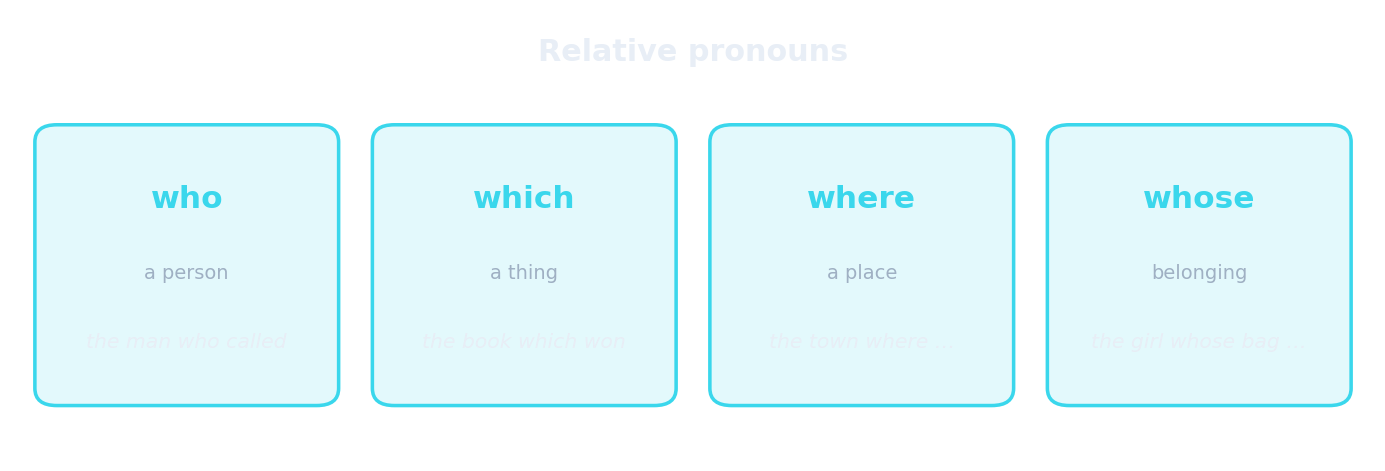
- A relative clause can identify or add information about a noun: The woman who lives next door is a doctor. Here who lives next door identifies the woman.
- Outcome: connect a description to the right noun and decide whether the relative word is a subject, object or possessive form.
- Start with basic clause order. Starting check: in the film we watched, who did the watching, and what was watched? We is the subject; the film supplies the object.
The student who borrowed my pen has become its permanent guardian.
who, which, that
- In defining clauses, who refers to people and which to things; that can refer to either: the person who/that called; the book which/that won.
- A clause’s role matters as well as the noun: the town which I visited has an object gap after visited. A place name does not automatically require where.
- In the standard written patterns taught here, the clause follows the noun it modifies. Check what each clause is describing when a sentence contains several nouns.
Choose among the offered words: “The man ___ called you is my uncle.”
Difficulty 1/5 · 100 coins + a small bonus on first completion today
Who is the person-reference choice among these options. That can also introduce this defining subject relative, although it is not offered here. Which does not fit the ordinary person-reference pattern.
Translate into English: 住在隔壁的那位女士是医生。
Difficulty 3/5 · 200 coins + a small bonus on first completion today
Person + relative clause: “The woman who lives next door is a doctor.”
You visited a harbour. Choose the offered word for the object gap: “The harbour ___ we visited has reopened.”
Difficulty 1/5 · 100 coins + a small bonus on first completion today
We visited the harbour: the harbour is the object. Which fits the offered choices; where would supply a location relation instead. That or omission could also fit a defining clause when offered.
where, when, whose
- Where supplies a location relation: the town where I grew up means the town in which I grew up. Compare the object pattern the town which I visited.
- When can supply a time relation: the day when we met. Whose introduces a noun phrase with a possessive relation: the writer whose books I love.
- Whose is not limited to people: a company whose offices are nearby is possible. Read the words after the gap before choosing a relative word.
Which relative pronoun?
Choose among the four offered relative words by reading the gap’s role, not only the preceding noun. Other forms such as that may work when offered.
Complete the possessive relation: “That’s the girl ___ bag was stolen.”
Difficulty 1/5 · 100 coins + a small bonus on first completion today
Belonging → whose: “the girl whose bag …”.
Complete with “whose” or “who”: “The painter ___ studio is upstairs makes large portraits.”
Difficulty 1/5 · 100 coins + a small bonus on first completion today
Whose introduces studio and its possessive relation to the painter. Who alone would not connect the owner to the following noun.
Complete with “where” or “which” for the meeting location: “This is the café ___ our team meets.”
Difficulty 1/5 · 100 coins + a small bonus on first completion today
Our team meets in the café. Where supplies that location relation; bare which does not supply the missing in in this pattern.
When omission works
- In a defining clause, an object relative word can often be omitted: The film (that) we saw was great. The clause already has a subject, we.
- Keep a subject relative word: the man who called. Removing who does not give the intended full relative clause.
- Do not extend this to every relative: My phone, which I bought yesterday, broke needs its relative word in the non-defining clause. A fronted preposition also needs its relative form: the person to whom I spoke; compare the person I spoke to.
Can “that” be omitted in this defining relative clause? “The film (that) we saw was great.”
Difficulty 1/5 · 100 coins + a small bonus on first completion today
Yes: this is a defining object relative, with we as its subject. Contrast the subject relative “the film that won”, where that is needed, and a non-defining clause, where the relative word cannot be omitted.
In the full defining relative “the volunteer who organised the trip”, removing “who” alone preserves the intended relative clause.
Difficulty 1/5 · 100 coins + a small bonus on first completion today
Who is the subject of organised in this full relative. Unlike an object relative, it cannot simply disappear here.
Repair the gap
- For the man who called, use who or that, not which, in this ordinary person-reference pattern.
- Standard written English does not normally use what after an explicit noun in the book what I read. Use the book that I read. But what I read was surprising is grammatical: what I read means the thing(s) that I read, without an earlier noun.
- The friend who I met him repeats the object; use the friend who I met. This diagnoses the English clause, not a presumed habit shared by all Chinese speakers.
Match each broad label to one possible relative word illustrated in this lesson. These labels are memory cues, not a rule choosing a word from the noun alone: compare the town where I lived with the town which I visited.
Difficulty 2/5 · 140 coins + a small bonus on first completion today
Who/which can refer to a person/thing, while where/when supply location/time relations. A place or date can instead be the object of a verb and take which/that or omission in a defining clause. Examine the gap, not only the noun.
Is this location-relative pattern correct? “That’s the town where I grew up.”
Difficulty 1/5 · 100 coins + a small bonus on first completion today
Yes: where supplies the location relation, as in “the town in which I grew up”. Compare “the town which I visited”, where the town is the direct object of visited.
Choose the standard written sentence without repeating the relative object.
Difficulty 1/5 · 100 coins + a small bonus on first completion today
Who represents the guide as the object of met; adding him repeats that object. Who can also be omitted in this defining object pattern.
- Find the noun, then ask what role is missing inside the clause. A place can be an object or a location; the choices differ.
- Omit an object relative only in a pattern that permits omission, not in a non-defining clause or after a fronted preposition.
- Keep the described noun and the clause role separate. A correct-looking relative word cannot repair a repeated object or a changed owner.
Describe an invented person or thing in one English sentence using a relative clause introduced by “who”, “which” or “that”.
Difficulty 3/5 · 200 coins + a small bonus on first completion today
Example: “I have a friend who speaks four languages.”
A guide writes: “The village which we visited is beside the river.” Which explanation correctly describes which in this sentence?
Difficulty 1/5 · 100 coins + a small bonus on first completion today
We visited the village: the village fills the object role. Where would supply a location relation and does not directly replace that object in we visited. If you chose from the noun’s place meaning alone, rebuild the simple clause first, identify its subject/object and then revisit the gap.
Invent a short English message about a library. In one sentence, identify it as the library you visited yesterday. In a second, describe a room there where a club meets. Use a relative clause in each sentence; revise one gap or repeated pronoun after comparing. You may choose natural wording rather than copying the model.
Compare the intended meaning and the relevant clause/form choices. Revise one supported issue; this local self-review does not award correctness or proficiency.
Worked contrasts: reconstruct the simple clause
- Object or location: the gallery which we photographed comes from we photographed the gallery. The gallery where we held a class comes from we held a class in the gallery. The same place noun has two roles; changing which to where alone does not preserve them.
- Caller or person called: the tutor who called me has the tutor as subject, so keep who/that in the full relative. The tutor who I called has I as subject and the tutor as object; the tutor I called is a possible defining version. Do not add him/her after called for that same object.
- Whose with an organisation: a choir whose members practise here links the members to the choir. Whose introduces the noun phrase members; it is not limited to a human owner. A choir who members … does not form that possessive link.
Fresh gaps, complete meanings
- Try twenty fresh independent written decisions without copying the examples. Find the described noun and reconstruct the clause’s subject, object, location, time or possessive relation before choosing a word.
- Check the whole pattern before omitting anything. Defining object omission, a non-defining clause and a fronted preposition have different limits. A task can request one offered form without making other complete grammatical frames invalid.
Complete the possessive relation: “The charity ___ volunteers repaired the roof thanked the village. (whose / which)”
Difficulty 1/5 · 100 coins + a small bonus on first completion today
Whose connects the volunteers to the charity. It can express a possessive relation with an organisation, not only a person.
Choose “where” or “which”: “The square ___ the festival takes place is near the station.”
Difficulty 1/5 · 100 coins + a small bonus on first completion today
The festival takes place in the square. Where supplies that location relation, whereas bare which does not replace in the square here.
Choose “which” or “where”: “The valley ___ we photographed looked different in winter.”
Difficulty 1/5 · 100 coins + a small bonus on first completion today
We photographed the valley. Which supplies that object; where would not directly fill the object gap in this meaning.
Choose “when” or “whose”: “I remember the evening ___ the lights went out.”
Difficulty 1/5 · 100 coins + a small bonus on first completion today
When supplies the time relation: the lights went out that evening. Whose would need a possessive noun phrase, which this gap does not introduce.
Use “who” or “that” in this defining subject relative: “The technician ___ repaired the lift left a note.”
Difficulty 1/5 · 100 coins + a small bonus on first completion today
Who and that can both introduce this defining person-subject relative. A complete answer need not copy a single preferred model.
In “The sculptor who designed the fountain lives nearby”, who does the designing?
Difficulty 1/5 · 100 coins + a small bonus on first completion today
Who refers to the sculptor and is the subject of designed. The fountain is the object; reconstruct the simple clause before assigning roles.
Choose the sentence expressing the relation between a company and its offices.
Difficulty 1/5 · 100 coins + a small bonus on first completion today
Whose offices connects the offices with the company. A possessive relative can have an inanimate antecedent; the other options do not form this noun phrase correctly.
Choose the standard written repair of “The parcel that I collected it was damaged”.
Difficulty 1/5 · 100 coins + a small bonus on first completion today
That supplies the object of collected, so remove the repeated it. The parcel I collected also works as a defining object relative.
Which defining clause permits omission of the bracketed word without another change?
Difficulty 1/5 · 100 coins + a small bonus on first completion today
We is the subject of tested, and recipe is its object, so that can be omitted there. Who/that is the subject in the other two clauses.
Choose the complete full relative clause in standard written English.
Difficulty 1/5 · 100 coins + a small bonus on first completion today
That is the subject of arrives in the relative clause. Removing it leaves the intended full relative incomplete; where does not fill a subject role.
For the supplied non-defining pattern, choose the standard sentence.
Difficulty 1/5 · 100 coins + a small bonus on first completion today
The comma-marked extra-information clause retains which. Object omission and that are not the standard choices for this non-defining pattern.
Choose the full relative form after the fronted preposition in this formal person-reference pattern: “The researcher to ___ I wrote replied promptly.”
Difficulty 1/5 · 100 coins + a small bonus on first completion today
To whom is the formal fronted-preposition pattern. Omission works in a different arrangement such as the researcher I wrote to, not by dropping whom after fronted to.
Choose the grammatical defining object relative with the preposition left at the end.
Difficulty 1/5 · 100 coins + a small bonus on first completion today
The assistant I spoke to allows object omission with to at the end. Moving to before the gap needs an appropriate relative form; adding him repeats the object.
Read “What the mechanic found surprised us.” Which account fits?
Difficulty 1/5 · 100 coins + a small bonus on first completion today
What introduces the whole noun-like clause here: there is no separate antecedent such as the fault before it. This differs from the fault what the mechanic found in the standard pattern taught here.
For standard written English, choose a defining object relative after the explicit noun report.
Difficulty 1/5 · 100 coins + a small bonus on first completion today
That can follow the explicit noun report and supply the object of read. What I read can stand without an earlier noun in a different construction; the last option changes the gap and repeats it.
Choose the sentence making the musician the person who repaired the violin.
Difficulty 1/5 · 100 coins + a small bonus on first completion today
Who repaired the violin modifies musician in the first sentence. The other options reverse the roles or use whose without the noun phrase this possessive form needs.
Every place noun requires “where” even when it fills the object role of a verb such as “visit”.
Difficulty 1/5 · 100 coins + a small bonus on first completion today
A place can be the object: the island which we visited. Where supplies a location relation instead; noun meaning alone does not determine the clause gap.
“Whose” can refer only to a human owner, so “a team whose players train here” cannot be grammatical.
Difficulty 1/5 · 100 coins + a small bonus on first completion today
Whose can express relations with groups and things as well as people. Whose players links the team and its players in this example.
Both “the artist who won” and “the artist that won” can form defining person-subject relatives.
Difficulty 1/5 · 100 coins + a small bonus on first completion today
Who and that are both possible in this defining pattern. This does not license that in every comma-marked non-defining clause.
Transfer the description accurately
- In the new visitor and theatre descriptions, preserve who acted on which object and where an event took place. A grammatical relative clause with reversed people or objects communicates a different fact.
- Write the English description before revealing a model. Compare the underlying simple clauses; repair a repeated object/location, possessive link or unsupported detail rather than merely copying a relative word.
Facts: a visitor borrowed the red folder; a different visitor returned the blue binder. The borrower is now waiting by the door. You want to identify that person. Choose the faithful sentence.
Difficulty 1/5 · 100 coins + a small bonus on first completion today
The first preserves who borrowed what. The other options change the object/action or reverse the roles. The sentence supplies a location for the identified visitor without confusing the borrower with the other visitor.
You painted a theatre last year and held an exhibition inside it this year. Choose the pair correctly expressing the object relation and then the exhibition location.
Difficulty 1/5 · 100 coins + a small bonus on first completion today
We painted the theatre gives an object gap; we held the exhibition in the theatre gives a location relation. The correct pair preserves those two different roles.
Retrieve the role later
- Tomorrow, attempt the omission check and repair-shop description before rereading. Explain each gap and compare your draft with the concealed model; revise one mismatch or explain why your wording is already valid.
- Next: defining and non-defining clauses, to examine how punctuation changes the information presented. Planning time is provisional across sessions. These written checks are not a speaking assessment or proof of proficiency; independent grammar/key specialist, accessibility and learner reviews remain pending.
Usage checked 21 October 2026: Cambridge, relative pronouns (earlier reference); British Council defining clauses and non-defining clauses. New contexts and models are original. Local source checks; independent language, answer and learner review pending.
Because “the ticket we bought” permits omission, we can also omit “which” from the supplied non-defining clause “My ticket, which I bought online, is on my phone” without another change.
Difficulty 1/5 · 100 coins + a small bonus on first completion today
The defining object pattern permits omission; the comma-marked non-defining pattern retains its relative word. Do not transfer omission to every object relative.
Later, write a two-sentence English description before showing the model. Facts: you visited a repair shop on Tuesday; its owner’s spare keys are kept behind the counter; classes take place in its back room. Use a defining object relative to identify the visited shop, a whose clause for the owner’s keys, and where or in which for the class location. Preserve the facts, compare, then revise one gap or repeated pronoun.
Compare the underlying simple clauses before choosing a relative word. A model supports revision; self-review does not automatically establish correctness or proficiency.