Your learning plan · Continue · Review →
Conditionals — first and second
IntroducedYour saved position stays in this browser. Resuming does not complete the lesson or answer its questions.
If … , then …
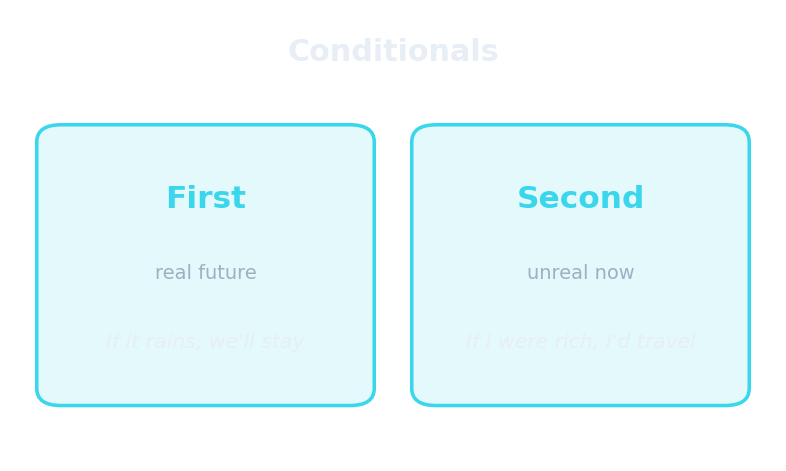
- A conditional connects a condition with a result, decision or offer. It does not promise that the condition will happen.
- Here we practise an open future possibility and an imagined situation viewed as more remote. The diagram’s “real future” is shorthand for an open possibility, not certainty; the remote pattern can concern the future as well as the present.
- Outcome: interpret those viewpoints and write a useful conditional message. Start with present simple and future reference. Starting check: does If the bus is late, I’ll walk tell you that the bus will be late? It leaves that open.
If it rains tomorrow, my umbrella will choose to stay at home.
First conditional — an open possibility
- A common pattern is
if + present simple, will + base verb: If it rains, we will stay home. The present form refers to a possible future condition. - The result can also use a modal or an instruction: If you need help, you can call me. If the door is locked, use the side entrance.
- If you study, you’ll pass expresses the speaker’s prediction; its grammar does not prove that studying guarantees a pass.
Practise the first-conditional will pattern: “If it rains, we ___ at home.” Choose the result containing “will”.
Difficulty 1/5 · 100 coins + a small bonus on first completion today
Will stay supplies the requested will + base-verb result. Stay can describe a habitual result in another context; it is not the requested will pattern. A conditional prediction is not proof that an outcome is guaranteed.
For an ordinary open future weather condition, is this the standard pattern? “If it will rain tomorrow, we will stay home.” Here “will” is intended only as a future marker.
Difficulty 1/5 · 100 coins + a small bonus on first completion today
For that ordinary future condition use “If it rains tomorrow, we will stay home.” This is not a ban on will after every if: willingness and indirect whether-questions have different patterns.
Translate into English: 如果下雨,我们就待在家里。
Difficulty 3/5 · 200 coins + a small bonus on first completion today
The reference uses a common open-future condition and will result. Preserve the conditional meaning; other natural wording can communicate it too.
Use the present simple of “close” in this ordinary future condition: “If the bridge ___ tomorrow, we’ll use the ferry.”
Difficulty 1/5 · 100 coins + a small bonus on first completion today
Closes fits the ordinary future condition and agrees with the singular bridge. Tomorrow does not require will inside this condition.
A station sign offers an instruction if the ticket machine is broken. Which complete sentence gives that instruction?
Difficulty 1/5 · 100 coins + a small bonus on first completion today
Ask the attendant is a complete imperative result. A conditional result need not contain will; the other options leave the instruction incomplete.
Second conditional — imagined or more remote
- A common pattern is
if + past form, would + base verb: If I had more time, I would travel. The past form here marks distance from reality, not a past date. - It can describe an imagined present or future: If I moved next year, I would need a new job. It does not assign a numerical probability.
- If I were you, I’d rest is a conventional advice pattern. Were works with all subjects in this hypothetical use; was also occurs with singular subjects, especially informally.
First or second conditional?
Recognise the open-future and remote-hypothetical patterns in these written examples; they express viewpoints, not guaranteed outcomes or measured probabilities.
Use the past form of “be” in this imagined advice pattern: “If I ___ you, I would rest.”
Difficulty 1/5 · 100 coins + a small bonus on first completion today
Were is conventional in “If I were you” and works with all subjects in this hypothetical use. Singular was also occurs informally and is accepted here. The past form marks an imagined viewpoint, not a past date.
Use the past form of “live” for this imagined future move: “If we ___ nearer the station next year, we would walk there.”
Difficulty 1/5 · 100 coins + a small bonus on first completion today
Lived marks a remote imagined viewpoint here. Next year makes the future reference explicit; the past form does not move the situation into last year.
unless — except if
- You’ll be late unless you hurry means you’ll be late if you don’t hurry.
- Check the whole meaning rather than deleting or adding not mechanically: I’ll lend it to you unless you don’t want it has a meaningful negative condition — not wanting it is the exception.
- For an ordinary future condition, use a present form after unless. This is a useful pattern, not a rule banning every negative clause.
“The club will lend you a helmet unless you bring your own.” What is the stated exception to the offer?
Difficulty 1/5 · 100 coins + a small bonus on first completion today
Unless introduces the exception: bringing your own helmet. Do not reverse it by treating unless as an instruction to insert not everywhere.
Check meaning before changing a form
- For the ordinary condition of having time, write If I have time, I’ll help, rather than adding a future will inside that condition.
- But If you will wait here, I’ll find the manager can use will for willingness. I wonder if it will rain is also grammatical: its if introduces an indirect question, meaning whether.
- Compare If I knew the answer, I would tell you with If I know the answer, I’ll tell you. The first presents knowing it as remote; the second leaves it open. Neither form alone proves what the person actually knows.
Match the familiar if-clause/result combinations shown here. These are model patterns, not a claim that a condition can take only one result form.
Difficulty 2/5 · 140 coins + a small bonus on first completion today
The examples pair an open-future prediction with will, hypothetical advice with would and a general fact with present simple. Other coherent modal or imperative results can occur in other messages.
The speaker presents knowing the answer as an imagined, remote situation. Which option uses the standard second-conditional pattern for that meaning?
Difficulty 1/5 · 100 coins + a small bonus on first completion today
If I knew … I would tell … is the requested remote pattern. Knew here marks the imagined viewpoint, not an earlier date. The task does not ban willing/polite would in every other if-clause.
The second-conditional frame itself assigns an exact 10% probability to its imagined condition.
Difficulty 1/5 · 100 coins + a small bonus on first completion today
The frame expresses the speaker’s remote viewpoint, not a numerical probability. A separate forecast or measurement would need its own evidence.
- Read the condition and the result; distinguish an open possibility from an imagined remote one.
- The familiar first/second patterns are useful starting frames. Other modals, instructions and meanings of will also occur.
- Keep explicit facts, imagined conditions and predicted results separate. A conditional does not automatically establish its condition or prove the reverse connection.
Imagine a remote present or future situation. Write one English sentence using the requested pattern “if + past form, would + base verb”. You may invent a person and ordinary details.
Difficulty 3/5 · 200 coins + a small bonus on first completion today
Example: “If I won the lottery, I would travel the world.”
A workshop message says: “If the projector fails tomorrow, we can use the printed diagrams.” Which reading preserves what the message actually says?
Difficulty 1/5 · 100 coins + a small bonus on first completion today
If leaves the future failure open; can gives an available response. Neither a failure nor diagram accuracy is established. If you read the condition as a fact or guarantee, underline if and can, then rewrite the message as an open possibility before trying a new backup plan.
A friend plans an outdoor lunch, but the weather is uncertain. Write a two-sentence English message: give one possible condition and a practical backup action, then imagine a different location you could choose if you had unlimited space. After comparing, revise one unclear condition or verb frame. Invent ordinary details; no proficiency score is assigned.
Compare the intended meaning and the relevant clause/form choices. Revise one supported issue; this local self-review does not award correctness or proficiency.
Worked contrasts: keep the viewpoint
- Backup versus report: a ferry company says If the crossing is cancelled tomorrow, we can transfer your ticket. Cancellation remains open; can offers an option. The crossing was cancelled would instead report an event. Using the backup does not prove cancellation was its only possible cause.
- Remote future versus past: If Jo rented a workshop next spring, she would need insurance imagines a future situation as remote. Jo rented a workshop last spring reports a past event. Read the whole time reference; neither rented alone nor a conditional label supplies a percentage chance.
- A negative exception: I’ll reserve you a seat unless you don’t want one leaves not wanting a seat as the exception. Removing don’t reverses the offer. In I’ll reserve a seat unless you already have one, having a seat is the exception instead: interpret the complete clause before changing a negative.
Fresh decisions, complete messages
- Try twenty fresh independent written decisions without copying the examples. Some name a particular practice frame; others ask what a message establishes. A grammatical alternative can exist even when a task asks for one specific form.
- Track the condition and the result separately, especially with negatives and unless. A result may use a modal or an instruction. An indirect if question meaning whether differs from the condition of another action.
Use the present simple of “need” in this open future condition: “If the printer ___ more paper tomorrow, I’ll refill it.”
Difficulty 1/5 · 100 coins + a small bonus on first completion today
Needs agrees with the singular printer in the ordinary future condition. The proposed refill does not assert that paper will run out.
Use the base verb “keep” after would: “If I owned a greenhouse, I would ___ herbs there.”
Difficulty 1/5 · 100 coins + a small bonus on first completion today
Would keep completes the requested remote result. Keeping or kept would not follow would directly in this frame.
Complete with “doesn’t” or “isn’t” for this open future condition: “If the parcel ___ arrive today, I’ll contact the shop.”
Difficulty 1/5 · 100 coins + a small bonus on first completion today
Doesn’t arrive is the present-simple negative for the singular parcel. Isn’t arrive combines the wrong auxiliary and verb form.
Complete with “unless” or “although” to state that permission is the exception: “We won’t enter the workshop ___ the owner gives permission.”
Difficulty 1/5 · 100 coins + a small bonus on first completion today
Unless supplies the requested exception. Without permission, the proposed entry will not happen; although would express contrast instead.
Use the past form of “have” for the imagined situation: “If Lea ___ a larger desk, she would keep the map open.”
Difficulty 1/5 · 100 coins + a small bonus on first completion today
Had presents the desk situation as imagined and remote. This form does not itself say the desk was larger at a past date.
A host says “If our guest arrives early tomorrow, we’ll offer breakfast.” Which conclusion is supported?
Difficulty 1/5 · 100 coins + a small bonus on first completion today
The condition leaves early arrival open and states the proposed response. It neither reports a completed meal nor guarantees arrival.
Read “If Tessa moved abroad next summer, she would need a new phone plan.” Which viewpoint fits?
Difficulty 1/5 · 100 coins + a small bonus on first completion today
Next summer supplies future time; moved/would marks the remote imagined viewpoint. Past form and past time are not the same thing here.
A visitor imagines renting a bicycle during a possible trip: “If I rented a bike, I could explore the coast.” What does could contribute?
Difficulty 1/5 · 100 coins + a small bonus on first completion today
Could gives a possible option in the imagined situation. The result of a remote conditional need not be would, and no ownership or road guarantee follows.
Choose the reordered sentence that preserves “If the meeting ends early, I’ll catch the six o’clock train.”.
Difficulty 1/5 · 100 coins + a small bonus on first completion today
Putting the result first keeps the same condition. Swapping which event is the condition changes the message; the last option reports past events instead.
A manager says “If the small room is full, we’ll use the hall.” This alone proves that using the hall means the small room must be full.
Difficulty 1/5 · 100 coins + a small bonus on first completion today
The message gives one condition for using the hall, not the only possible reason. Do not reverse if A then B into if B then A without more information.
In “I’m not sure if the ferry will run tomorrow”, what does if introduce?
Difficulty 1/5 · 100 coins + a small bonus on first completion today
If means whether after not sure here. It introduces uncertain information, not the condition of a stated result, so will is grammatical.
A guide says “If you will wait by the desk, I’ll fetch the key.” Here will means be willing to. Which interpretation fits?
Difficulty 1/5 · 100 coins + a small bonus on first completion today
The expressly stated willingness meaning permits will in the if-clause. It differs from mechanically adding a future marker to an ordinary weather condition.
A neighbour says “I’ll bring you soup unless you don’t want any.” What is the exception to bringing soup?
Difficulty 1/5 · 100 coins + a small bonus on first completion today
Not wanting soup is the exception here. The negative has a clear role; removing it would reverse the offer. Read unless together with the whole condition.
A café message says “We’ll sit outside unless the wind gets stronger.” Which paraphrase preserves the ordinary intended meaning?
Difficulty 1/5 · 100 coins + a small bonus on first completion today
Unless gives the stronger-wind exception; the paraphrase keeps the proposed outside seating when that exception does not occur. It does not assert what the wind will do.
Mara tells you that she owns no car. She adds “If I had a car, I would drive to the lake.” Which reading uses both the stated fact and the sentence?
Difficulty 1/5 · 100 coins + a small bonus on first completion today
Her explicit no-car statement supplies the current fact; the conditional imagines a different situation. The past form does not establish yesterday’s ownership.
Use the requested remote pattern for an imagined change of job.
Difficulty 1/5 · 100 coins + a small bonus on first completion today
Changed/would move supplies the requested remote pattern. Move remains the base verb after would; this correction concerns the given target frame, not every possible use of would after if.
The grammar of “If you enter the competition, you’ll win” proves that every entrant will win.
Difficulty 1/5 · 100 coins + a small bonus on first completion today
The speaker predicts a win under a condition. Grammatical form is not independent evidence that the prediction is true.
A shop will keep a repair request open if no reply arrives by Friday. Choose the message preserving that condition and result.
Difficulty 1/5 · 100 coins + a small bonus on first completion today
The first preserves no reply and not closing. The other options change the condition or reverse the result. Track both negatives separately.
Someone asks for imagined advice, using the conventional were pattern. Which reply fits that requested frame?
Difficulty 1/5 · 100 coins + a small bonus on first completion today
Were/would check gives the requested hypothetical advice frame. Singular was is also used informally; that does not make the other incomplete options here valid.
Transfer the plan accurately
- The new event and studio updates supply known facts and uncertain possibilities. Preserve the day, available backup and current situation; do not change them to make a familiar pattern easier to write.
- Draft the English message before revealing a model. Compare open and remote viewpoints and repair one meaning or verb-frame mismatch. Equivalent natural wording is valid when it preserves the requested facts and frame.
Facts: the rooftop event is planned for Saturday; rain is uncertain; the downstairs hall is available. Choose a faithful open backup message.
Difficulty 1/5 · 100 coins + a small bonus on first completion today
The first preserves Saturday, uncertain rain and the available hall. The others invent past rain, closure, a changed day or universal cancellation.
A maker has a small studio now and imagines a larger one next year. The actual delivery tomorrow may be delayed. Which pair keeps the two viewpoints distinct?
Difficulty 1/5 · 100 coins + a small bonus on first completion today
Had/would presents the remote studio future. Is delayed/I’ll use gives an open delivery contingency. Neither imagined space nor possible delay is asserted as a completed fact.
Retrieve without turning if into fact
- Tomorrow, attempt the bakery check and trip update before rereading. Explain what is conditional or imagined and what is actually known. Compare, then revise one mismatch or explain why your wording already fits.
- Next: reported speech, to pass on a changed plan accurately. Study time is provisional across sessions. These written checks are not a speaking assessment or proof of proficiency; independent specialist grammar/key, accessibility and learner reviews remain pending.
Usage checked 21 October 2026: British Council, verbs in time and if clauses and conditionals. New contexts and models are original. Local source checks; independent language, answer and learner review pending.
“If the new bakery opens next week, we’ll try it.” establishes that it will open next week.
Difficulty 1/5 · 100 coins + a small bonus on first completion today
The opening remains an open condition. Explain the possible action without turning the condition into an announced fact.
Later, before rereading, write two English sentences. Facts: a Sunday walking trip may be affected by fog; a local museum is an available backup. Then imagine having your own minibus, which you do not have now, and describe a different trip. Use an open condition with can or will and a remote if + past/would frame. Keep Sunday and the current ownership fact. Compare and revise one mismatch.
Compare the two viewpoints and the supplied facts before copying any wording. The model supports your revision; self-review does not automatically establish correctness or proficiency.