Your learning plan · Continue · Review →
Future forms review
IntroducedYour saved position stays in this browser. Resuming does not complete the lesson or answer its questions.
Talking about the future — a review
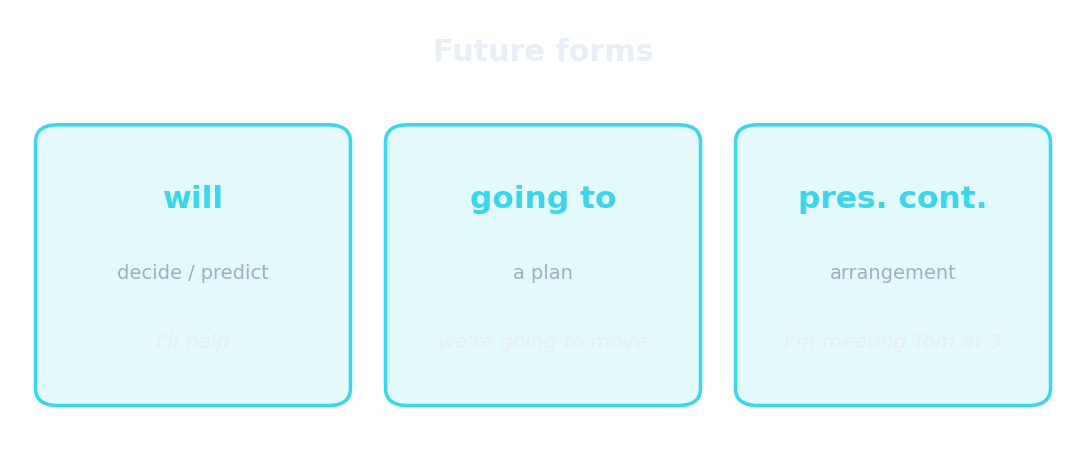
- English uses several forms for future reference: will, be going to, the present continuous and the present simple. Their uses can overlap.
- Outcome: explain a future choice from the speaker's meaning and context. Start with future plans. Starting check: does tomorrow alone tell you which form to use? No.
I am meeting my friend tomorrow; my calendar insists on a time.
will vs be going to
- Will can introduce a decision made now, a promise or a prediction: The chairs look heavy. I'll help you. Be going to can express an existing intention: We're going to repaint the room.
- Both can make predictions: I think the team will win; Look at that loose shelf — it's going to fall. Present evidence can motivate going to, but it does not make every will prediction wrong.
Use the base verb “carry” after will: “Those boxes look heavy. I’ll ___ one for you.”
Difficulty 1/5 · 100 coins + a small bonus on first completion today
Carry completes will + base verb in this offer. Carrying would need another frame, such as will be carrying.
Complete the stated intention with the present form of be: “She ___ going to study design next year.”
Difficulty 1/5 · 100 coins + a small bonus on first completion today
She is going to study is the complete intention frame. The subject she takes is.
Present continuous for arrangements
- The present continuous can present a future arrangement: I'm meeting the doctor at three. We're flying on Friday. A booking or agreement helps explain the choice; a time phrase alone does not establish one.
- We're going to fly on Friday can also describe the same plan. Neither form guarantees it will happen. Timetables often use the present simple: The train leaves at six.
Which form is shown?
Identify the displayed verb frame; the same future situation can allow other frames.
Complete the requested future arrangement frame with “am” or “will”: “I ___ meeting the doctor at three.”
Difficulty 1/5 · 100 coins + a small bonus on first completion today
Am completes the requested present-continuous frame am meeting. Will meeting is incomplete: will would need be before meeting or a base verb such as meet. Other complete future frames can describe arrangements too.
A printed museum schedule says the doors open at nine tomorrow. Choose the sentence using the present simple for that schedule.
Difficulty 1/5 · 100 coins + a small bonus on first completion today
Open is the present-simple frame requested for the published schedule. Opening alone lacks a finite verb here; will opening needs a different full frame.
Time clauses: when, as soon as
- In an ordinary future-time clause, use a present form: I'll call you when I arrive. Wait until the rain stops. A present perfect can mark completion: I'll send the file when I've checked it.
- An indirect question is different: I don't know when the train will arrive. Here when introduces the unknown arrival time, not the time at which another action will happen. Do not remove will just because when appears.
In this ordinary future-time clause, choose: “I’ll call you when I ___ home.”
Difficulty 1/5 · 100 coins + a small bonus on first completion today
Get locates the promised call at the future arrival time. This is a time clause, not an indirect question. Compare I don’t know when I will get home, where will is natural inside the unknown-time question.
For the ordinary future-time meaning “we will eat immediately after his arrival”, is this standard form correct? “As soon as he will arrive, we will eat.”
Difficulty 1/5 · 100 coins + a small bonus on first completion today
Use As soon as he arrives, we will eat for this ordinary time clause. This does not ban will from every clause containing a time word: I wonder when he will arrive is an indirect question.
Translate into English: 我到了就给你打电话。
Difficulty 3/5 · 200 coins + a small bonus on first completion today
I’ll call you when I arrive is one natural promise. The ordinary time clause uses arrive. Another appropriate future main-clause frame can fit; the translation does not test will only.
Compare “I’ll wait until the lift arrives” and “I don’t know when the lift will arrive”. Which reading fits?
Difficulty 1/5 · 100 coins + a small bonus on first completion today
Until the lift arrives gives a future-time boundary. When the lift will arrive is the unknown-time content of don’t know. Classify the clause’s job before changing the verb.
Common mistakes
- Use a complete frame: I will meet him or I am meeting him, not I will meeting him. I will be meeting him is another grammatical frame with be.
- What are you doing tonight? asks naturally about plans; What are you going to do tonight? can also fit. A future time does not select only one form.
- In the ordinary time clause in I'll wait until she arrives, use arrives. In Do you know when she will arrive?, the whole sentence asks for information; will is grammatical inside the indirect question.
Match each guided situation to the conventional teaching form in this exercise. These are model pairings, not the only possible future wording.
Difficulty 2/5 · 140 coins + a small bonus on first completion today
The model pairings highlight a decision now (will), an arrangement (present continuous), an intention (going to) and a timetable (present simple). Their uses overlap. A booking can also be described as an intention, and a future time alone does not prove which form is required.
Use the present simple of “arrive” in this future-time clause: “I’ll call you as soon as I ___ .”
Difficulty 1/5 · 100 coins + a small bonus on first completion today
Arrive is the requested present simple and fits the ordinary future-time clause. Other present frames can fit other contexts, such as as soon as I have arrived; the supplied frame here asks for the simple form.
“We’re having lunch together on Friday.” guarantees that illness or a cancellation cannot change the arrangement.
Difficulty 1/5 · 100 coins + a small bonus on first completion today
An arrangement presents a plan as arranged, not as immune to change. The verb form does not provide a guarantee.
- Choose from the intended decision, prediction, intention, arrangement or schedule; these are useful contrasts, not exclusive boxes.
- Read what the when clause does. An ordinary future-time clause differs from an indirect question about a time.
Write one English sentence about an agreed future arrangement, using “am/is/are + -ing”. You may invent a person and arrangement.
Difficulty 3/5 · 200 coins + a small bonus on first completion today
Example: “I am seeing my friends on Saturday.”
Worked contrasts: read the evidence
- Offer now: a colleague drops a pile of folders. I'll pick those up presents a decision as you speak. I'm going to pick those up can express an intention too; it does not automatically prove the intention was made yesterday.
- Same booking, two views: you have reserved a table for Thursday. We're eating there on Thursday presents an arrangement; We're going to eat there on Thursday presents your plan. Both fit. Neither sentence proves the restaurant cannot cancel.
- Two jobs for when: I'll text you when the gate opens locates your text in time. I wonder when the gate will open asks about an unknown opening time. The second has no promise to text, and the first is not an indirect question.
Mina has booked a study room for Tuesday. She says either “We’re meeting there on Tuesday” or “We’re going to meet there on Tuesday.” Which interpretation fits?
Difficulty 1/5 · 100 coins + a small bonus on first completion today
The booking supports an arrangement, and the intended meeting is also a plan. The two forms can overlap; neither guarantees a future event. Repair: separate what the speaker plans from what is certain to happen. Fresh check: explain a reason that a booked event could still be cancelled.
Apply and review
- Write an original message about an arrangement. Keep the arrangement, future reference and full verb frame clear; do not rely on one time word.
- Keep the agreed time and place separate from missing information. Draft the English message before revealing the model, then check the arrangement frame and embedded statement order. Do not invent a room to make the message seem complete.
A ferry has no announced departure time. Your friend says, “I don’t know when it will leave.” What does the when-clause do?
Difficulty 1/5 · 100 coins + a small bonus on first completion today
The friend is uncertain about the departure time: this is an indirect question about when. It does not locate a promised action at that time. Will can remain. Repair: contrast I’ll wave when it leaves, where the when-clause locates the waving. Fresh check: write an indirect question about a future opening time.
Facts: you and a classmate have agreed to meet at the library at four tomorrow. The room number is not known yet. Write a 2–3 sentence English message using the present continuous for the meeting and an indirect question with when or where about missing information. Do not invent a room number or guarantee that nothing can change. Compare, then revise one verb frame or unsupported detail.
Compare the stated facts, your English forms and the intended meaning. Revise one actual mismatch, or explain why no change is needed. This written self-review does not award correctness or certify proficiency.
Decide from the message
- Work through twenty fresh written decisions without copying the examples. Separate a requested frame from a free choice: several complete forms may describe the same plan, but a task can ask you to demonstrate one particular frame.
- Read a whole clause before repairing it. Does it set the time for another action, or ask for a time that is unknown? A present perfect can emphasise completion before the next action. A prediction does not become a promise just because it uses will.
Complete with the base verb “send”: “I promise I will ___ the receipt tonight.”
Difficulty 1/5 · 100 coins + a small bonus on first completion today
Will takes send in this promise. The complete frame preserves both the promised action and its future time.
Use the present continuous for this agreed visit: “We ___ visiting the workshop on Thursday.”
Difficulty 1/5 · 100 coins + a small bonus on first completion today
We are visiting gives the requested present-continuous arrangement. A future time alone would not establish agreement, but this task explicitly supplies it.
Complete the intention with the base verb “learn”: “Omar is going to ___ sign language next term.”
Difficulty 1/5 · 100 coins + a small bonus on first completion today
Learn follows is going to. Learning would not complete this going-to + base-verb intention frame.
Use the present simple of “finish” for this ordinary future-time condition: “I’ll tidy the bench after I ___ the repair.”
Difficulty 1/5 · 100 coins + a small bonus on first completion today
After I finish sets the time for tidying. This ordinary future-time clause uses a present form, although the repair is still in the future.
Use the present perfect with “have” and “check” to emphasise completion before sending: “I’ll send the form when I ___ it.”
Difficulty 1/5 · 100 coins + a small bonus on first completion today
Have checked is the requested present-perfect frame: sending follows completion of the checking. When I check can fit other phrasing, but the task specifically asks for the perfect.
Sana says “I’m going to join a ceramics class next month.” Nothing else is known. Which conclusion is supported?
Difficulty 1/5 · 100 coins + a small bonus on first completion today
Going to join expresses an intention. It does not itself prove payment or confirmation. Separate a stated plan from additional evidence.
A weather presenter says “I think the wind will weaken tomorrow.” What does will express here?
Difficulty 1/5 · 100 coins + a small bonus on first completion today
Will can express a prediction; it is not restricted to decisions made now. The speaker is forecasting weather, not arranging it.
A glass is wobbling at the edge of a table. A speaker says “It’s going to fall.” Which reading fits?
Difficulty 1/5 · 100 coins + a small bonus on first completion today
The visible wobble motivates this going-to prediction. That explains this choice without banning other prediction frames.
The word “tomorrow” alone proves that a sentence must use the present continuous.
Difficulty 1/5 · 100 coins + a small bonus on first completion today
Tomorrow gives a future reference. An intention, prediction, timetable or arrangement can all concern tomorrow. Check the message, not just the time word.
A team has agreed a future inspection. Which sentence uses the complete will be + -ing frame?
Difficulty 1/5 · 100 coins + a small bonus on first completion today
Will be inspecting is a complete future-continuous frame. Will inspecting omits be; will are inspecting combines incompatible auxiliary forms. A different complete frame can also describe the visit.
Luca asks “Do you know when the replacement part will arrive?” Which response about the grammar is accurate?
Difficulty 1/5 · 100 coins + a small bonus on first completion today
This is an indirect question about the delivery time. It does not locate Luca’s promised action at that time, so the ordinary future-time-clause pattern is not the reason to remove will.
The start time of an online course has not been announced. Choose the embedded question with statement order.
Difficulty 1/5 · 100 coins + a small bonus on first completion today
When the course will start has subject before will and a base verb. The embedded clause does not use direct-question inversion; will starts also has the wrong verb form.
A volunteer will wait for a message and leave after receiving it. Choose the ordinary future-time clause.
Difficulty 1/5 · 100 coins + a small bonus on first completion today
Until I receive supplies the time boundary in this ordinary reading. Will receive is not the target future-time frame, and receiving alone lacks a finite verb.
A notice reads “The shuttle leaves at 7:15 tomorrow.” Which account fits?
Difficulty 1/5 · 100 coins + a small bonus on first completion today
Leaves is present simple with future schedule reference. A clock time does not require present continuous, and the schedule does not guarantee punctual departure.
After booking a campsite, a person may describe the trip with either “We’re camping there this weekend” or “We’re going to camp there this weekend”.
Difficulty 1/5 · 100 coins + a small bonus on first completion today
The booking supports an arrangement and the trip is also an intention. Both complete frames can fit; neither is a guarantee. Read how each presents the plan.
Two friends are discussing Saturday plans. Which pair contains two possible plan questions?
Difficulty 1/5 · 100 coins + a small bonus on first completion today
Both questions in the first pair have complete, natural plan frames. The other pairs have missing auxiliaries, inversion or verb-frame errors. This is not a claim that only one plan form is possible.
An exhibition organiser writes “We are opening the exhibition next week, but the date could still change.” Is the message internally consistent?
Difficulty 1/5 · 100 coins + a small bonus on first completion today
The present continuous can present the opening as arranged without making it certain. The qualification does not contradict that frame.
Read “Tell me when the rehearsal will finish” as a request for the unknown finishing time. What should the listener supply?
Difficulty 1/5 · 100 coins + a small bonus on first completion today
On the expressly stated unknown-time reading, when introduces the information requested. A different reading could locate the telling in time; the instruction specifies the intended reading here.
For an ordinary future-time clause, “I’ll pack the tools when I have cleaned them” is grammatical; present simple is not the only possible present frame.
Difficulty 1/5 · 100 coins + a small bonus on first completion today
Have cleaned emphasises completed cleaning before packing. Present forms include this perfect frame as well as the simple in suitable contexts.
Transfer without inventing facts
- In the new visit and repair updates, preserve the agreed day, the missing information and any completion requirement. A grammatical frame with an invented hour or reversed day still changes the message.
- State plans with suitable confidence. An arrangement is evidence of planning, not proof that a cancellation is impossible. Use the requested full frame while keeping that limit clear.
Facts: Nia and Ben have agreed to visit a garden on Sunday, the opening time is unknown, and the visit could be cancelled. Choose the faithful English update.
Difficulty 1/5 · 100 coins + a small bonus on first completion today
The first keeps Sunday, a complete arrangement, a genuine unknown time and possible change. The other versions invent a time/guarantee, reverse the day or break the verb/question frame.
A technician must test a repair completely before releasing a machine. Which update explicitly uses a present perfect time clause for that completion?
Difficulty 1/5 · 100 coins + a small bonus on first completion today
Have tested is the requested present-perfect time clause, locating release after completed testing. Have testing is not a present-perfect frame.
Retrieve the contrast later
- Tomorrow, write the bicycle update before rereading and compare it with the concealed model. Check the entire frame and the job of the embedded clause; revise one mismatch or explain why it already fits.
- Continue with first and second conditionals. Study time is provisional across sessions. Written checks and self-review do not establish speaking skill or proficiency; independent grammar/key, accessibility and learner reviews remain pending.
Usage guidance checked 21 October 2026: British Council, future forms, Cambridge, when, future forms and future time and frames. Local source checks; independent language, answer and learner review pending.
Write 2–3 English sentences for this later review before showing the model. Facts: you and Eva have agreed to collect a repaired bicycle on Tuesday; the repair completion time is not known. Use a present-continuous arrangement and an indirect question about the unknown completion time. Add no invented hour or guarantee. Compare and revise one mismatch.
Compare your agreed collection day, complete continuous frame and question about the unknown time separately. A model is one possible response, not an automatic correctness judgment.