Your learning plan · Continue · Review →
used to — past habits
IntroducedYour saved position stays in this browser. Resuming does not complete the lesson or answer its questions.
Describe what changed
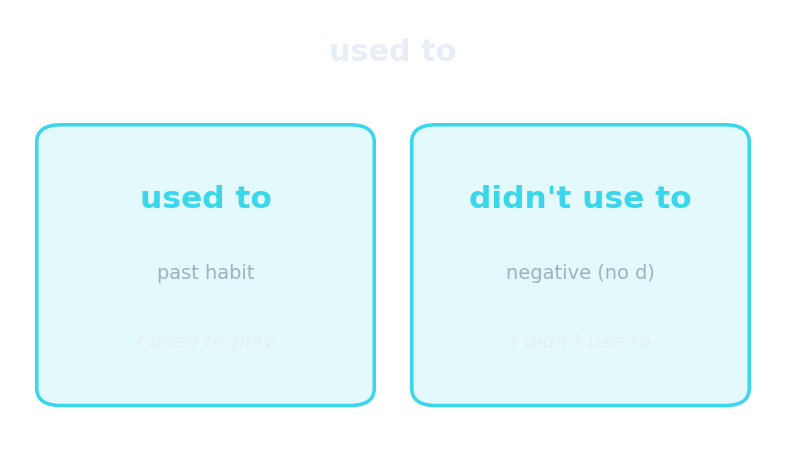
- Outcome: describe a former habit/state and distinguish it from familiarity or adjustment. Start with past simple and present continuous if those patterns are new.
- “used to + base verb” presents a former regular habit or extended state, usually contrasted with now. A changed routine does not mean the person can never do the activity again. The diagram shows two edited model forms, not every pattern containing used to.
I used to wake early; my alarm clock misses that version of me.
Keep the base verb
- Use “used to + base verb” with any subject: “She used to live beside the river.” and “We used to walk to school.” The base verb does not gain another past ending.
- A repeated action and an extended state both fit: “They used to play chess after dinner.” describes a routine; “The room used to be a kitchen.” describes an earlier state. One isolated event normally needs a past-simple report instead.
Which sentence is correct?
Difficulty 1/5 · 100 coins + a small bonus on first completion today
used to + base verb: “I used to play football.”
Translate into English using “used to + base verb”: 我过去常踢足球。
Difficulty 3/5 · 200 coins + a small bonus on first completion today
Past habit → used to + base verb: “I used to play football.”
A village had a small cinema for many years; it has now closed. Which sentence uses the former-state pattern?
Difficulty 1/5 · 100 coins + a small bonus on first completion today
Used to be presents the former situation. Be stays in its base form after used to.
Use the requested edited spelling
- This practice uses “didn’t use to + base verb” and “Did … use to …?”. For example, “Did Niko use to work here?” and “Niko didn’t use to work here.”
- Spellings with used after did also occur. Our form tasks specify the edited use-after-did target; they do not claim that nobody writes another spelling. “did not” and “didn’t” are equivalent auxiliaries in these negative tasks.
Former habit, familiarity or adjustment?
Read the full pattern and time reference: a former habit/state, current familiarity, or the process of becoming familiar.
Use the edited negative pattern practised here. Complete with “didn't” or “wasn't”: “I ___ use to like coffee.”
Difficulty 1/5 · 100 coins + a small bonus on first completion today
In this edited practice pattern, didn’t use to or did not use to fits. Use follows did without another d here. Spellings with used after did also occur; the instruction specifies this target.
Use the edited question pattern: “Did Rosa ___ to keep a diary?”
Difficulty 1/5 · 100 coins + a small bonus on first completion today
Use follows did in the edited pattern requested here. The question concerns a former habit.
A former routine or an event?
- “I used to swim every morning.” presents an earlier routine. “I swim on Sundays now.” gives a current one; bare used to is not the current-habit pattern.
- In a clear past context, past simple can also recount habits. Would can recount repeated past actions once the past scene is established. Do not replace every extended state with would mechanically; it also has other meanings.
Written pattern check. Can “used to + base verb” itself describe a current habit rather than a former one?
Difficulty 1/5 · 100 coins + a small bonus on first completion today
No. “used to + base verb” presents a former habit or state. A current habit can use present simple; “be used to + noun/-ing” is a different familiarity pattern.
You visited a museum only once, on a particular day. Choose the report of that single event.
Difficulty 1/5 · 100 coins + a small bonus on first completion today
Visited reports the single event. Used to visit presents a former repeated situation, not this one isolated visit.
Read be or get before used to
- “I am used to carrying this bag.” means it is familiar; “I am getting used to carrying it.” describes becoming familiar. A noun or pronoun can follow too: “I am used to it.”
- These familiarity patterns can use past, present or future forms: “I was used to it then.” and “I will get used to it.” Read the tense of be/get and the following noun/-ing form, rather than treating the words used to as a past-time signal in every phrase.
Match each sentence to its meaning.
Difficulty 2/5 · 140 coins + a small bonus on first completion today
The first pair presents smoking as a former regular habit; its stopped label concerns that habit, not a prediction about every future occasion. Am used to describes familiarity, while usually walk describes a current routine.
Use the edited negative pattern practised here. Complete with “didn't” or “wasn't”: “I ___ use to like coffee, but now I love it.”
Difficulty 1/5 · 100 coins + a small bonus on first completion today
In this edited practice pattern, didn’t use to or did not use to fits. Use follows did without another d here. Spellings with used after did also occur; the instruction specifies this target.
Use the -ing form of work after the familiarity pattern: “I am used to ___ at night.”
Difficulty 1/5 · 100 coins + a small bonus on first completion today
Am used to means accustomed to here; the following verb uses its -ing form. This differs from used to work as a former habit.
“She is used to the noise.” itself says that being around the noise is only a former habit and cannot be true now.
Difficulty 1/5 · 100 coins + a small bonus on first completion today
Is used to describes present familiarity in this sentence. Read is + used to + noun, not only the words used to.
- Former habit/state: “used to + base verb”. Familiarity: “be used to + noun/-ing”. Becoming familiar: “get used to + noun/-ing”. Keep the whole pattern and the intended meaning together.
- A form-practice task can request used to even when a past-simple alternative could be grammatical. A negative reply about the past does not, by itself, establish the opposite fact now.
Write one English sentence about a former habit or state that differs from now, using “used to + base verb”. You may use an imaginary person.
Difficulty 3/5 · 200 coins + a small bonus on first completion today
Example: “I used to be afraid of dogs.”
Three worked contrasts
- Routine and one event: an old caretaker regularly checked the roof on Fridays: “The caretaker used to check the roof on Fridays.” A single emergency inspection last Tuesday is “The caretaker checked the roof last Tuesday.” The one event does not establish a former routine.
- Familiar or becoming familiar: “Mira is used to the market crowds.” gives current familiarity. “Mira is getting used to them.” gives a process. Neither sentence by itself says the crowds are an abandoned past habit.
- Past scene and alternatives: during earlier winter visits, an aunt regularly made soup. “She used to make soup” and “She would make soup” can fit that repeated-action context. For her extended former ownership of a cottage, “She used to own a cottage” is a normal state description; do not substitute would for every state indiscriminately.
Interpret fresh contexts
- Try the next twenty written decisions before copying an example. Check whether the task asks for a specified edited form, a former situation, one event, a present routine or familiarity/adjustment.
- Keep what is stated separate from what is unknown. A former routine does not give an exact event count; a reply about childhood does not automatically tell you the person’s current situation. Split study across sessions if useful.
Use the base form of collect after the former-habit pattern: “Nadia used to ___ postcards every summer.”
Difficulty 1/5 · 100 coins + a small bonus on first completion today
Collect is the base verb after used to. Repeated summers provide the former-routine context.
Use the edited question pattern practised here: “Did the old library ___ to close at noon?”
Difficulty 1/5 · 100 coins + a small bonus on first completion today
Did takes use in this requested edited pattern. The question concerns the library’s earlier routine.
Use the -ing form of share: “The twins are used to ___ a bedroom.”
Difficulty 1/5 · 100 coins + a small bonus on first completion today
Are used to describes familiarity; sharing follows that full pattern. It does not mean they no longer share.
A person still takes the same tram every weekday. Choose a direct report of the current routine.
Difficulty 1/5 · 100 coins + a small bonus on first completion today
Present simple directly reports the current routine. Used to take presents an earlier routine instead.
Milo lost a wallet once last Friday and found it the next morning. Which sentence reports that single loss without inventing a repeated habit?
Difficulty 1/5 · 100 coins + a small bonus on first completion today
Lost reports this one event. The stated facts do not establish a repeated former habit of losing the wallet.
The college owned an orchard for thirty years, then sold it. Use the former-state pattern.
Difficulty 1/5 · 100 coins + a small bonus on first completion today
Used to own presents extended former ownership. Owning would fit after an appropriate be/get used to familiarity pattern, which is a different meaning.
Choose the edited negative question about a former routine.
Difficulty 1/5 · 100 coins + a small bonus on first completion today
Didn’t Priya use to print uses the requested edited question pattern and a base verb. Other grammatical negative wordings can exist, but the other options here do not fit this pattern.
The new meal times still feel strange but become easier each week. Which sentence reports adjustment in progress?
Difficulty 1/5 · 100 coins + a small bonus on first completion today
Am getting used to eating describes becoming familiar. A former eating habit is different, and ate does not fit after this familiarity pattern.
A new work uniform will probably feel normal after a month. Which sentence expresses that expected future familiarity process?
Difficulty 1/5 · 100 coins + a small bonus on first completion today
Will get used to wearing places the expected adjustment in the future. Used to wear would present a former habit, not that future process.
Read “At the old hotel, the porter was used to carrying heavy cases.” Which meaning is expressed?
Difficulty 1/5 · 100 coins + a small bonus on first completion today
Was used to carrying describes past familiarity. Be used to is not restricted to the present; the tense of be supplies the reference time.
“I used to draw every evening.” guarantees that the speaker can never draw on any future occasion.
Difficulty 1/5 · 100 coins + a small bonus on first completion today
The former regular routine is presented as changed. That is not a lifetime prohibition on every later drawing occasion.
A person is asked whether they had a dog as a child and replies “No, I didn’t use to have one.” That reply alone proves that they own a dog now.
Difficulty 1/5 · 100 coins + a small bonus on first completion today
The reply answers the question about the earlier situation. It does not by itself establish present dog ownership; ask about now if that fact matters.
You want to describe a present habit, not familiarity. Choose the sentence that does so directly.
Difficulty 1/5 · 100 coins + a small bonus on first completion today
Usually check directly describes the current habit. A former routine and being familiar with weather are different claims.
The past scene is established: during childhood holidays, an uncle regularly repaired toys after dinner. Which statement is accurate?
Difficulty 1/5 · 100 coins + a small bonus on first completion today
With the repeated past scene established, either can recount the actions. This does not license replacing every extended past-state description with would.
A retired gardener says “I worked in the town park every spring back then.” Which judgment is accurate?
Difficulty 1/5 · 100 coins + a small bonus on first completion today
The time phrase and repeated springs establish the past routine. Past simple can describe it without used to; the sentence does not establish current work.
Choose “am” or “did” for present familiarity: “I ___ used to this heavier bag now.”
Difficulty 1/5 · 100 coins + a small bonus on first completion today
Am used to + noun describes being accustomed now. Did used to this bag is not that pattern.
Use the -ing form of speak after the adjustment pattern: “She got used to ___ through a microphone.”
Difficulty 1/5 · 100 coins + a small bonus on first completion today
Got used to speaking reports becoming familiar in the past. The -ing complement does not make it the former-habit construction.
Which sentence expresses present familiarity rather than saying an activity was a former habit?
Difficulty 1/5 · 100 coins + a small bonus on first completion today
Am used to cooking gives present familiarity. Used to cook presents a former routine; cooked once supplies one event.
“The ferry used to leave at six.” alone tells us exactly how many departures took place in the earlier period.
Difficulty 1/5 · 100 coins + a small bonus on first completion today
A former schedule or routine is reported, not an exact departure count. Do not invent a total from the form.
Use the edited question pattern to ask whether a general past state was true.
Difficulty 1/5 · 100 coins + a small bonus on first completion today
Did + subject + use to + have asks about the former state in this edited pattern. Have remains a base verb.
Preserve the direction of change
- The new updates distinguish what happened before, what happens now and what still feels unfamiliar. A correct form with reversed times or a changed meal time gives the wrong message.
- Write the English update before revealing its model. Compare the former habit, current routine and adjustment process, then repair one mismatch. Equivalent natural wording can preserve the facts.
A centre formerly served lunch at noon. It now serves lunch at one. Staff are becoming familiar with the later meal time. Which update preserves all three facts?
Difficulty 1/5 · 100 coins + a small bonus on first completion today
The former routine, current schedule and adjustment process stay distinct. The other reports either preserve the wrong current time or reverse the change.
Aisha formerly lived alone. She now shares a flat, and sharing feels normal to her. Choose the accurate update.
Difficulty 1/5 · 100 coins + a small bonus on first completion today
Used to live gives the former state; is used to sharing gives current familiarity. Keep the direction of the change.
Write a short English update using all facts. Before moving, Jun regularly ate alone. Now Jun eats with colleagues at twelve-thirty. The shared meals still feel unfamiliar but are becoming easier. Use a former-habit sentence, a current-routine sentence and an adjustment sentence. Do not claim adjustment is already complete.
Compare the facts, full pattern and time reference. Several natural phrasings can fit; this written self-review does not assess spoken proficiency.
Retrieve the whole pattern later
- Tomorrow, try the review choice and explanation before rereading. Identify be/get where present and explain one thing the sentence does not establish about now or the future.
- Next: future forms review. Planning time is provisional. These are written tasks, not a speaking assessment or proof of mastery; independent grammar, key, accessibility and learner reviews remain pending.
Usage checked 21 October 2026: British Council past habits, different uses, Cambridge phrases with used to and BBC used to/would. Scenarios and writing models here are original.
Later review: “I was used to the early start.” must mean exactly the same as “I used to start early.”
Difficulty 1/5 · 100 coins + a small bonus on first completion today
Was used to describes familiarity at a past time. Used to start describes a former routine. Sharing the words used to does not erase that difference.
Later written review. A neighbour says “I used to walk this path every morning.” Explain in one or two English sentences why this does not guarantee that the neighbour can never walk the path again.
Compare the facts, full pattern and time reference. Several natural phrasings can fit; this written self-review does not assess spoken proficiency.