Your learning plan · Continue · Review →
Present perfect vs past simple
IntroducedYour saved position stays in this browser. Resuming does not complete the lesson or answer its questions.
Two ways to look at the past
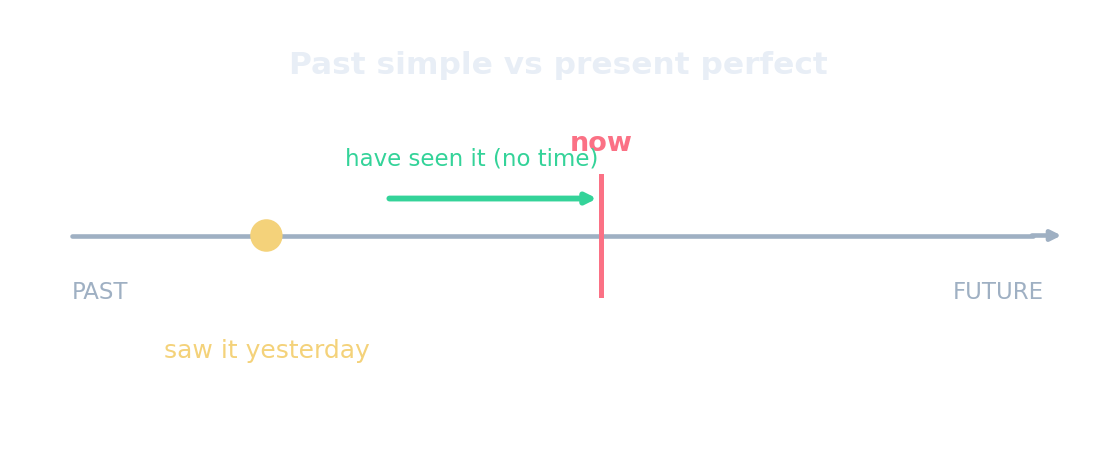
- The diagram contrasts saw it yesterday with have seen it. Its label no time means this perfect example gives no finished event time; it does not ban time references such as for a year.
- The past simple can place an event in a finished past period. The present perfect looks back from now, for example at experience or a current result. Past-simple events can also have consequences now.
- I saw it yesterday. / I have seen it. Outcome: choose a viewpoint while preserving the facts. Start with past simple and present perfect. Allow 35–50 minutes across sessions.
I lost my keys yesterday; I have found three old receipts since.
Finished time → past simple
- Use the past simple with a finished past time.
- yesterday, last week, in 2019, two days ago.
- We met in 2018. She called an hour ago.
Choose the ordinary sentence placing the visit in the finished time last Tuesday.
Difficulty 1/5 · 100 coins + a small bonus on first completion today
Visited is the past-simple form for the visit at last Tuesday. The perfect form does not take that finished-time phrase directly in this ordinary use; have visit also lacks a participle.
Connected to now → present perfect
- Use the present perfect to look back from now, for example when describing experience up to now or a result that matters now. A finished past-time phrase needs a different viewpoint.
- I have visited Japan. He has just left.
- It matters now — the result or the experience. Past simple can also describe recent events, especially in American English; being recent does not force a perfect form.
Complete: Have you ever ___ (be) to London?
Difficulty 1/5 · 100 coins + a small bonus on first completion today
The supplied Have you ever …? question needs the past participle been. Ever appears in this experience question, but can occur with other tenses in other contexts; it is not a rule choosing the tense by itself.
Which supplied sentence uses the present perfect?
Difficulty 1/5 · 100 coins + a small bonus on first completion today
Has repaired is have/has + past participle. Repaired alone is past simple; repairs is present simple. Identifying a form is different from saying no other form could fit any context.
Clues, not automatic switches
- Past simple: yesterday, … ago, last …, in 2019.
- Words such as already, ever and for are clues, not tense rules by themselves. Compare I lived there for a year (a finished period) with I have lived here for a year (a period reaching now).
- In ordinary standard usage, do not attach yesterday or an hour ago directly to the present-perfect event: say I finished it yesterday.
Read the whole verb phrase
Classify these supplied verb forms, not isolated signal words. Both tenses can occur with just, already or for in suitable contexts.
Choose the correct sentence.
Difficulty 1/5 · 100 coins + a small bonus on first completion today
“yesterday” is a finished time → past simple: “I saw him yesterday.”
Is this correct? “I have finished my homework an hour ago.”
Difficulty 1/5 · 100 coins + a small bonus on first completion today
“an hour ago” is a finished time → past simple: “I finished … an hour ago.”
Practise the present perfect: translate into English, 我从没去过北京。
Difficulty 3/5 · 200 coins + a small bonus on first completion today
The requested present-perfect form looks back over experience up to now: I have never been to Beijing. Never can also occur with other tenses in other time frames.
“I worked there for six months, then left.” What does for six months give?
Difficulty 1/5 · 100 coins + a small bonus on first completion today
For six months gives how long the finished job lasted. Then left closes that period; for is not reserved for present perfect.
Common mistakes
- To ask the time of one completed arrival, use When did you arrive? A different question, such as When have you ever arrived early?, can use present perfect; the word when itself does not ban it.
- ❌ This is the first time I go here. → ✓ …the first time I have been here.
- I finished just now and I have just finished are useful patterns. I just finished is also common, especially in American English. Read the context rather than choosing from just alone.
Which sentence is correct?
Difficulty 1/5 · 100 coins + a small bonus on first completion today
last year is an exact past time → past simple.
Which word means a very short time before now? I have ___ finished the report.
Difficulty 1/5 · 100 coins + a small bonus on first completion today
Just expresses very recent completion. Already means before now or earlier than expected; yet normally occurs in questions or negatives in this pattern. I just finished is also common, especially in American English.
- For an event at a named finished past time in the ordinary sentence patterns here, use past simple.
- Experience up to now or a current result can use present perfect.
- Read the time frame and intended meaning; a word such as just does not decide the tense alone.
Grammar guidance checked 2026-10-20: British Council, present perfect.
Write one sentence about something you have done recently, using the present perfect (no exact time).
Difficulty 3/5 · 200 coins + a small bonus on first completion today
Example: “I have just finished a good book.”
Worked contrasts: three decisions
- A consequence now: I dropped my phone yesterday, so the screen is cracked now still uses past simple for the dated event. A duration: I lived there for a year, then moved away describes a finished period; I have lived here for a year and still live here explicitly reaches now.
- A recent event: I've just sent the photo and I just sent the photo can both be natural, with the latter especially common in American English. Read the form and context; do not replace every past-simple sentence containing just.
Independent decisions
- Read what is stated and what form is requested. A grammatical alternative can miss an explicitly requested form without being wrong in every context.
- After a miss, identify whether you changed the time viewpoint, chose the wrong verb form or inferred a rule from one signal word. Then try the fresh contexts.
A speaker says “I just sent it”, using common American English. Which judgement fits?
Difficulty 1/5 · 100 coins + a small bonus on first completion today
Sent without have/has is past simple here. Just can mark a recent event in that pattern; recent meaning does not itself require present perfect.
“I broke my glasses yesterday, so I cannot read this now.” Which claim is correct?
Difficulty 1/5 · 100 coins + a small bonus on first completion today
Broke places the event yesterday; the so-clause explicitly gives its present consequence. A useful present-perfect viewpoint does not ban present relevance in a past-simple report.
Choose the explicitly requested present-perfect experience question.
Difficulty 1/5 · 100 coins + a small bonus on first completion today
Have … slept is the requested present-perfect form. Did you ever sleep…? can be grammatical with a suitable past viewpoint, but it is a different form; Do you ever sleep…? asks about a present pattern.
“I spoke to the manager.” Must this be changed to present perfect merely because it gives no date?
Difficulty 1/5 · 100 coins + a small bonus on first completion today
The time can be understood from context or left unspecified. Spoke is a valid past-simple form; absence of a date does not force a replacement.
Jo moved here a year ago and still lives here. Which sentence uses the requested present perfect to describe that period reaching now?
Difficulty 1/5 · 100 coins + a small bonus on first completion today
Has lived uses third-person has and the participle lived for the period in the stated context. Has live lacks the participle; have does not agree with Jo.
Compare “When did you arrive?” with “When have you ever arrived early?” Which explanation fits?
Difficulty 1/5 · 100 coins + a small bonus on first completion today
The two questions have different scopes. The first asks when a particular arrival happened; when does not universally ban a perfect experience question such as the second.
Transfer: two viewpoints in one message
- Use the notes to report one finished event and one experience up to now in English. Keep the time and the experience facts separate.
- Reveal the comparison after writing; check a specific mismatch and revise it. Models show possible answers rather than a required script.
A holiday job ran from June to August last year and ended. Which report preserves that finished period?
Difficulty 1/5 · 100 coins + a small bonus on first completion today
The stated job ended last year. Worked reports that finished period; for states its duration and does not override the finished-time context.
“I have read four of the six chapters.” What is still not established?
Difficulty 1/5 · 100 coins + a small bonus on first completion today
Four of six establishes a completed part, not the complete book. Present-perfect form does not turn a partial total into full completion.
Notes: I finished a puzzle at eight last night. Up to now, I have never ridden a horse. Write two English sentences: use past simple for the finished event and present perfect for the experience. Keep the times and facts. Compare and revise.
Compare the time viewpoint, requested form and facts with your English. Revise an actual mismatch or explain why none is needed. Self-review does not award correctness or certify proficiency.
Return later and check the evidence
- Tomorrow, recall an ordinary past-simple report, a present-perfect experience and a grammatical past-simple example with just or already. Then try the bag task before rereading.
- Next: present perfect continuous. A written self-review does not establish correctness or certify proficiency.
Usage comparison checked 20 October 2026: Cambridge, present perfect or past simple. Original examples; independent grammar/key/learner review pending.
Recall: in common American usage, can “I already paid” be a grammatical past-simple report?
Difficulty 1/5 · 100 coins + a small bonus on first completion today
Paid is the past-simple form here. Already can occur with it, especially in American English; have already paid is another pattern.
Choose the ordinary past-simple report of an event at the stated finished time.
Difficulty 1/5 · 100 coins + a small bonus on first completion today
Met reports the meeting an hour ago. In this ordinary event-time use, do not attach an hour ago directly to present perfect; have meet also lacks the participle.
Later recall: Notes: Sam arrived on Monday. It is now Saturday. Sam still has not unpacked the bag. Write two English sentences, using past simple for the arrival and present perfect for the not-yet-completed unpacking. Keep the facts and compare your choices.
Compare the time viewpoint, requested form and facts with your English. Revise an actual mismatch or explain why none is needed. Self-review does not award correctness or certify proficiency.