Your learning plan · Continue · Review →
Present perfect continuous
IntroducedYour saved position stays in this browser. Resuming does not complete the lesson or answer its questions.
Link an activity to now
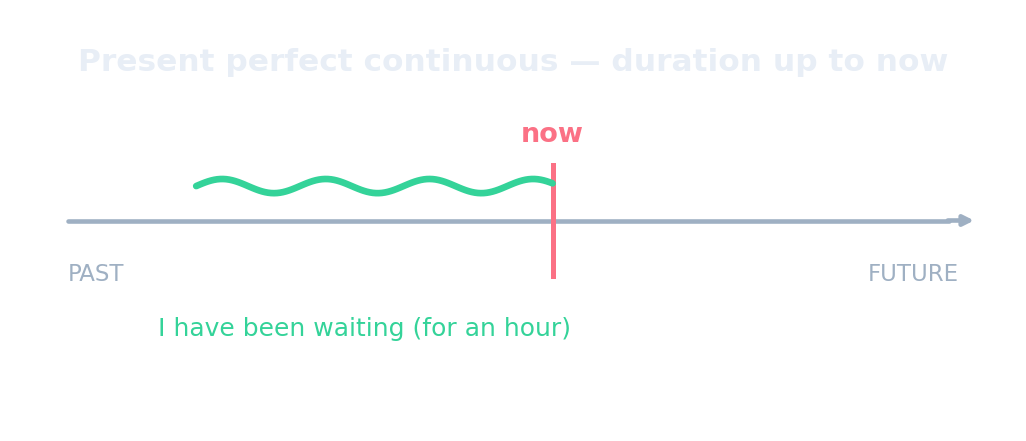
- Outcome: interpret an activity’s connection to now and distinguish it from a completed total or state. Start with present perfect and past simple if the reference time is unclear. The diagram shows one ongoing example, not every use.
- “I have been waiting for an hour.” focuses on the activity over time. Perfect continuous can describe activity still continuing, repeated during a recent period, or stopped recently with a present connection; it need not mean nonstop work.
I have been studying for hours; the kettle has been waiting just as long.
Choose the auxiliary and keep the pattern
- Use “have/has + been + verb-ing”: “She has been studying. They have been working.” The subject chooses have or has; the object does not.
- Negatives use “haven’t/hasn’t been + verb-ing”. Questions put have/has before the subject: “Has Nia been working?” A phrase containing been is not automatically continuous.
Which sentence is the present perfect continuous?
Difficulty 1/5 · 100 coins + a small bonus on first completion today
Present perfect continuous = have/has been + verb-ing.
Use the present perfect continuous for an activity continuing to now. “The repair team ___ been checking the engine.”
Difficulty 1/5 · 100 coins + a small bonus on first completion today
The singular team uses has been checking in this requested pattern. Is checking is present continuous; does been checking is not the requested form.
Duration or starting point?
- “for two hours” gives a length; “since this morning” gives a starting point. Since can also introduce a starting event: “since I arrived”.
- Match the reference time as well as the phrase. “I waited for an hour yesterday.” is a finished past report with a duration. The word for does not force perfect continuous.
Complete with “for” or “since”: “She has been studying ___ nine o’clock.”
Difficulty 1/5 · 100 coins + a small bonus on first completion today
Nine o'clock is a starting point → since.
Translate into English using the present perfect continuous: 我已经等了一个小时了。
Difficulty 3/5 · 200 coins + a small bonus on first completion today
Ongoing duration → have been + -ing: “I have been waiting for an hour.”
Choose “for” or “since”: “We have been rehearsing ___ forty minutes.”
Difficulty 1/5 · 100 coins + a small bonus on first completion today
Forty minutes names a length of time. Since needs a starting point, such as ten o’clock.
Activity, total or state?
- “I have been reading.” reports activity without establishing a completed book. “I have read three books this week.” directly gives a completed total; continuous does not mean that nothing was completed either.
- “I have known her for years.” describes a continuing state. With live, both “I have lived here for four years” and “I have been living here for four years” can fit. Decide from the meaning and requested viewpoint, not a permanent ban on a verb or a for phrase.
Choose from the meaning in context
Choose a perfect form from the verb meaning in these examples.
Is this correct for the continuing state of knowing this person? “I have been knowing him for years.”
Difficulty 1/5 · 100 coins + a small bonus on first completion today
Knowing a person is a state meaning here: I have known him for years. Do not turn this example into a ban on every continuous use of every verb with a state meaning.
Leena has just stopped gardening and comes indoors with muddy shoes. “She has been gardening.” is impossible because she is no longer outside.
Difficulty 1/5 · 100 coins + a small bonus on first completion today
A recently stopped activity can have a present connection, such as the muddy shoes. The continuous does not require gardening at the instant of speaking.
A person still lives in the same flat after four years. Which statement about these forms is accurate?
Difficulty 1/5 · 100 coins + a small bonus on first completion today
Live permits both forms here. A for phrase does not automatically force continuous, and simple does not automatically mean the person has left.
Check the actual job of been
- To ask about elapsed residence up to now, use “How long have you been living here?” or “How long have you lived here?”. A planned future stay is a different question; do not label every present-continuous duration question wrong without its context.
- “She has finished” reports a finished task; “She has been busy” is a state; “The work has been finished” is passive. Only the activity pattern here uses “been + verb-ing”. Identify the structure rather than deleting every been.
Put the words in order to make a question.
Difficulty 3/5 · 200 coins + a small bonus on first completion today
How long + have + subject + been + -ing: “How long have you been waiting?”
You want to emphasise the completed total of three books this week. Does “I have been reading three books this week.” itself clearly establish that completed total?
Difficulty 1/5 · 100 coins + a small bonus on first completion today
No. I have read three books this week directly expresses the completed total. The continuous can describe work on three books without establishing that all three were finished.
You need to report one finished task, not the activity leading up to it. Which directly states completion?
Difficulty 1/5 · 100 coins + a small bonus on first completion today
Has completed directly reports the finished task. Has been preparing describes the activity without establishing that it is complete.
- Perfect continuous focuses on activity with a present connection; it does not prove full completion or uninterrupted action. An explicit form-practice question may ask for this pattern even when another grammatical wording could fit the situation.
- Use for for a length and since for a starting point/event in these contrasts. Keep the time, quantity and state meaning of the whole message.
Written English practice. What have you or an imaginary person been doing a lot lately? Write one English sentence using the present perfect continuous.
Difficulty 3/5 · 200 coins + a small bonus on first completion today
Example: “I have been practising English every day.”
Three worked viewpoints
- Still continuing: the team began repairing a bike at ten; it is noon and repairs continue. “They have been repairing the bike since ten.” connects the activity to now. It does not prove that the bike is ready or that nobody took a break.
- Just stopped: Arun has just returned from a run and is out of breath. “Arun has been running.” can explain the present situation without saying he is running at this instant. “Arun has run five kilometres” adds a completed distance that the first sentence alone does not supply.
- State and activity: “I have known Dana for years.” uses the knowing-a-person state. “I have been thinking about a reply” uses think as an activity. A verb’s meaning in the sentence matters; a word list is not a decoder for every use.
Apply the viewpoint to fresh situations
- Try the next twenty written decisions without copying the worked examples. Some ask for an explicitly named form; others ask what the message does or does not establish. Read that instruction before choosing.
- Split the practice across sessions if useful. After feedback, explain one fact the sentence does not tell you, or repair one auxiliary, time phrase or unjustified completion claim.
Use the present perfect continuous with this singular subject: “The technician ___ been examining the fault since breakfast.”
Difficulty 1/5 · 100 coins + a small bonus on first completion today
The technician is singular, so has completes has been examining. The phrase since breakfast links the activity to a starting point.
Use the negative present perfect continuous. “We ___ been using the old entrance this week.”
Difficulty 1/5 · 100 coins + a small bonus on first completion today
We have not been using is the requested negative. Haven’t and have not are equivalent here.
Build the conventional present-perfect-continuous question from these chunks, starting with Why.
Difficulty 3/5 · 200 coins + a small bonus on first completion today
Why have they been arguing? puts have before the subject they, followed by been + arguing. The question asks about the reason for a recent activity.
Choose “for” or “since”: “The volunteers have been clearing the path ___ Saturday morning.”
Difficulty 1/5 · 100 coins + a small bonus on first completion today
Saturday morning names the starting point; it is not a length such as three hours.
Yesterday’s outage ended before the day was over. Which report correctly places the whole forty-five-minute wait in that finished past period?
Difficulty 1/5 · 100 coins + a small bonus on first completion today
Waited locates the wait in the finished period yesterday. A duration does not by itself require a present perfect form.
Omar has just returned from a ride and parked his bicycle. Omar can still say “I have been cycling.” to report that recent activity.
Difficulty 1/5 · 100 coins + a small bonus on first completion today
The ride can have stopped just before the report. Perfect continuous does not, by itself, say the speaker is still moving.
You must explicitly report the completed total of six invitations. Which sentence does that?
Difficulty 1/5 · 100 coins + a small bonus on first completion today
Have mailed six directly gives the completed total. Have been mailing describes activity without supplying that completed count.
Read “The builders have been patching the roof.” What does the sentence itself establish?
Difficulty 1/5 · 100 coins + a small bonus on first completion today
Activity is reported. Neither total completion nor zero completed work follows from the continuous form alone. Check separate evidence before making a completion claim.
A family bought a van six years ago and still owns it. Choose the natural simple form for this continuing ownership meaning.
Difficulty 1/5 · 100 coins + a small bonus on first completion today
Have owned expresses this continuing ownership state. The simple form does not mean the van has been sold; the ownership meaning here normally uses a non-continuous form.
A nurse began working at the same clinic five years ago and still works there. Which judgment is accurate?
Difficulty 1/5 · 100 coins + a small bonus on first completion today
Both can fit this continuing employment situation with different focus. Simple need not mean finished, and continuous need not mean uninterrupted.
Read “He has been having dance lessons lately.” What does have mean in this context?
Difficulty 1/5 · 100 coins + a small bonus on first completion today
Having lessons is an activity meaning of have. A rule about the ownership meaning does not ban this continuous use.
Choose “for” or “since”: “We have been collecting rainwater ___ we moved here.”
Difficulty 1/5 · 100 coins + a small bonus on first completion today
We moved here supplies a starting event. Since can introduce such a clause; for normally introduces the duration in this contrast.
You want the number of completed sketches, rather than the length of the drawing activity. Which question directly asks for that number?
Difficulty 1/5 · 100 coins + a small bonus on first completion today
How many sketches has she drawn? asks for the completed count. How long asks for duration, and the yes/no question does not request a number.
Choose “for” or “since”: “I have been learning the local routes ___ several weeks.”
Difficulty 1/5 · 100 coins + a small bonus on first completion today
Several weeks is an elapsed length. It does not name the starting point, so for fits this sentence.
The sentence “The receptionist has been busy all morning.” is present perfect continuous merely because it contains been.
Difficulty 1/5 · 100 coins + a small bonus on first completion today
Busy is an adjective here: has been busy is present perfect simple of be. The continuous pattern being practised needs been + an -ing verb.
Identify the pattern in “The parcel has been delivered.”.
Difficulty 1/5 · 100 coins + a small bonus on first completion today
Has been delivered is a perfect passive. Been is not restricted to -ing; the words after it and the sentence structure matter.
Read “I have been answering customer emails this week.” It necessarily means the writer has done nothing else at any moment of the week.
Difficulty 1/5 · 100 coins + a small bonus on first completion today
The report can describe repeated email-answering sessions. It does not establish uninterrupted work or exclude meals, sleep or other activities.
A tired speaker says “I have been preparing the exhibition.” In a suitable recent context, this can be grammatical without adding a for or since phrase.
Difficulty 1/5 · 100 coins + a small bonus on first completion today
A duration phrase is not compulsory. The activity can have a recent present connection even when its exact duration is not stated.
Use the requested present perfect continuous with the whole subject: “The local gardeners ___ planting trees all morning.”
Difficulty 1/5 · 100 coins + a small bonus on first completion today
The plural gardeners take have been planting. Trees is the object and does not choose the auxiliary.
The repair activity began earlier and still continues now. Select the present-perfect-continuous form to report it from now.
Difficulty 1/5 · 100 coins + a small bonus on first completion today
Have been adjusting uses the requested present reference. Had been adjusting looks back from a past reference, and were adjusting is past continuous; those can work in other contexts.
Transfer into an accurate update
- Keep elapsed activity, completed quantities and continuing states separate in the new reports. A grammatical tense with a changed number or owner still gives the wrong information.
- Write the volunteer update in English before revealing its model. Compare all three viewpoints and revise one mismatch; different natural wording can preserve the same facts.
A team started labelling boxes forty minutes ago and is still working. Six boxes are labelled; others remain. Which report preserves both facts?
Difficulty 1/5 · 100 coins + a small bonus on first completion today
The continuous reports the activity/duration; the simple reports the completed six. Neither the source nor the report says every box is finished.
A crew still owns a van bought four years ago. It borrowed a trailer two weeks ago and has been using it for a current job. Which report keeps ownership and activity distinct?
Difficulty 1/5 · 100 coins + a small bonus on first completion today
Have owned fits the van’s continuing ownership state; have been using fits the recent trailer activity. Borrowing the trailer does not establish ownership.
Write a short English update using these facts. Your volunteer team started sorting donations at 09:00; it is now 11:00 and sorting continues. The team has prepared nine bags. The coordinator has known the manager for six years. Use a continuous activity sentence, a completed-total sentence and a state sentence, keeping all facts.
Compare form, time reference and preserved facts. Several natural English updates can fit; this written self-review does not establish spoken performance or mastery.
Retrieve the limits later
- Tomorrow, try the review decision and the short English explanation before rereading. Do not infer a finished total merely from an activity sentence, and do not assume the activity must still be happening at this instant.
- Next: past perfect and a past reference point. Planning time is provisional; this is written practice, not a speaking assessment or proof of mastery. Independent language, key, accessibility and learner reviews remain pending.
Grammar guidance checked 21 October 2026: British Council simple and continuous, Cambridge present perfect continuous and simple or continuous. The scenarios and writing models are original.
Later review: “She has been editing four pages.” by itself guarantees that all four pages are now finished.
Difficulty 1/5 · 100 coins + a small bonus on first completion today
It reports editing activity involving those pages. A separate completion statement, such as She has edited all four pages, directly establishes the finished total.
Later written review. Mia painted a fence from 10:00 until a minute ago and has just stopped for lunch. She has not said whether the whole fence is finished. Write two English sentences: first report the recent activity in the present perfect continuous, then state what you cannot infer about completion.
Compare form, time reference and preserved facts. Several natural English updates can fit; this written self-review does not establish spoken performance or mastery.