Total War
Introduced| English | Meaning |
|---|---|
| total war/ˈtəʊtl wɔː/ | War in which a state mobilises its economy and society extensively and the distinction between military and civilian targets is weakened. |
| political propaganda/pəˈlɪtɪkl ˌprɒpəˈɡændə/ | Communication designed to shape beliefs or behaviour in support of a political cause, authority or programme. |
When a whole society becomes a weapon
- World War I was a total war 总体战.
- Total war means a state directs the whole of its society and economy at the war, not only its army.
- So the home front becomes a military asset, and civilians become part of the war effort by policy.
Select all the mobilisation strategies the CED names.
Difficulty 2/5 · 140 coins + a small bonus on first completion today
Intensified forms of nationalism complete the CED's list.
Four named tools of mobilisation
- Governments used a variety of strategies, including political propaganda 政治宣传, art, media, and intensified forms of nationalism, to mobilise populations.
- Three of the four are about persuasion; the fourth is the belief that makes persuasion land.
- Note that the CED lists art separately from media — posters, songs and film were policy instruments.
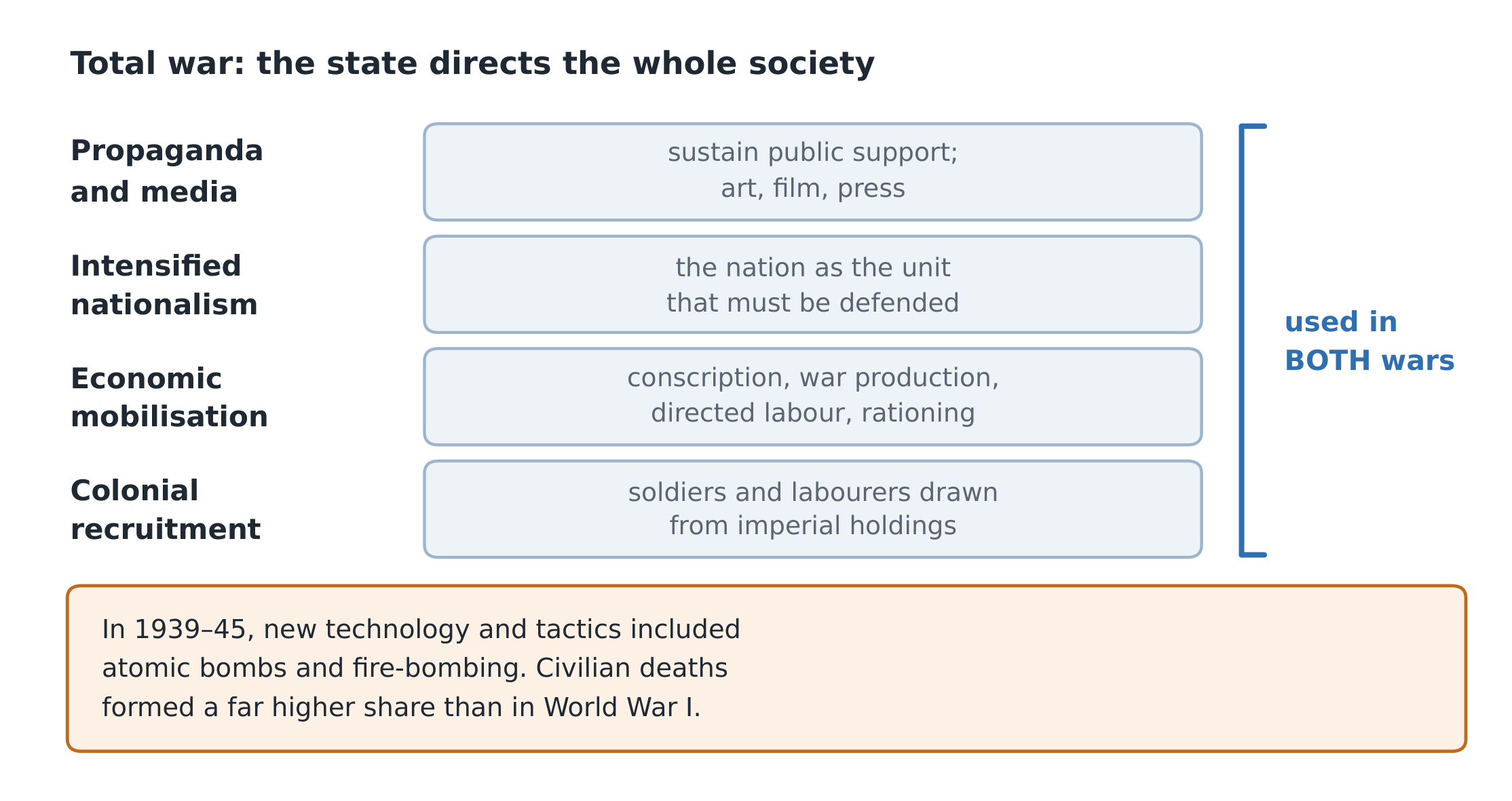
The same four instruments appear in both wars, which is why the comparison question is answerable
Total war mobilised populations in the colonies as well as at home.
Difficulty 1/5 · 100 coins + a small bonus on first completion today
That clause sets up the anticolonial politics of unit 8.
Colonies were mobilised too
- The CED writes that populations were mobilised both in the home countries and the colonies.
- Colonial soldiers, labourers and raw materials were drawn into a European war.
- That single clause explains much of unit 8: people who fought for an empire asked afterwards what they had earned.
Follow technology to total war
Technology, then stalemate, then national mobilisation — the 'because' at each step is what is marked.
Total war means a state directs the whole of its ____ and economy at the war.
Difficulty 1/5 · 100 coins + a small bonus on first completion today
Not only its army — the home front becomes a military asset.
Total war mobilised colonies as well as home countries. The CED says so in the same clause — colonial soldiers, labourers and materials were drawn into a European war, and that fact sets up the anticolonial politics of unit 8.
The CED attributes increased wartime casualties to...
Difficulty 1/5 · 100 coins + a small bonus on first completion today
The industrial capacity of unit 5 is what made this war different from earlier ones.
Technology raised the casualties
- New military technology led to increased levels of wartime casualties.
- The industrial capacity of unit 5 is what makes a total war possible and what makes it lethal.
- So the same factories that raised living standards for some produced the shells that made this war different from earlier ones.
Select all the instruments an answer about methods can name.
Difficulty 2/5 · 140 coins + a small bonus on first completion today
The objective is about methods, not campaigns.
"How governments conducted war"
- The objective is about methods, so an answer names instruments rather than battles.
- Propaganda, art, media, intensified nationalism, colonial mobilisation, and industrial production of weapons.
- Six instruments, and each one can be evidenced from a poster, a law or a production figure.
A ministry commissions posters, controls newspapers, and sets factory quotas; a colony supplies troops and raw material under the same authority. None of that is a battlefield decision, and all of it is how the war was conducted — which is exactly what the objective asks about.
World War I was a total war. Governments used political propaganda, art, media and intensified nationalism to mobilise populations both in the home countries and the colonies. New military technology led to increased wartime casualties — the industrial capacity of unit 5 made total war both possible and lethal.
Write from colonial soldiers in total war
- Britain used conscription and propaganda at home.
- It also recruited soldiers from its colonies.
How far did mobilisation reach?
Empires used colonial manpower as part of total war.
Who besides home populations was mobilised?
Difficulty 1/5 · 100 coins + a small bonus on first completion today
The empires recruited in the colonies.