Governments and Economic Crisis
Introduced| English | Meaning |
|---|---|
| Great Depression/ɡreɪt dɪˈpreʃn/ | The severe worldwide economic downturn of the 1930s, marked by falling output and widespread unemployment. |
| Five Year Plans/faɪv jɪə plænz/ | State economic programmes setting production and development targets for five-year periods. |
The state moves into the economy
- Following World War I and the onset of the Great Depression 大萧条, governments began to take a more active role in economic life.
- The CED gives two triggers, in order: the war first, then the Depression.
- Total war had already shown that a state could direct production — the Depression made that capacity look necessary in peacetime.
Select all the government responses the CED names.
Difficulty 2/5 · 140 coins + a small bonus on first completion today
Soviet Five Year Plans complete the set; the CED's theme is a more active role.
Three different answers
- The CED's examples span very different systems: the New Deal, the fascist corporatist economy, and governments with strong popular support in Brazil and Mexico.
- So "a more active role" is a shared direction, not a shared politics.
- That is what makes this subtopic a comparison rather than a description.
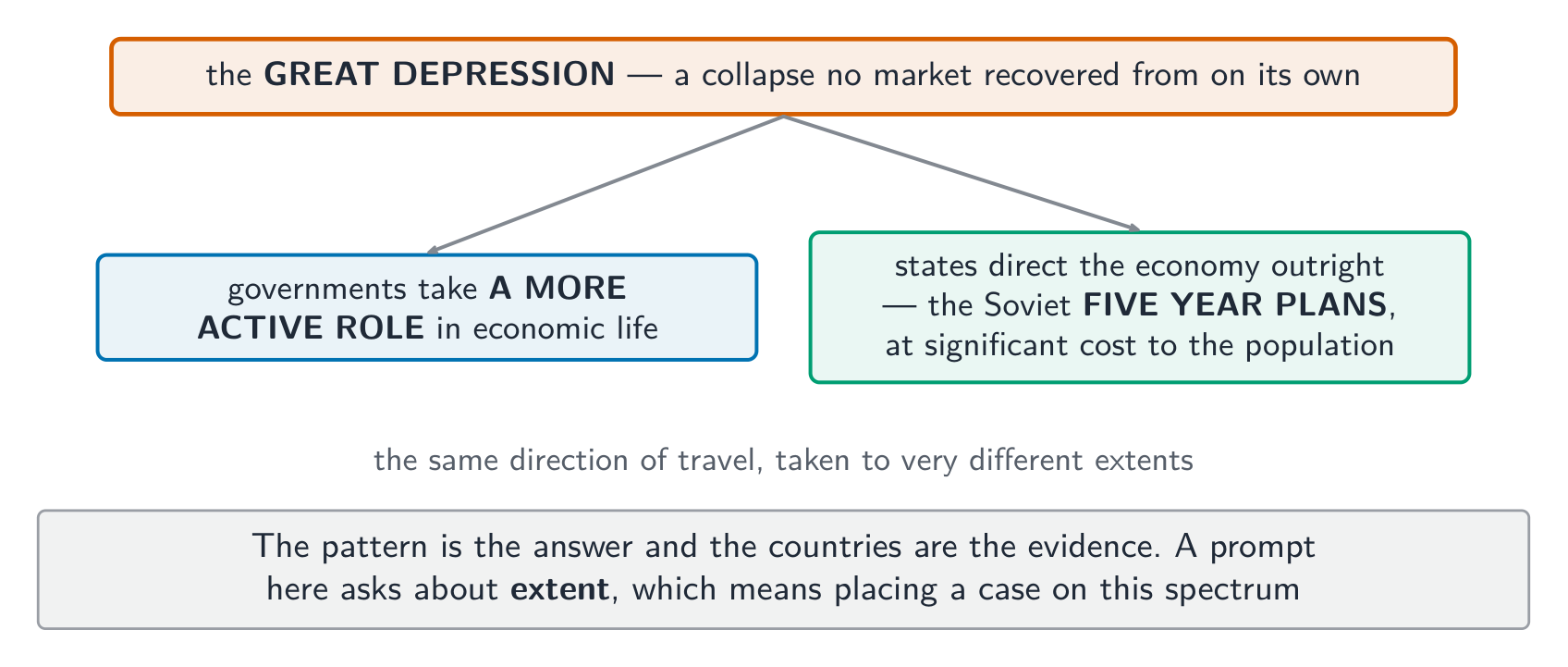
The Depression pushed very different states in one direction, to very different extents
Select both halves of the CED's Soviet sentence.
Difficulty 2/5 · 140 coins + a small bonus on first completion today
An answer giving only output figures has quoted half the sentence.
The Soviet case
- In the Soviet Union, the government controlled the national economy through the Five Year Plans 五年计划, often implementing repressive policies, with negative repercussions for the population.
- The CED states both halves in one sentence: central control of the economy, and repression with consequences for people.
- An answer that gives only the industrial output figures has quoted half of the CED's own sentence.
What is the state's relationship to producers here?
Sort each response by who decides.
The CED gives which two triggers, in order?
Difficulty 1/5 · 100 coins + a small bonus on first completion today
Total war had already shown a state could direct production.
"A more active role" describes a direction, not a politics. The CED's examples include the New Deal, a fascist corporatist economy, popular governments in Brazil and Mexico, and Soviet Five Year Plans. An answer that treats state intervention as one policy has collapsed four different systems into one.
A useful comparison axis is whether the state directs private owners, ____ them, or bargains with organised groups.
Difficulty 1/5 · 100 coins + a small bonus on first completion today
Answering that for two cases is a complete comparison paragraph.
Comparing the responses
- All four responses expand state capacity; they differ in who decides and what is protected.
- A useful axis: does the state direct private owners, replace them, or bargain with organised groups?
- Answering that question for two cases is a complete comparison paragraph.
"A more active role" means the same policy in every country.
Difficulty 1/5 · 100 coins + a small bonus on first completion today
It is a shared direction, not a shared politics — the CED supplies four systems.
How governments responded
- The objective is how different governments responded to economic crisis after 1900 — different is doing real work.
- So the answer must include at least two systems, and must not treat one as the natural response.
- The CED deliberately supplies liberal, fascist, populist and communist examples in one bullet list.
Four states face falling output and mass unemployment. One buys public works and regulates banks; one fuses firms and unions under party direction; one bargains with organised labour for support; one abolishes private ownership of industry and plans output centrally. Same problem, four systems — and the objective's word is different.
After World War I and the onset of the Great Depression, governments took a more active role in economic life — the New Deal, the fascist corporatist economy, and popularly supported governments in Brazil and Mexico. In the Soviet Union the government controlled the economy through the Five Year Plans, often implementing repressive policies with negative repercussions for the population.
Write from the Five-Year Plan
- After the economic crisis, governments took different roles in production.
- The Soviet state issued a Five-Year Plan for industry.
Who set Soviet industrial targets?
Moscow assigned production goals.
What set Soviet industrial targets?
Difficulty 1/5 · 100 coins + a small bonus on first completion today
The plan was a command for output.