Classical Conditioning
Introduced| English | Meaning |
|---|---|
| unconditioned stimulus/ʌŋkənˈdɪʃnd ˈstɪmjʊləs/ | unconditioned stimulus |
| unconditioned response/ʌŋkənˈdɪʃnd rɪˈspɒns/ | unconditioned response |
| neutral stimulus/ˈnjuːtrəl ˈstɪmjʊləs/ | A stimulus that does not initially produce the particular response being studied in conditioning. |
| conditioned stimulus/kənˈdɪʃnd ˈstɪmjʊləs/ | conditioned stimulus |
| conditioned response/kənˈdɪʃnd rɪˈspɒns/ | conditioned response |
| Acquisition/əkwɪˈsɪʃn/ | The initial development of a learned response through experience, such as repeated conditioning trials. |
| Extinction/ekˈstɪŋkʃn/ | A reduction in a conditioned response when its supporting stimulus relationship or reinforcement is discontinued. |
| spontaneous recovery/spɒnˈteɪnɪəs rɪˈkʌvəri/ | spontaneous recovery |
| Generalisation/ˌdʒenərəlaɪˈzeɪʃn/ | Generalisation |
| discrimination/dɪˌskrɪmɪˈneɪʃn/ | Unfair treatment of people based on their membership of a particular group. |
| Habituation/ˌhæbɪtʃuːˈeɪʃn/ | A different process entirely. |
| phobias/ˈfəʊbɪəz/ | phobias |
| Taste aversions/teɪst əˈvɜːʃnz/ | Taste aversions |
| one-trial conditioning/wʌn ˈtraɪəl kənˈdɪʃənɪŋ/ | one-trial conditioning |
| biological preparedness/ˌbaɪəˈlɒdʒɪkl prɪˈpeədnəs/ | An evolved tendency to learn some associations more readily than others. |
A sound that makes your mouth water
- A bell means nothing until it reliably precedes food.
- After enough pairings, the bell alone produces the response.
- Nothing was rewarded and nothing was chosen — this is learning by association.
The four terms
- The unconditioned stimulus 无条件刺激 (UCS) naturally produces the unconditioned response 无条件反应 (UCR).
- A neutral stimulus 中性刺激 paired with it becomes the conditioned stimulus 条件刺激 (CS).
- The conditioned response 条件反应 (CR) is what the CS now produces on its own.
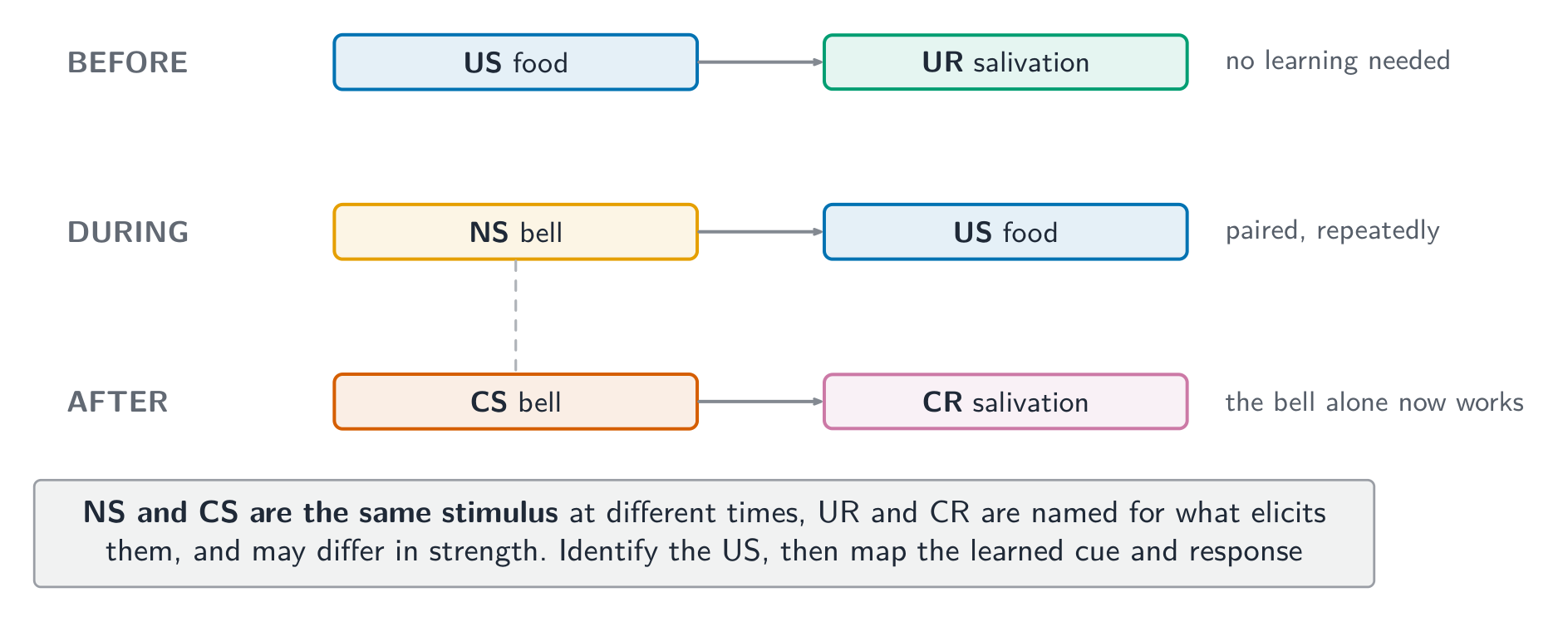
NS and CS are the same stimulus at different times- identify the US first
Pairing turns a neutral stimulus into a conditioned stimulus.
Condition a response in three stages
NS and CS are the same stimulus at different times, and so are UR and CR. Identify the US first.
In Pavlov's study, the bell after conditioning is the...
Difficulty 1/5 · 100 coins + a small bonus on first completion today
The bell started neutral and became the CS; salivation to it is the CR.
What happens to a conditioned response
- Acquisition 习得 builds the association through repeated pairing.
- Extinction 消退 weakens it when the CS appears without the UCS; spontaneous recovery 自发恢复 brings it partly back later.
- Generalisation 泛化 spreads the response to similar stimuli; discrimination 歧视 narrows it back.
Presenting the CS repeatedly without the UCS weakens the response — this is ____.
Difficulty 1/5 · 100 coins + a small bonus on first completion today
Extinction weakens the association; spontaneous recovery later brings it partly back.
Select all the processes that describe how a conditioned response changes.
Difficulty 2/5 · 140 coins + a small bonus on first completion today
Scaffolding is a Vygotskian developmental term, not a conditioning process.
Habituation is not classical conditioning. Conditioning forms an association between two stimuli; habituation is simply a fading response to one repeated stimulus. The CED lists them together precisely because they are easy to confuse.
Conditioned emotions
- Research has shown that emotional responses can be classically conditioned.
- That finding is the basis of the behavioural explanation of some phobias 恐惧症.
- A fear that was learned by association can, in principle, be unlearned the same way.
Habituation is a type of classical conditioning.
Difficulty 1/5 · 100 coins + a small bonus on first completion today
Conditioning links two stimuli; habituation is a fading response to one repeated stimulus.
Match each phenomenon to what makes it unusual.
Difficulty 2/5 · 140 coins + a small bonus on first completion today
Taste aversion breaks the usual rules; generalisation and discrimination widen and narrow.
Taste aversion and habituation
- Taste aversions 味觉厌恶 form after a single pairing, sometimes hours apart — one-trial conditioning 一次试验条件作用.
- That is a biological preparedness 生物准备性: some associations are far easier to learn than others.
- Habituation 习惯化 is different: a diminished response to a repeated stimulus, with no association formed at all.
Someone eats an unfamiliar dish, falls ill six hours later from an unrelated virus, and cannot face that dish for years. One pairing, a long delay, and a lasting aversion — taste aversion breaks the usual rules because biology prepared it.
Classical conditioning pairs a neutral stimulus with a UCS until it becomes a CS producing a CR. Acquisition, extinction, spontaneous recovery, generalisation and discrimination describe its course. Emotions can be conditioned, taste aversion needs only one trial, and habituation is a different process entirely.
Write from 12 pairings and then 8 alone
- A bell is paired with food 12 times, and the bell then produces salivation. The bell is later presented alone for 8 trials and salivation stops.
- Name acquisition and extinction.
After 12 pairings a bell produces salivation. After 8 presentations of the bell alone, salivation stops. What are those two stages, and what is the bell?
Acquisition builds the response. Extinction presents the conditioned stimulus without the unconditioned stimulus.
What are the 8 alone presentations?
Difficulty 1/5 · 100 coins + a small bonus on first completion today
The bell alone, for 8 trials, is extinction of the conditioned response.