Operant Conditioning
Introduced| English | Meaning |
|---|---|
| Law of Effect/lɔː ɒv ɪˈfekt/ | Law of Effect |
| Reinforcement/ˌriːɪnˈfɔːsmənt/ | A consequence that makes a behaviour more likely to be repeated. |
| punishment/ˈpʌnɪʃmənt/ | In operant conditioning, a consequence that decreases the future likelihood of the behaviour it follows. |
| Positive/ˈpɒzɪtɪv/ | In operant conditioning, indicating that a stimulus is added after a behaviour. |
| negative/ˈneɡətɪv/ | In operant conditioning, indicating that a stimulus is removed after a behaviour. |
| Shaping/ˈʃeɪpɪŋ/ | Teaching a behaviour by reinforcing responses that progressively resemble the desired response more closely. |
| primary reinforcer/ˈpraɪməri ˌriːɪnˈfɔːsə/ | A consequence with an unlearned reinforcing effect, often because it meets a biological need. |
| secondary reinforcer/ˈsekəndəri ˌriːɪnˈfɔːsə/ | A consequence that gains its reinforcing effect through learned associations with other reinforcers. |
| successive approximations/səkˈsesɪv əˌprɒksɪˈmeɪʃnz/ | Responses that become progressively closer to a target behaviour during shaping. |
| Continuous reinforcement/kənˈtɪnjuːəs ˌriːɪnˈfɔːsmənt/ | A schedule in which every occurrence of the target response is reinforced. |
| ratio/ˈreɪʃɪəʊ/ | A comparison of quantities expressed through division or the relative number of parts. |
| interval/ˈɪntəvl/ | An amount of time between events; in reinforcement schedules, the time that must pass before a response can be reinforced. |
| Variable ratio/ˈveərɪəbl ˈreɪʃɪəʊ/ | Variable ratio |
| Superstitious behaviour/ˌsuːpəˈstɪʃəs bɪˈheɪvjə/ | Superstitious behaviour |
| Learned helplessness/lɜːnd ˈhelpləsnəs/ | Reduced attempts to change a situation after experience with events perceived as uncontrollable. |
Behaviour that pays is behaviour that repeats
- Classical conditioning links two stimuli. Operant conditioning links a behaviour to its consequence.
- The Law of Effect 效果律 states that behaviour followed by a good outcome is more likely to recur.
- The learner is now doing something, not just receiving something.
Four cells, two questions
- Reinforcement 强化 increases a behaviour; punishment 惩罚 decreases it.
- Positive 正 means something is added; negative 负 means something is removed.
- So negative reinforcement still increases behaviour — by removing something unpleasant.
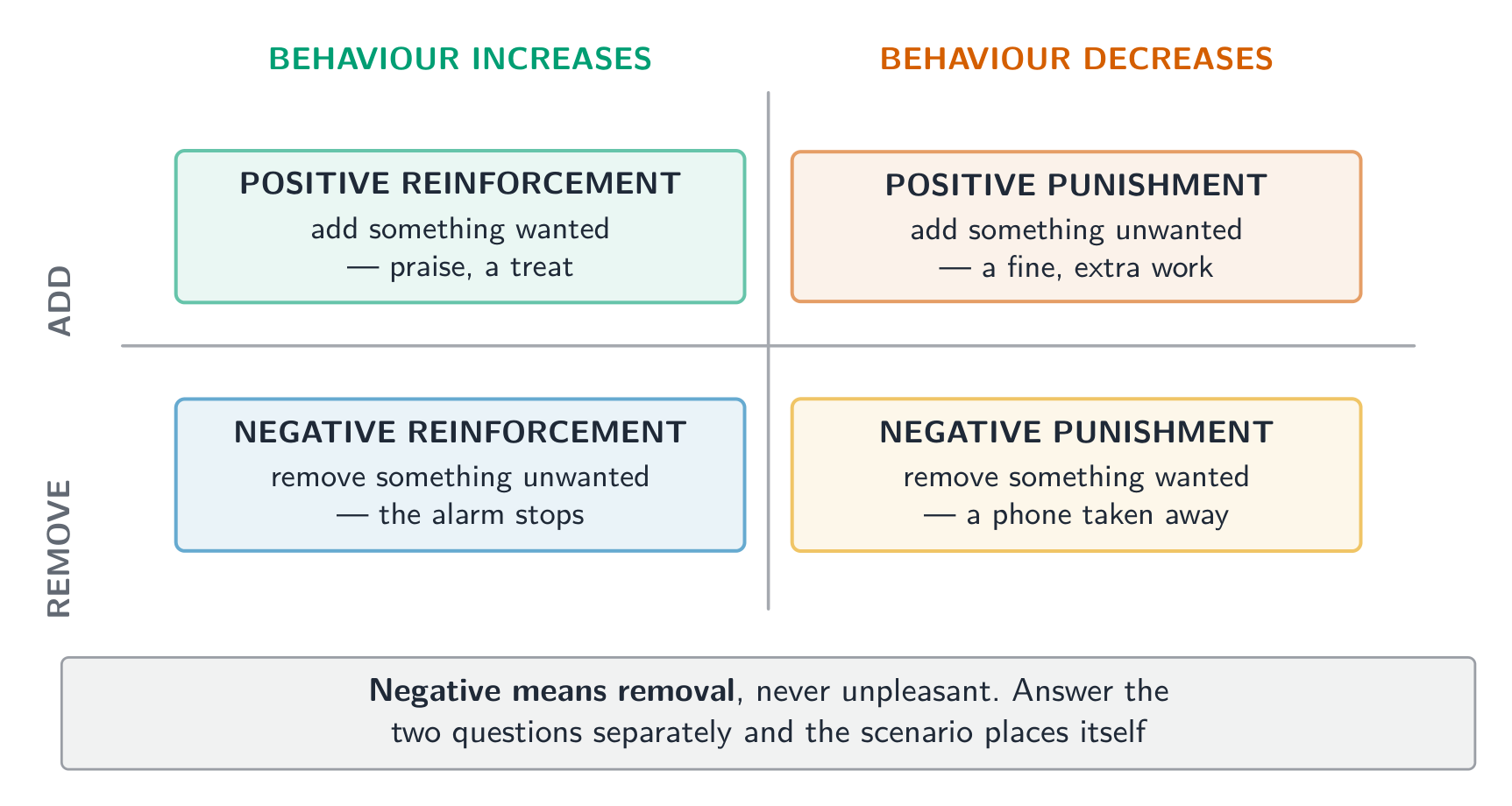
Negative means removal, never unpleasant- answer the two questions separately
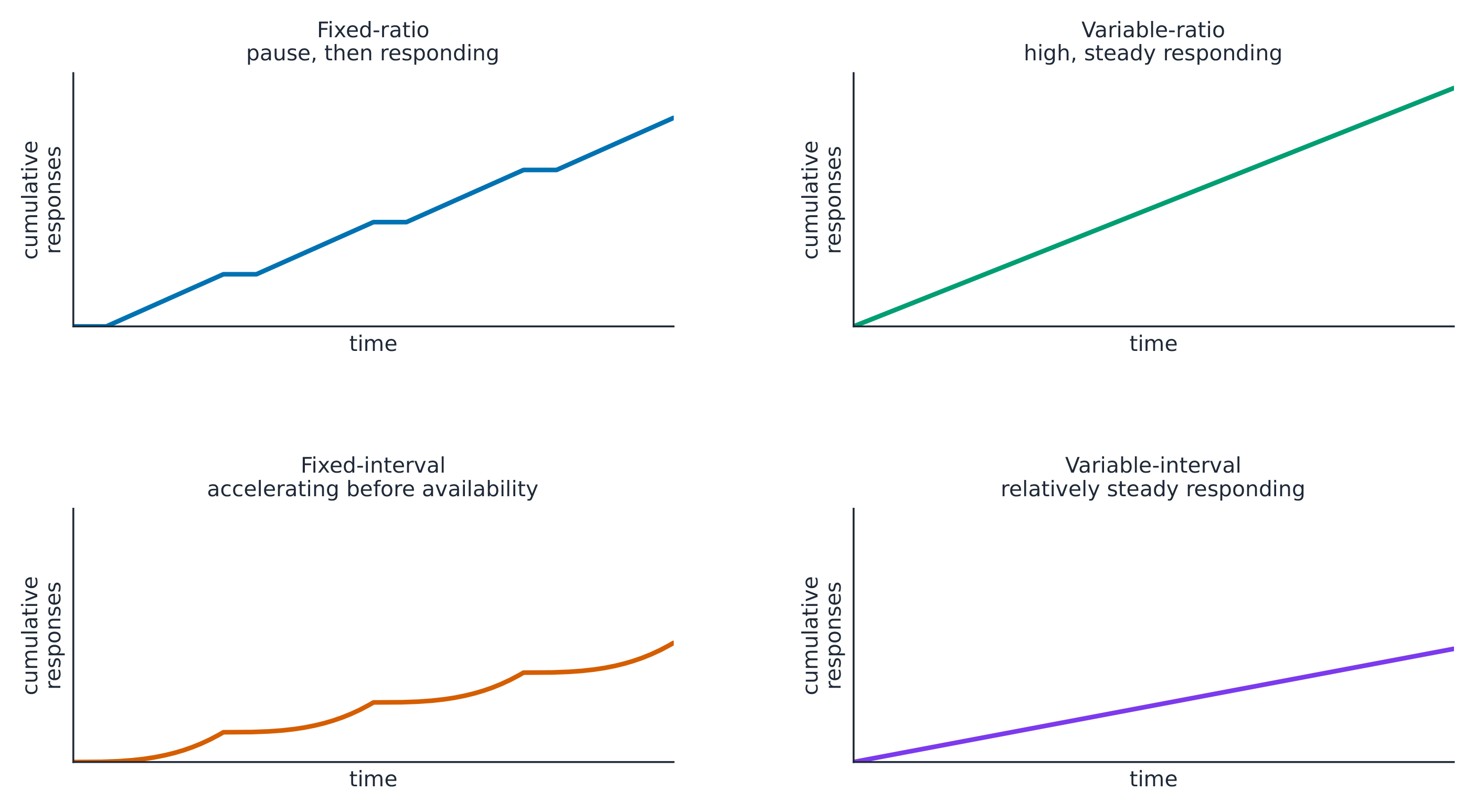
Schematic cumulative response patterns; invented teaching curves, not measured study data
Which cell of the grid?
Sort each consequence by whether it adds or removes, and increases or decreases.
Taking a painkiller to remove a headache, and doing it again next time, is an example of...
Difficulty 1/5 · 100 coins + a small bonus on first completion today
Something unpleasant was removed and the behaviour increased — negative reinforcement.
Primary, secondary, and shaping
- A primary reinforcer 原级强化物 satisfies a biological need; a secondary reinforcer 次级强化物 is learned, like money.
- Shaping 塑造 builds a complex behaviour by reinforcing successive approximations 逐步接近.
- Shaping is how a behaviour that never occurs spontaneously can still be reinforced.
Reinforcing successive approximations to build a complex behaviour is called ____.
Difficulty 1/5 · 100 coins + a small bonus on first completion today
Shaping is how a behaviour that never occurs spontaneously can be reinforced into existence.
Select all that are true of a secondary reinforcer.
Difficulty 2/5 · 140 coins + a small bonus on first completion today
A primary reinforcer satisfies a biological need directly; a secondary one is learned.
Negative reinforcement is not punishment. Negative means something is removed; reinforcement means the behaviour increases. Taking an aspirin to remove a headache is negative reinforcement — and you are more likely to do it again.
Which schedule produces the highest and most extinction-resistant response rate?
Difficulty 1/5 · 100 coins + a small bonus on first completion today
Variable ratio — an unpredictable number of responses per reward.
Schedules of reinforcement
- Continuous reinforcement 连续强化 rewards every response — fast learning, fast extinction.
- Partial schedules are fixed or variable, by ratio 比率 (number of responses) or interval 时距 (time).
- Variable ratio 可变比率 produces the highest, most extinction-resistant rate of responding.
Superstitious behaviour occurs when a consequence reinforces a behaviour that did not cause it.
Difficulty 1/5 · 100 coins + a small bonus on first completion today
The learner tracks what followed, not what actually caused the outcome.
When consequences mislead
- Superstitious behaviour 迷信行为 occurs when a consequence reinforces an unrelated behaviour.
- Learned helplessness 习得性无助 occurs when repeated inescapable outcomes teach that nothing one does matters.
- Both show that the learner tracks what followed, not what actually caused it.
A slot machine pays out after an unpredictable number of pulls — a variable-ratio schedule. That is exactly the schedule that produces the highest response rate and the greatest resistance to extinction, which is why the design is not accidental.
Operant conditioning links behaviour to consequence via the Law of Effect. Reinforcement increases and punishment decreases; positive adds and negative removes. Shaping builds new behaviour by successive approximations, and variable-ratio schedules produce the most persistent responding.
Write from a beep that stops
- A seatbelt beep stops when the belt is clicked, and the clicking increases. A separate parking fine of 40 is added after late payment.
- Classify both consequences.
A beep stops when a seatbelt is clicked, and clicking increases. A parking fine of 40 is added for late payment, and late payment decreases. Classify both.
Removal that increases a behaviour is negative reinforcement. An added penalty that decreases a behaviour is positive punishment.
What is the seatbelt beep that stops?
Difficulty 1/5 · 100 coins + a small bonus on first completion today
The beep is removed and clicking increases. That is negative reinforcement.