Social and Emotional Development
Introduced| English | Meaning |
|---|---|
| Ecological systems theory/ˌekəˈlɒdʒɪkl ˈsɪstəmz ˈθɪəri/ | An account of development shaped by interacting layers of social and environmental context over time. |
| microsystem/ˈmaɪkrəʊsɪstəm/ | In ecological systems theory, a person's immediate settings and direct relationships, such as family or school. |
| mesosystem/ˈmesəsɪstəm/ | In ecological systems theory, the connections between a person's immediate settings, such as home-school relationships. |
| exosystem/ˈeksəʊsɪstəm/ | In ecological systems theory, settings that indirectly influence a person despite their not participating directly. |
| macrosystem/ˈmækrəsɪstəm/ | In ecological systems theory, the wider cultural values, institutions and social arrangements surrounding development. |
| chronosystem/ˈkrɒnəsɪstəm/ | In ecological systems theory, changes and transitions over time that shape a person's development. |
| parenting styles/ˈpeərəntɪŋ staɪlz/ | Patterns of parental behaviour commonly described through dimensions such as warmth, responsiveness and control. |
| authoritarian/ˌɔːθɔːrɪˈteərɪən/ | Describing a parenting style with strong demands for obedience and relatively low responsiveness. |
| authoritative/ɔːˈθɒrɪtətɪv/ | Describing a parenting style combining clear expectations and limits with warmth and responsiveness. |
| permissive/pəˈmɪsɪv/ | Describing a parenting style with relatively high warmth but few enforced demands or limits. |
| Attachment styles/əˈtætʃmənt staɪlz/ | Attachment styles |
| identity/aɪˈdentɪti/ | A person's sense of who they are, including the characteristics and groups with which they identify. |
| stage theory of psychosocial development/steɪdʒ ˈθɪəri ɒv ˈsaɪkəʊsəʊʃl dɪˈveləpmənt/ | stage theory of psychosocial development |
| moratorium/ˌmɔːrəˈtɔːrɪəm/ | In identity development, active exploration of alternatives without a settled commitment. |
| Adverse childhood experiences/ædˈvɜːs ˈtʃaɪldhʊd ekˈspɪərɪənsɪz/ | Adverse childhood experiences |
Development happens inside circles of other people
- A child is shaped by parents, but also by a school, a neighbourhood and a decade.
- Those influences sit at different distances and act at different speeds.
- This topic names the circles, and what happens inside the closest one.
Ecological systems theory
- Ecological systems theory 生态系统理论 describes five nested systems around a developing person.
- The microsystem 微系统 is direct contact; the mesosystem 中间系统 is links between those settings.
- The exosystem 外系统 affects the child indirectly, the macrosystem 宏系统 is culture, and the chronosystem 时间系统 is change over time.
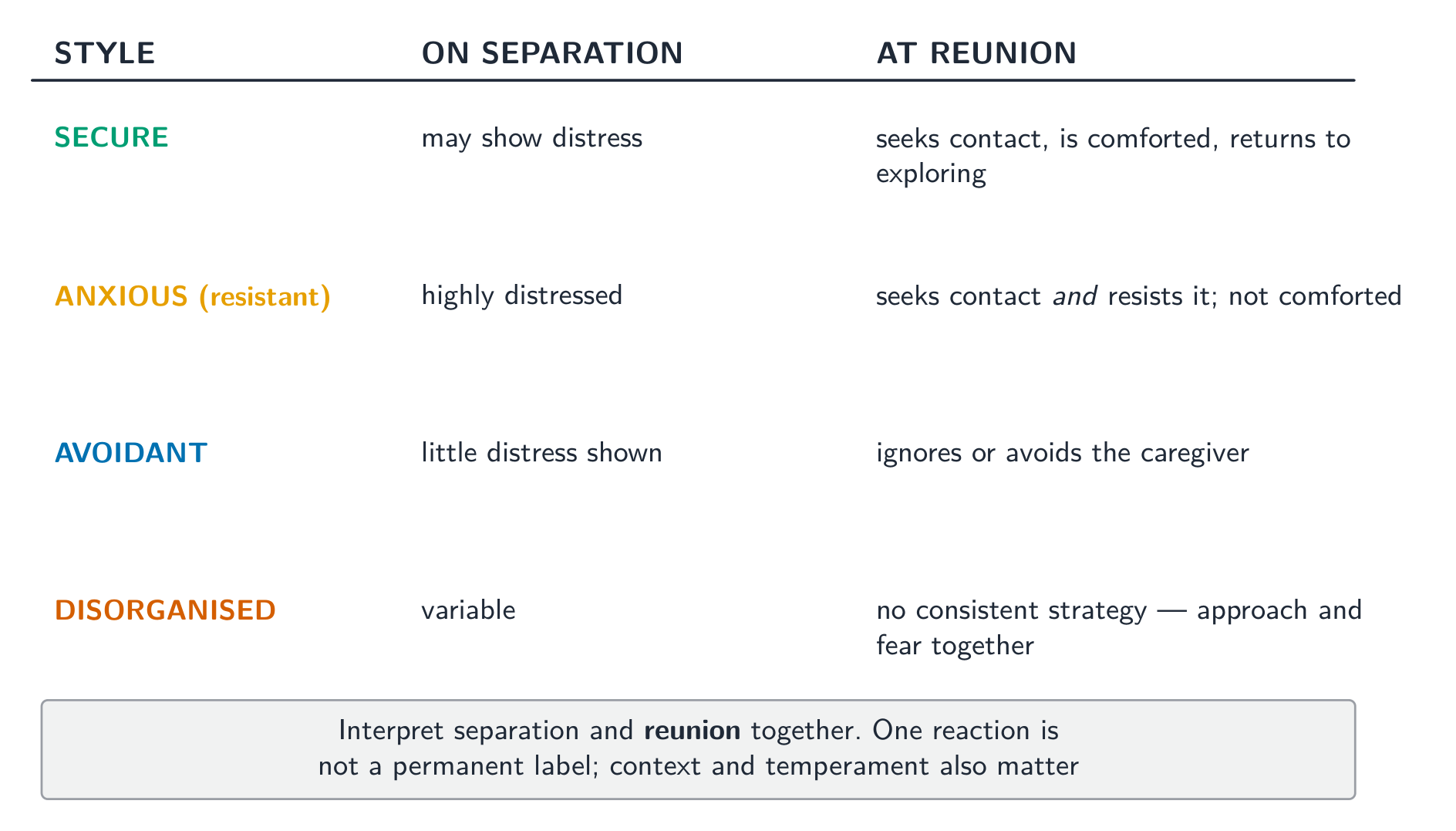
Interpret separation and reunion patterns together; one observation is insufficient for a permanent attachment label
Match each system to its distance from the child.
Difficulty 2/5 · 140 coins + a small bonus on first completion today
The systems are nested, from immediate contact out to culture and time.
Parenting styles and attachment
- The CED names three parenting styles 教养方式: authoritarian 专制型, authoritative 权威型 and permissive 放任型.
- Attachment styles 依恋类型 in infants vary by culture, which the CED states explicitly.
- The pair to keep straight: authoritarian demands without warmth; authoritative sets limits and explains them.
Which ecological system?
Place each influence at the right distance from the child.
A parent who sets firm limits and explains the reasons is best described as...
Difficulty 1/5 · 100 coins + a small bonus on first completion today
Authoritative combines high demand with warmth and explanation.
The CED states that attachment styles vary by culture.
Difficulty 1/5 · 100 coins + a small bonus on first completion today
That is stated explicitly, and it is why a single cultural norm cannot be treated as universal.
Authoritarian and authoritative are one letter apart and mean opposite things about warmth. Authoritarian is high demand with low warmth; authoritative is high demand with warmth and explanation. Mixing them up reverses the finding.
Select all the identity statuses the CED names for adolescence.
Difficulty 2/5 · 140 coins + a small bonus on first completion today
Assimilation is a Piagetian term about schemas, not an identity status.
Psychosocial stages and identity
- The stage theory of psychosocial development 心理社会发展阶段理论 proposes a conflict to resolve at each stage of life.
- Adolescents form an identity 认同 through achievement, diffusion, foreclosure and moratorium 同一性延缓.
- Development continues into adulthood — the CED explicitly studies how adults develop socially over time.
Adverse childhood experiences are abbreviated as ____.
Difficulty 1/5 · 100 coins + a small bonus on first completion today
ACEs affect the relationships a person forms throughout life.
Adverse childhood experiences
- Adverse childhood experiences 童年逆境经历 (ACEs) affect the relationships a person forms throughout life.
- The effect runs through later relationships, not only through immediate distress.
- Peer relationships also develop across time and are studied in their own right.
Two parents both set a 9 p.m. curfew. One says "because I said so"; the other explains the reason and listens to the objection. Same rule, different style — and the CED's categories separate them by warmth and explanation, not by strictness.
Ecological systems theory nests five systems around a person. Parenting styles are authoritarian, authoritative and permissive; attachment styles vary by culture. Psychosocial stages run through life, adolescents form identity, and ACEs shape later relationships.
Write from a 10 p.m. curfew that is explained
- One parent sets a 10 p.m. weekend curfew, explains it and listens. Another sets 10 p.m. and says because I said so.
- Name both styles.
Both parents set a 10 p.m. curfew. One explains and listens, and the other says because I said so. Which parenting styles are these?
The categories use warmth and explanation. Strictness alone does not identify them.
What style explains the 10 p.m. rule and listens?
Difficulty 1/5 · 100 coins + a small bonus on first completion today
Explanation and listening make the 10 p.m. rule authoritative. Other options — Authoritarian (because a curfew is strict); Permissive (because the time is later than 9 p.m).