Studying Development
Introduced| English | Meaning |
|---|---|
| Developmental psychology/dɪˈveləpmentl saɪˈkɒlədʒi/ | The study of change and continuity in behaviour and mental processes across the lifespan. |
| longitudinal study/ˌlɒŋɡɪˈtjuːdɪnl ˈstʌdi/ | Research that follows the same participants or units across multiple points in time. |
| cohort effect/ˈkəʊhɔːt ɪˈfekt/ | cohort effect |
| cross-sectional study/krɒs ˈsekʃənl ˈstʌdi/ | Research comparing different participants or groups at one point or period in time. |
Two ways to watch a person change
- You can follow one group of people for twenty years.
- Or you can test people of many ages on the same afternoon.
- Both answer "how do people change?" — and each buys the answer at a different price.
What developmental psychology studies
- Developmental psychology 发展心理学 studies change across the lifespan.
- It works both chronologically — birth, infancy, childhood, adolescence, adulthood — and thematically.
- The enduring themes cut across ages: stability and change, nature and nurture, and continuous versus discontinuous development.
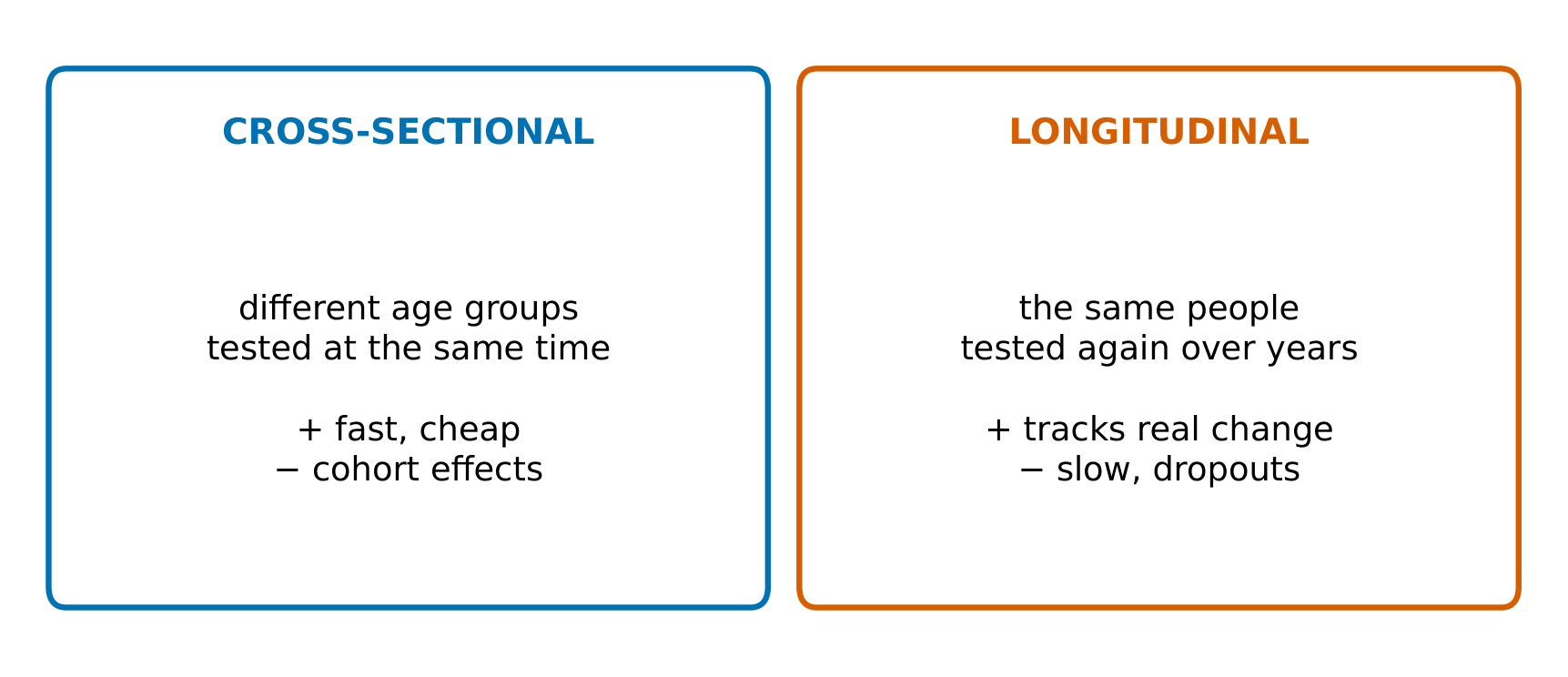
Cross-sectional and longitudinal designs for studying development
Select all the enduring themes the CED names in developmental psychology.
Difficulty 2/5 · 140 coins + a small bonus on first completion today
Recall and recognition belong to memory, not to developmental themes.
Longitudinal research
- A longitudinal study 纵向研究 follows the same people over time.
- It shows genuine change within individuals, which is what a developmental claim needs.
- The costs: it takes years, and people drop out — often not at random.
Longitudinal or cross-sectional?
Sort each feature by the design it belongs to.
A longitudinal study is the only design that can show...
Difficulty 1/5 · 100 coins + a small bonus on first completion today
Following the same people is what makes within-person change measurable.
A cohort effect is not a small technical caveat. If 70-year-olds score lower on a technology task than 20-year-olds in a cross-sectional study, the honest reading is that they grew up in a different world, not that ability declines with age.
The confound in cross-sectional research, where age groups also differ by generation, is the ____ effect.
Difficulty 1/5 · 100 coins + a small bonus on first completion today
The cohort effect means the groups grew up in different worlds, not only at different ages.
Cross-sectional research is faster than longitudinal research.
Difficulty 1/5 · 100 coins + a small bonus on first completion today
It tests everyone at once, which is exactly why it cannot separate age from generation.
Cross-sectional research
- A cross-sectional study 横断研究 compares different age groups at one time.
- It is fast and cheap, and gives an answer this month rather than in 2045.
- The cost is the cohort effect 同辈群体效应: the groups differ by generation as well as by age.
Match each design to its main cost.
Difficulty 2/5 · 140 coins + a small bonus on first completion today
Each design buys one thing and pays for it with another.
Choosing between them
- If the question is whether a person changes, only a longitudinal design can answer it.
- If the question is how age groups differ right now, cross-sectional is enough.
- An exam answer names the design and the cost that comes with it.
A cross-sectional study finds older adults use fewer digital services. A longitudinal study of the same people over ten years finds their use rising. Both are correct: the first measured a cohort difference, the second measured change.
Developmental psychology works chronologically and thematically. A longitudinal study follows the same people — slow, but it measures real change. A cross-sectional study compares age groups at once — fast, but confounded by the cohort effect.
Write from the same 25 children
- A 4-year longitudinal study of 25 children finds reading scores rise by 12 points. A one-week cross-sectional comparison also shows a 12-point age gap, and the older group had a different curriculum.
- Separate change from a cohort effect.
The same 25 children gain 12 reading points over 4 years. A cross-sectional gap of 12 points appears in one week, and the older group had a different curriculum. What can each design claim?
Following the same people measures change. Comparing age groups once can mix in the era they grew up in.
What does the 4-year study measure?
Difficulty 1/5 · 100 coins + a small bonus on first completion today
The same children were followed, so the 12-point rise is longitudinal change. Other options — A cohort difference only (because 12 points also appear in one week); Digital-service use (the lesson topic).