Physical Development
Introduced| English | Meaning |
|---|---|
| Teratogens/ˈterətədʒnz/ | Teratogens |
| genetic mutations/dʒɪˈnetɪk mjuːˈteɪʃnz/ | genetic mutations |
| reflexes/ˈriːfleksɪz/ | Automatic responses to particular stimuli that do not require a deliberate decision. |
| rooting reflex/ˈruːtɪŋ ˈriːfleks/ | An infant's automatic turning of the head towards touch near the cheek or mouth, helping locate a source of milk. |
| visual cliff/ˈvɪʒuːəl klɪf/ | An apparatus using a glass-covered apparent drop to investigate depth perception and responses to apparent height. |
| Critical/ˈkrɪtɪkl/ | Critical |
| sensitive periods/ˈsensɪtɪv ˈpɪərɪədz/ | sensitive periods |
| adolescent growth spurt/ˌædəˈlesənt ɡrəʊθ spɜːt/ | A period of rapid increase in body size during adolescence. |
| puberty/ˈpjuːbəti/ | The developmental process through which the body undergoes sexual maturation. |
| Adulthood/əˈdʌlthʊd/ | Adulthood |
Same order, different timetable
- Babies sit before they crawl and crawl before they walk, almost everywhere.
- But one baby walks at ten months and another at fifteen, and both are typical.
- Order is highly regular; timing is not.
Across cultures, physical development in infancy is...
Difficulty 1/5 · 100 coins + a small bonus on first completion today
Order is highly regular; timing varies between typical children.
Before birth
- Teratogens 致畸物 are agents that can harm prenatal development.
- Maternal illness, genetic mutations 基因突变, hormonal and environmental factors also influence it.
- The examinable point is that prenatal development is influenced by the environment, not only by genes.
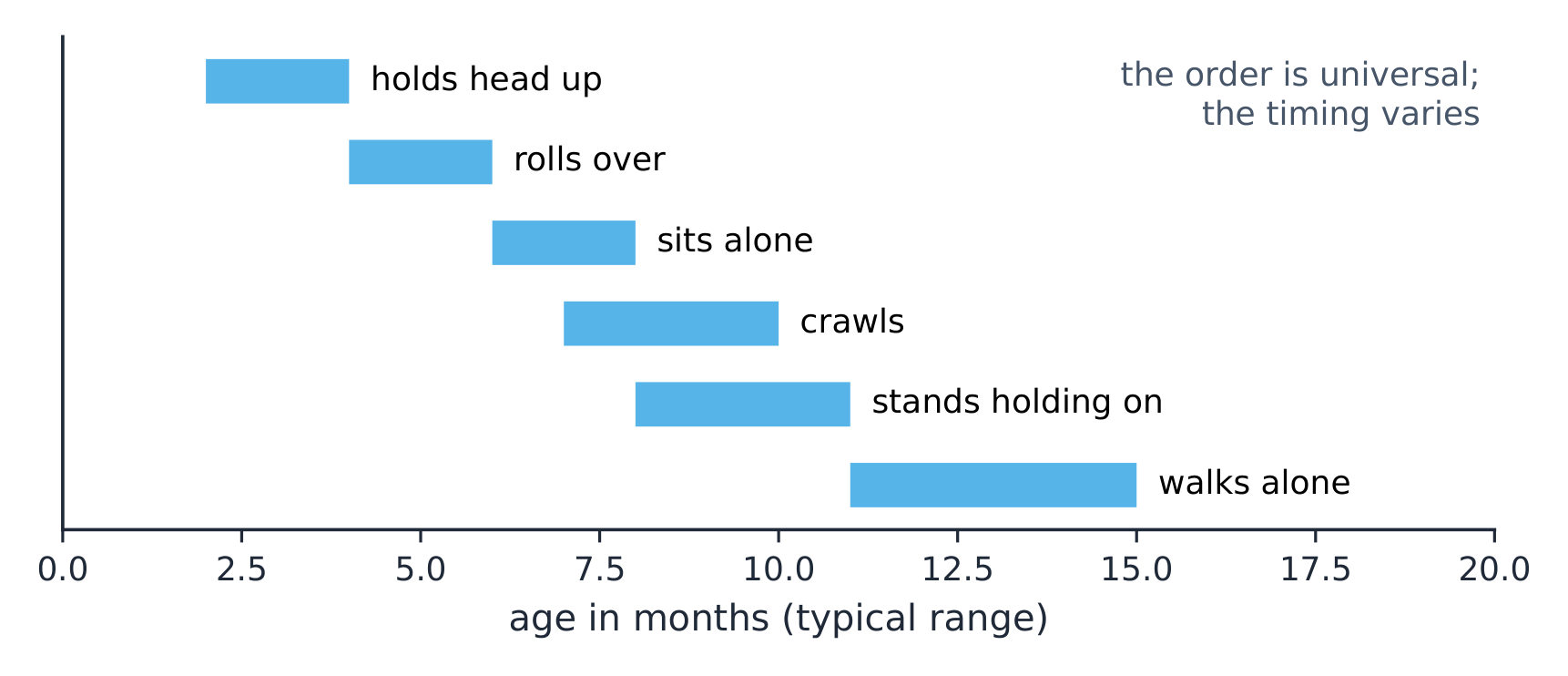
Motor milestones follow a fixed order while their timing varies
An agent that can harm prenatal development is called a ____.
Difficulty 1/5 · 100 coins + a small bonus on first completion today
Teratogens are the CED's term for harmful prenatal agents.
Infancy and childhood
- Infants possess reflexes 反射 such as the rooting reflex 觅食反射, which indicate on-track development.
- The visual cliff 视崖 experiment showed infants perceive depth early — and are wary of it.
- Critical 关键期 and sensitive periods 敏感期 are windows in which experience has unusually strong effects.
Follow physical development across a life
The examinable pattern is that development is orderly but not uniform — and each period has its own markers.
The visual cliff showed that infants perceive depth earlier than they can describe it.
Difficulty 1/5 · 100 coins + a small bonus on first completion today
That gap is why infancy research relies on behavioural rather than verbal methods.
Match each term to what it claims.
Difficulty 2/5 · 140 coins + a small bonus on first completion today
The two period terms differ in how absolute the window is.
A critical period and a sensitive period are not the same claim. A critical period implies the window closes; a sensitive period implies effects are strongest then but not impossible later. Use the stronger word only when the evidence supports it.
Select all the adolescent milestones the CED names.
Difficulty 2/5 · 140 coins + a small bonus on first completion today
Rooting and the visual cliff belong to infancy, not adolescence.
Adolescence
- The main milestones are the adolescent growth spurt 青春期发育突增 and puberty 青春发育期.
- Physical change arrives on a biological schedule that social maturity does not follow.
- The gap between the two is itself a source of the period's psychological pressure.
Adulthood
- Adulthood 成年期 spans most of the lifespan.
- It is characterised by a general levelling off and then a varying decline in physical capability.
- "Varying" is the load-bearing word: the rate differs enormously between people and between abilities.
On the visual cliff, crawling infants stop at the apparent drop even when a caregiver calls from the other side. Depth perception is present far earlier than the ability to describe it — which is why behavioural methods matter in infancy research.
Physical development follows a regular order with variable timing. Teratogens and maternal factors shape prenatal development, infant reflexes and the visual cliff reveal early capability, critical and sensitive periods are high-impact windows, and adulthood shows a varying decline.
Write from walking at 10 months and at 15 months
- One infant walks at 10 months and another at 15 months. Both sat before they walked.
- Separate order from timing.
One infant walks at 10 months and another at 15 months, and both sat before walking. What is orderly here, and what varies?
15 minus 10 is 5. Motor milestones keep their sequence while their dates vary.
What varies between these infants?
Difficulty 1/5 · 100 coins + a small bonus on first completion today
Both sit before walking. The dates differ by 5 months.