Introduction to Memory
Introduced| English | Meaning |
|---|---|
| Explicit/ekˈsplɪsɪt/ | Explicit |
| episodic/ˌepɪˈsɒdɪk/ | episodic |
| semantic/səˈmæntɪk/ | Relating to meaning or interpretation. |
| Implicit/ɪmˈplɪsɪt/ | Implicit |
| procedural/prəˈsiːdʒərəl/ | procedural |
| Long-term potentiation/lɒŋ tɜːm pəˌtenʃɪˈeɪʃn/ | The process by which synaptic connections strengthen with repeated firing. |
| multi-store model/ˈmʌlti stɔː ˈmɒdl/ | A model of memory that distinguishes sensory, short-term and long-term stores. |
| sensory memory/ˈsensəri ˈmeməri/ | Very brief retention of sensory information after the stimulus is no longer present. |
| iconic/aɪˈkɒnɪk/ | Relating to the brief visual store within sensory memory. |
| echoic/eˈkəʊɪk/ | Relating to the brief auditory store within sensory memory. |
| working memory model/ˈwɜːkɪŋ ˈmeməri ˈmɒdl/ | An account of temporary information processing using interacting control and storage components rather than one undivided store. |
| levels of processing model/ˈlevlz ɒv ˈprəʊsesɪŋ ˈmɒdl/ | The account that memory retention depends on the kind and depth of processing, with meaningful elaboration often helping recall. |
| structural/ˈstrʌktʃərəl/ | Relating to the physical organisation or arrangement of parts, such as the anatomy of the brain. |
| phonemic/fɒˈnemɪk/ | phonemic |
You can ride a bicycle but not describe how
- Some memories can be put into words; others can only be performed.
- That is the first clue that memory is not one system.
- This topic names the systems and the models that describe them.
Kinds of memory
- Explicit 外显 memories can be consciously stated: episodic 情景 (events) and semantic 语义 (facts).
- Implicit 内隐 memories cannot: procedural 程序性 skills and conditioned responses.
- Memories differ by how they are processed, stored and retrieved — not by how important they feel.
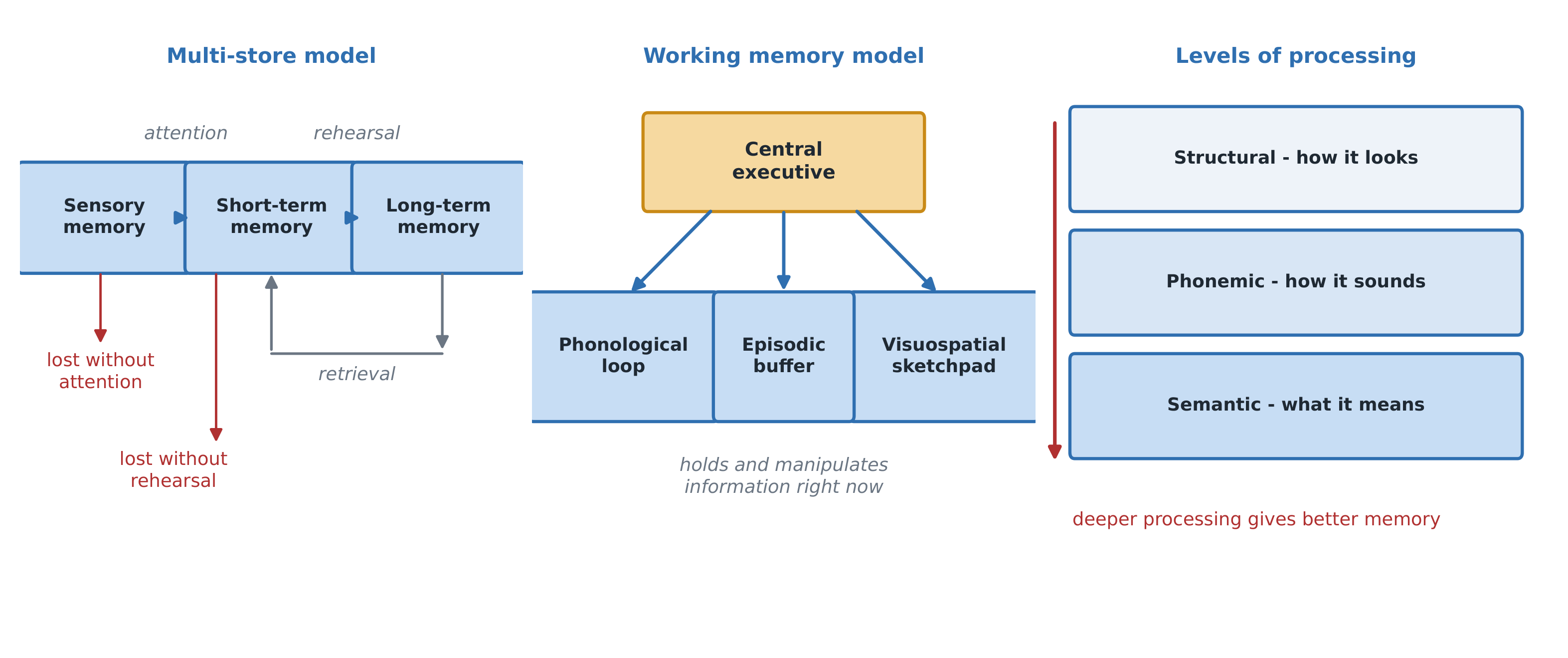
Three models of memory: multi-store, working memory and levels of processing
Explicit or implicit?
Sort each memory by whether it can be consciously stated.
Select all that are explicit memories.
Difficulty 2/5 · 140 coins + a small bonus on first completion today
Riding a bicycle is procedural, and procedural memories are implicit.
What a memory is, physically
- Long-term potentiation 长时程增强 is the process by which synaptic connections strengthen with repeated firing.
- It is the biological account of why practice works.
- A memory is a changed connection, not an object stored somewhere.
Long-term potentiation refers to...
Difficulty 1/5 · 100 coins + a small bonus on first completion today
LTP is the biological account of why repeated practice makes a memory stick.
The three memory models are not rivals to be ranked. The CED presents them as different descriptions of the same system, and an answer that says one is "correct" and the others "wrong" has misread what a model is for.
Order the levels of processing from shallowest to deepest.
Difficulty 3/5 · 200 coins + a small bonus on first completion today
Deeper processing produces the more durable memory, which is why meaning beats repetition.
Brief sensory memory for sound is called ____ memory.
Difficulty 1/5 · 100 coins + a small bonus on first completion today
Echoic memory holds sound; iconic memory holds a visual image.
Three models of the same thing
- The multi-store model 多重存储模型 proposes sensory memory 感觉记忆 (including iconic 图像记忆 and echoic 声像记忆), short-term and long-term stores.
- The working memory model 工作记忆模型 treats the primary system as active, not a passive store.
- The levels of processing model 加工水平模型 says depth matters: structural 结构 (shallowest), phonemic 音位, then semantic 语义 (deepest).
The CED presents the three memory models as rivals, one of which is correct.
Difficulty 1/5 · 100 coins + a small bonus on first completion today
They are different descriptions of the same system, each useful for a different question.
Choosing which model to use
- Use the multi-store model when a question is about where information sits and for how long.
- Use the working memory model when it is about what the mind is doing with information right now.
- Use levels of processing when it is about why one study method beat another.
Two students study the same list. One repeats the words aloud (phonemic), the other writes a sentence using each one (semantic). The second remembers more — not because she worked longer, but because levels of processing predicts deeper encoding lasts.
Memory splits into explicit (episodic, semantic) and implicit (procedural). Long-term potentiation is its physical basis. The multi-store, working memory and levels of processing models each describe the same system from a different angle.
Write from 15 days of practice without a title
- A pianist practised a piece on 15 days and plays it fluently, but cannot name it.
- Classify the memory.
After 15 days of practice a pianist plays a piece fluently but cannot name it. What kind of memory is the playing, and what kind would the title be?
A skill and a fact can separate. Fluent playing does not require the name.
What kind of memory is the fluent playing?
Difficulty 1/5 · 100 coins + a small bonus on first completion today
The skill is procedural. The missing title would have been semantic. Other options — Semantic memory (because she studied for 15 days); Phonemic rehearsal of a word list (the lesson comparison).