Encoding Memories
Introduced| English | Meaning |
|---|---|
| Encoding/enˈkəʊdɪŋ/ | Processing incoming information into a form that can be stored in memory. |
| Mnemonic devices/nɪˈmɒnɪk dɪˈvaɪsɪz/ | Strategies that support recall by organising information or linking it with memorable cues. |
| method of loci/ˈmeθəd ɒv ˈləʊsaɪ/ | A memory strategy that links items to imagined locations along a familiar route or within a familiar place. |
| Chunking/ˈtʃʌŋkɪŋ/ | Organising separate items into larger meaningful units to make them easier to hold or recall. |
| spacing effect/ˈspeɪsɪŋ ɪˈfekt/ | The tendency for learning spread over time to support better later retention than comparable massed practice. |
| serial position effect/ˈsɪərɪəl pəˈzɪʃn ɪˈfekt/ | Differences in recall depending on an item's place in a sequence, often favouring the beginning and end. |
| primacy effect/ˈpraɪməsi ɪˈfekt/ | primacy effect |
| recency effect/rɪˈsensi ɪˈfekt/ | recency effect |
Two hours of study, two different results
- Two students spend equal time on the same material and remember different amounts.
- The difference is not effort — it is how the information went in.
- Encoding 编码 is the set of processes that get information into memory.
Mnemonics
- Mnemonic devices 记忆术 aid encoding into working and long-term memory.
- The CED's named example is the method of loci 位置法 — placing items along a familiar route.
- Mnemonics work by attaching new material to a structure you already hold.
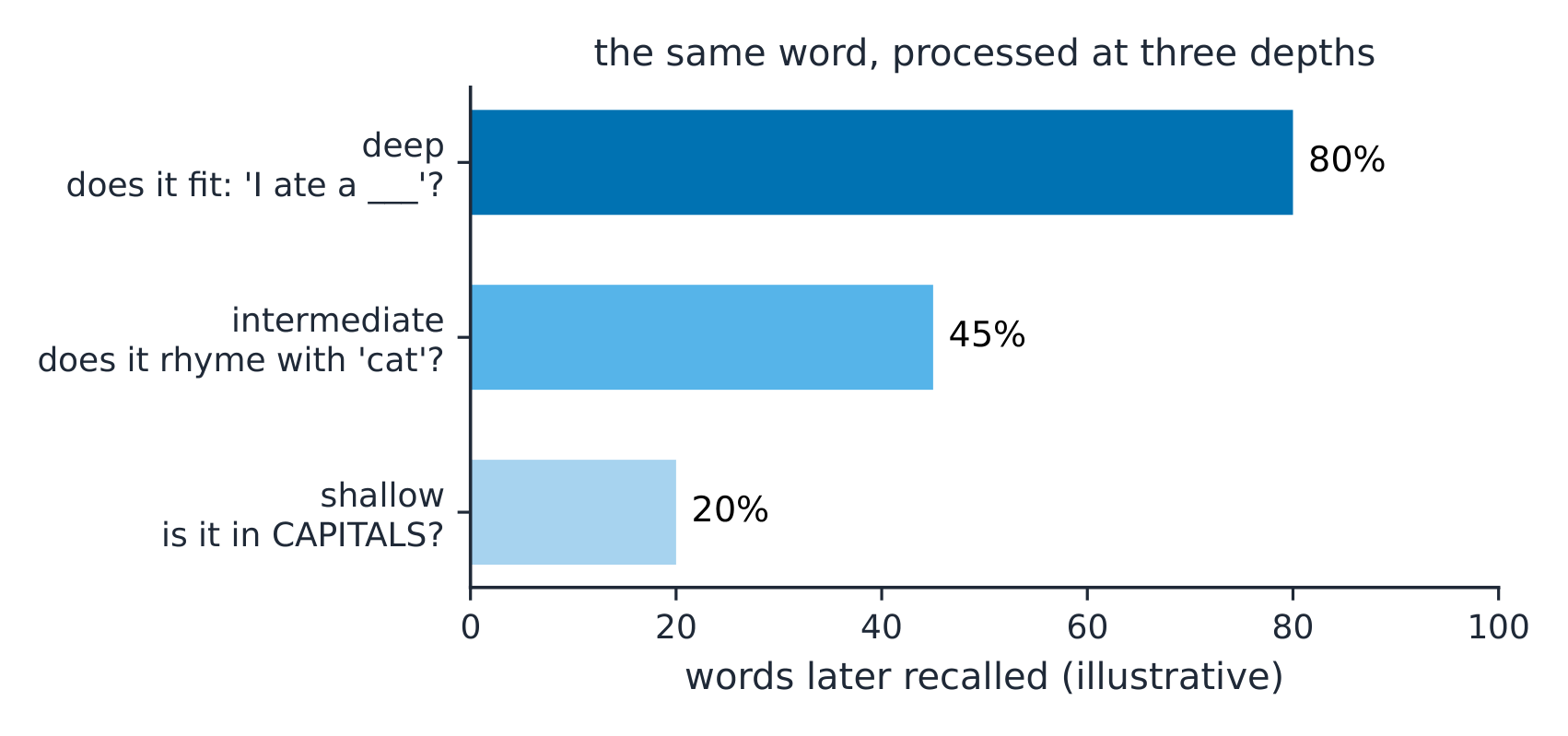
Deeper processing of meaning gives better recall (illustrative)
Select all that are true of mnemonic devices.
Difficulty 2/5 · 140 coins + a small bonus on first completion today
Mnemonics are general-purpose; the CED names the method of loci as an example.
Chunking
- Chunking 组块 groups information into meaningful units.
- A phone number in three chunks is easier than eleven separate digits.
- The number of items falls; the amount of information does not.
Follow one item through the memory system
Encoding, storage and retrieval are three different stages, and a failure at each looks different.
Chunking reduces the amount of information you have to hold.
Difficulty 1/5 · 100 coins + a small bonus on first completion today
It reduces the number of items, not the information — the same content is held in fewer units.
The spacing effect is not about studying more. The total time is held constant — that is the whole point. An answer that explains spaced practice as "working harder" has described a different thing.
Spreading the same study time over several sessions is the ____ effect.
Difficulty 1/5 · 100 coins + a small bonus on first completion today
The total time is held constant; only the distribution changes.
The spacing effect
- The spacing effect 间隔效应 means spread-out study encodes better than the same time massed together.
- Four sessions of thirty minutes beat one session of two hours.
- The total time is identical — only the distribution changed.
Losing the middle of a list while remembering the start and end is explained by...
Difficulty 1/5 · 100 coins + a small bonus on first completion today
Primacy favours the first items and recency the last; the middle is lost.
Match each effect to the part of a list it favours.
Difficulty 2/5 · 140 coins + a small bonus on first completion today
The middle of a list is favoured by neither, which is why it is lost.
Serial position
- The serial position effect 系列位置效应 says order of presentation changes what is encoded.
- The primacy effect 首因效应 favours the first items; the recency effect 近因效应 favours the last.
- The middle of a list is the part that gets lost.
Asked to recall a twenty-word list, students reliably get the first few (primacy) and the last few (recency) and lose the middle. Nothing about the middle words is harder — their position is what cost them.
Encoding determines what gets in. Mnemonics such as the method of loci attach new material to old structure, chunking groups items into meaningful units, the spacing effect favours distributed study, and the serial position effect produces primacy and recency.
Write from 11 digits in 3 chunks
- An 11-digit phone number is stored as 3 chunks. Another student studies one topic for 40 minutes in one sitting, or as 4 sessions of 10 minutes.
- Compare chunking with the spacing effect.
How does chunking turn an 11-digit number into 3 units, and why can 4 sessions of 10 minutes beat one 40-minute sitting?
4 times 10 is 40. The advantage is the distribution, not extra time.
What does chunking do to the phone number?
Difficulty 1/5 · 100 coins + a small bonus on first completion today
Three meaningful groups replace 11 unrelated digits.