Arithmetic and Geometric Sequences
Introduced| English | Meaning |
|---|---|
| arithmetic sequence/əˈrɪθmətɪk ˈsiːkwəns/ | A sequence whose consecutive terms differ by a constant amount. |
| common difference/ˈkɒmən ˈdɪfrəns/ | The constant amount added to each term to obtain the next term in an arithmetic sequence. |
| geometric sequence/ˌdʒiːəʊˈmetrɪk ˈsiːkwəns/ | A sequence in which each term is obtained by multiplying the previous term by a fixed common ratio. |
| common ratio/ˈkɒmən ˈreɪʃɪəʊ/ | The factor multiplying each term to obtain the next term in a geometric sequence. |
| explicit/ekˈsplɪsɪt/ | explicit |
| recursive/rɪˈkɜːsɪv/ | Defined in terms of earlier values or smaller instances of the same process. |
Add tiles or double the pattern
- A tile pattern starts with 2 tiles and adds 2 each stage: $2,4,6,8,\dots$. Another starts with 1 tile and doubles each stage: $1,2,4,8,\dots$.
- These are ordered lists of numbers. The first rule adds a fixed amount; the second multiplies by a fixed factor. The number of the stage is part of each rule.
Arithmetic: add the same amount
- An arithmetic sequence 等差数列 has a common difference 公差: subtract a term from the next one. For $5,8,11,14,\dots$, each difference is 3.
- The difference may be positive, zero or negative. The terms lie on a straight line, but a sequence has discrete points: the allowed term numbers are whole numbers, not every point between them.
An arithmetic sequence has a constant…
Difficulty 1/5 · 100 coins + a small bonus on first completion today
Each term is the previous one plus a fixed common difference — that steady addition makes it arithmetic.
Geometric: multiply by the same amount
- A geometric sequence 等比数列 uses a common ratio 公比. For $3,6,12,24,\dots$, the multiplier is 2. Divide the next term by the current term only when the current term is nonzero.
- With a positive starting term, a ratio above 1 gives growth; a ratio between 0 and 1 gives decay. A negative ratio makes the signs alternate. A geometric sequence need not curve upward or increase.
A geometric sequence has a constant…
Difficulty 1/5 · 100 coins + a small bonus on first completion today
Each term is the previous one times a fixed common ratio — steady multiplication makes it geometric.
Check where counting starts
- If the starting term is $a_0=3$ and the difference is 5, then $a_n=3+5n$ and $a_4=23$. Index 4 means four changes after index 0.
- Start instead at $a_1=3$. The same list uses $a_n=3+5(n-1)$ and $a_4=18$. Index 4 now means three changes. The values have not changed; their labels have shifted.
An arithmetic sequence has a₀ = 7 and common difference −2. Find a₅.
Difficulty 2/5 · 140 coins + a small bonus on first completion today
Index 5 is five changes after index 0: a₅ = 7 + 5(−2) = −3.
Explicit and recursive rules
- An explicit 显式 rule gives a term directly. From term 1, arithmetic uses $a_n=a_1+(n-1)d$ and geometric uses $g_n=g_1r^{n-1}$. From a known term at index k, replace the starting term by $a_k$ or $g_k$ and the number of changes by $n-k$.
- A recursive 递归 rule needs a starting value as well as its update. For example, $a_1=5$ and $a_n=a_{n-1}+3$ for $n\ge2$. The update alone does not determine a unique sequence.
A ____ rule defines each term using the term before it.
Difficulty 1/5 · 100 coins + a small bonus on first completion today
A recursive rule like $a_n = a_{n-1} + 3$ builds from the previous term; an explicit rule jumps straight to $a_n$.
A geometric sequence starts $3, 6, 12, 24, \dots$. What is the 5th term?
Difficulty 2/5 · 140 coins + a small bonus on first completion today
The common ratio is $2$, so the 5th term is $24 \times 2 = 48$.
An arithmetic sequence has a₄ = 17 and difference 3. Find a₉.
Difficulty 2/5 · 140 coins + a small bonus on first completion today
There are 9 − 4 = 5 changes: a₉ = 17 + 5 × 3 = 32.
Compare growth with its conditions
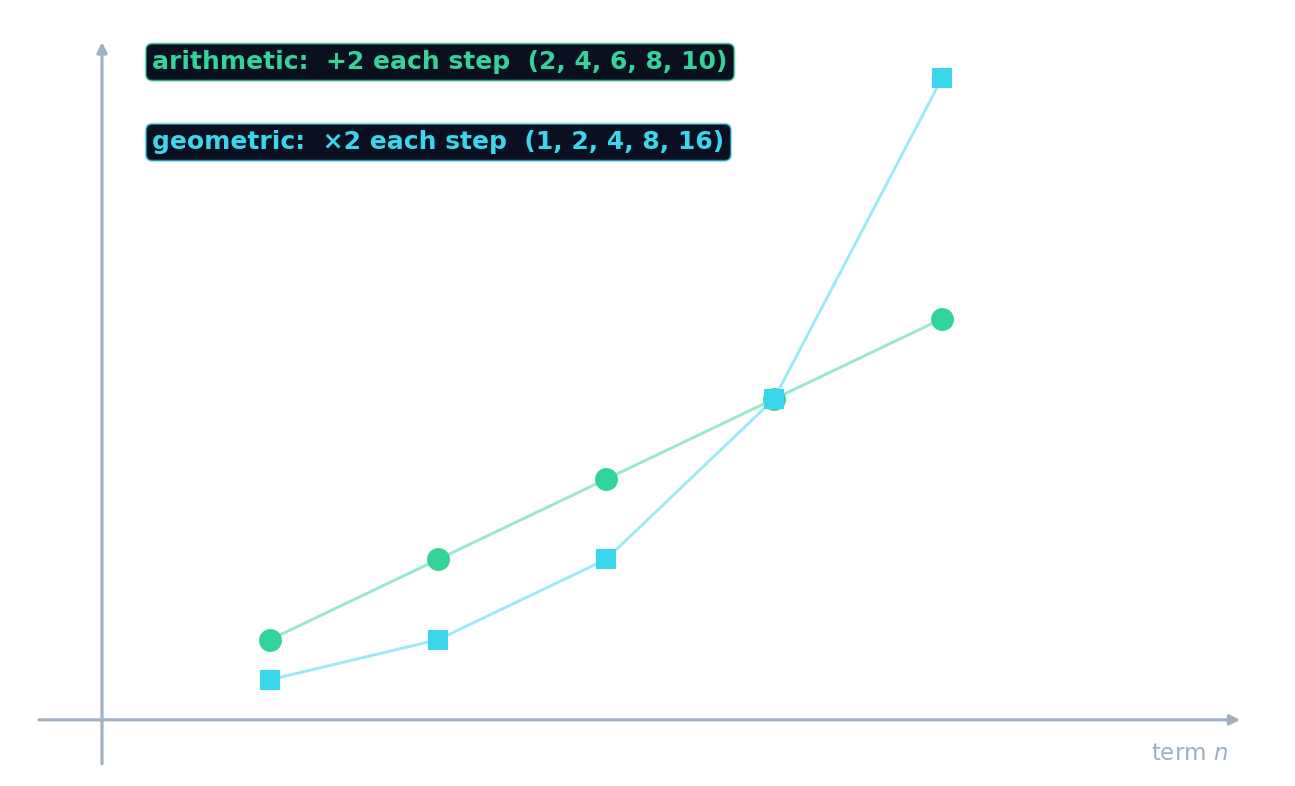
- The pictured rules are $a_n=2+2(n-1)$ and $g_n=2^{n-1}$. At term 5 their values are 10 and 16. A finite picture illustrates the difference; it does not prove an eventual-growth statement.
- With a positive geometric starting value and $r>1$, geometric growth eventually exceeds any fixed arithmetic rule. The positive-start condition matters: a start of $-1$ with ratio 2 gives $-1,-2,-4,\dots$, not positive growth. A zero start stays zero.
Compare the pictured sequences
Arithmetic starts at 2 and adds 2; geometric starts at 1 and doubles. At term 5 the values are 10 and 16. Test which assumptions make growth positive.
Select all true statements about these sequences.
Difficulty 2/5 · 140 coins + a small bonus on first completion today
Sequences may start at different values. The eventual-growth statement needs a positive geometric starting value and a ratio greater than 1.
Every geometric sequence with ratio 2 eventually becomes positive.
Difficulty 1/5 · 100 coins + a small bonus on first completion today
A negative starting term stays negative when multiplied by 2; a zero starting term stays zero. The starting value matters.
Check whether a list adds or multiplies before naming it. $2,4,6,8$ adds 2, but $2,4,8,16$ multiplies by 2. Their first two terms agree, so test a third term. Always state the starting index and value.
Find the 6th term of $4,12,36,\dots$, with the first term numbered 1.
- The ratio is $12\div4=3$. The explicit rule is $g_n=4\cdot3^{n-1}$.
- Six terms require five changes: $g_6=4\cdot3^5=4\cdot243=972$. A matching recursive rule is $g_1=4$, then $g_n=3g_{n-1}$ for $n\ge2$.
Arithmetic means a constant difference; geometric means a constant multiplier. An explicit rule uses the term index. A recursive rule needs both a starting value and an update. State the sign and ratio conditions before claiming geometric growth eventually overtakes an arithmetic sequence.
Continue a second geometric pattern
- A new sequence starts $5,10,20,40,\dots$, with the first term numbered 1. Find its fifth term and give a recursive rule with its starting value.
- Show the multiplier you used. Keep this new sequence separate from $3,6,12,24,\dots$; the starting value is different.
A geometric sequence starts 5, 10, 20, 40, with its first term numbered 1. Find the fifth term and give a recursive rule with its starting value.
40 times 2 is 80.
A geometric sequence begins 5, 10, 20, 40. What is its fifth term?
Difficulty 1/5 · 100 coins + a small bonus on first completion today
One more doubling gives 80. Other options — 48 (the lesson later term); 40 (the fourth term).