Resistive Forces
Introduced| English | Meaning |
|---|---|
| resistive force/rɪˈzɪstɪv fɔːs/ | A force opposing an object’s motion relative to its surroundings, such as fluid drag; its value depends on the stated resistance model. |
| terminal velocity/ˈtɜːmɪnl vəˈlɒsɪti/ | A constant falling velocity reached when weight is balanced by resistance. |
| differential equation/ˌdɪfəˈrenʃl ɪˈkweɪʒn/ | An equation involving a function and one or more of its derivatives. |
Why a skydiver stops speeding up
- Jump from a plane and you accelerate — but not forever.
- Air pushes back harder the faster you fall, until it exactly balances gravity.
- From then on you fall at a steady, top speed.
- Understanding this needs a force that grows with velocity — and a little calculus.
A resistive force
- A resistive force 阻力 (air resistance, drag) opposes motion through a fluid.
- Unlike friction, it grows with speed — move faster and it fights back harder.
- At rest there is no drag at all; at high speed it can be huge.
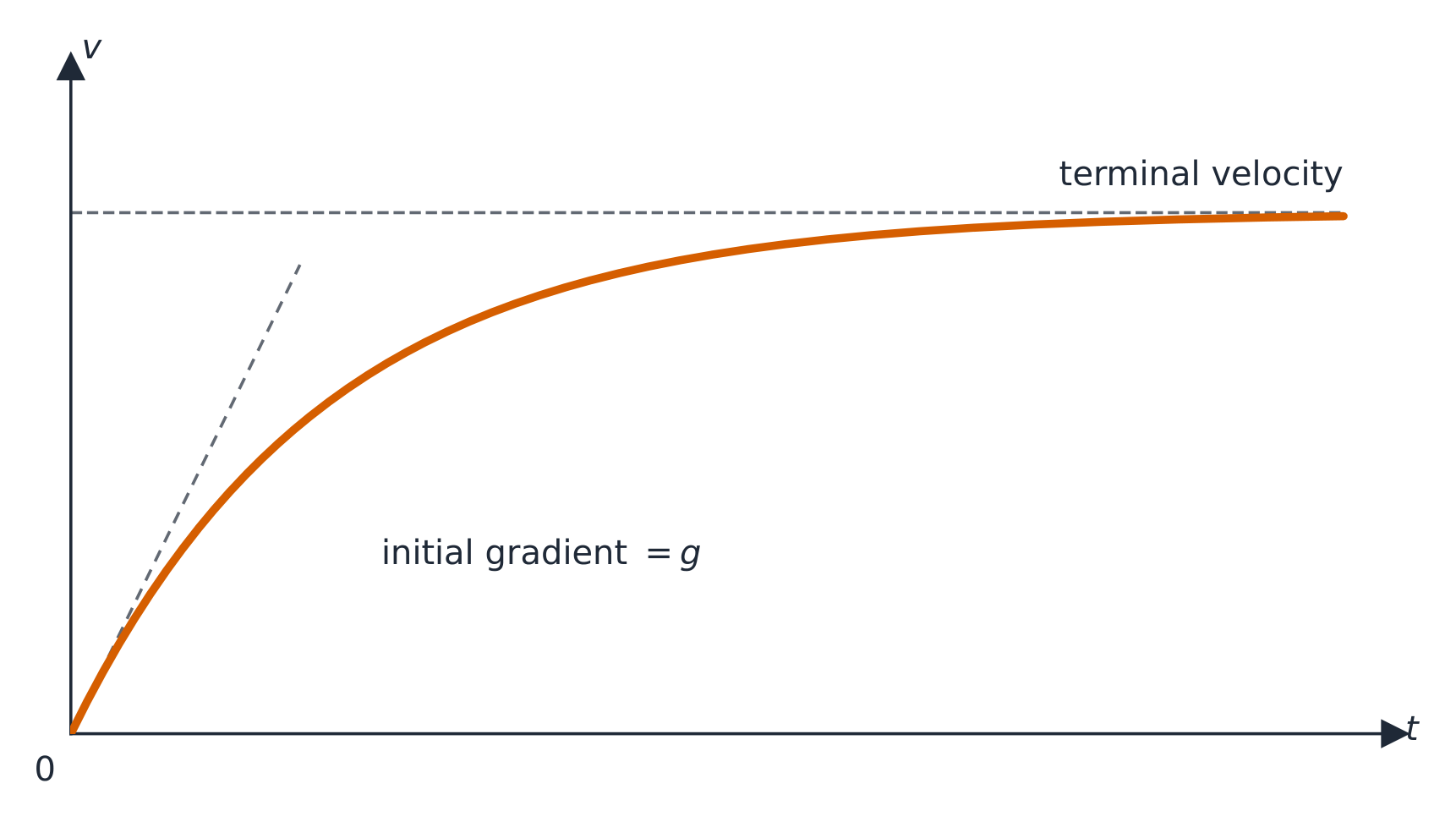
An object falling through a fluid speeds up to a terminal velocity 终极速度
A resistive force grows larger as the object moves faster.
Difficulty 1/5 · 100 coins + a small bonus on first completion today
Unlike ordinary friction, drag increases with speed -- that is why it can eventually balance gravity.
Modeling the drag
- We often model drag as proportional to speed, $F = -bv$, or to speed squared, $F = -cv^2$.
- The minus sign means it always points against the motion.
- Applying $\sum F = ma$ gives a differential equation 微分方程 for the velocity.
Applying Newton's second law to a velocity-dependent drag gives a ____ equation for v(t).
Difficulty 1/5 · 100 coins + a small bonus on first completion today
$m\,dv/dt = mg - bv$ is a differential equation, solved to find how v approaches terminal velocity.
Terminal velocity
- As you speed up, drag grows until it balances the driving force (gravity).
- Then the net force is zero, acceleration stops, and speed levels off.
- That steady top speed is the terminal velocity.
Resistive forces and terminal velocity
As a falling body speeds up, drag grows until it balances weight and the body stops accelerating.
At terminal velocity, the object's acceleration is...
Difficulty 1/5 · 100 coins + a small bonus on first completion today
Drag has grown to cancel gravity, so the net force -- and the acceleration -- is zero.
Approaching the limit
- Solving $m\dfrac{dv}{dt} = mg - bv$ shows $v$ rising smoothly toward $v_t = mg/b$.
- It gets ever closer but never quite exceeds it.
- That is why a skydiver's speed flattens out instead of climbing without limit.
An object of weight $mg = 60\ \text{N}$ falls with drag $F = -bv$ where $b = 3\ \tfrac{\text{kg}}{\text{s}}$. Find its terminal velocity (in m/s).
Difficulty 2/5 · 140 coins + a small bonus on first completion today
At terminal velocity $mg = bv_t$, so $v_t = 60/3 = 20\ \tfrac{\text{m}}{\text{s}}$.
Select all true statements about terminal velocity.
Difficulty 2/5 · 140 coins + a small bonus on first completion today
Drag acts the whole way down. Terminal velocity is just where it has grown enough to cancel gravity.
With the same drag coefficient $b$, a heavier object has a terminal velocity that is...
Difficulty 1/5 · 100 coins + a small bonus on first completion today
$v_t = mg/b$ grows with mass, so a heavier object falls faster at the top speed.
A falling object of mass $m$ feels drag $F = -bv$.
- Terminal velocity is where $\dfrac{dv}{dt} = 0$, so $mg = b v_t$.
- Solving, $v_t = \dfrac{mg}{b}$ — heavier objects or weaker drag mean a higher top speed.
Terminal velocity is not the moment drag appears — drag acts the whole way down. It is the special speed where drag has grown enough to cancel gravity. Below it, you are still accelerating (just less and less).
A resistive force grows with speed ($F = -bv$ or $-cv^2$), so $\sum F = ma$ becomes a differential equation. As speed rises, drag builds until it cancels gravity — the net force hits zero at the terminal velocity $v_t = mg/b$, which the object approaches smoothly but never exceeds.
Write from a drag of 30 N at terminal speed
- A 3 kg skydiver has reached terminal speed. Use g = 10.
- Find the drag force.
A 3 kg skydiver has reached terminal speed. Use g = 10 N/kg. What is the drag force then?
3 times 10 is 30, and that upward drag cancels the weight.
What is the drag at terminal speed?
Difficulty 1/5 · 100 coins + a small bonus on first completion today
Steady speed means drag balances the 30 N weight. Other options — 20 N (the lesson figure); 0 (because the speed is steady).