Circular Motion
Introduced| English | Meaning |
|---|---|
| uniform circular motion/ˈjuːnɪfɔːm ˈsɜːkjʊlə ˈməʊʃn/ | uniform circular motion |
| centripetal force/senˈtrɪpɪtl fɔːs/ | The resultant force towards the centre of a circular path. |
| centripetal acceleration/senˈtrɪpɪtl əkˌseləˈreɪʃn/ | The acceleration towards the centre of a circular path, caused by the changing direction of velocity. |
| tangential/tænˈdʒenʃl/ | Directed along the tangent to a curve or circular path at a particular point. |
Cut the string and it flies straight
- Whirl a ball on a string in a circle, then suddenly let go.
- It does not curve outward — it shoots off in a straight line, along the tangent.
- So something was constantly bending its path inward.
- That inward pull is the secret of all circular motion.
Uniform circular motion
- In uniform circular motion 匀速圆周运动 the speed is constant.
- But the direction keeps changing — so the velocity changes, which means the object is accelerating.
- An object can move at steady speed and still be accelerating, as long as it turns.
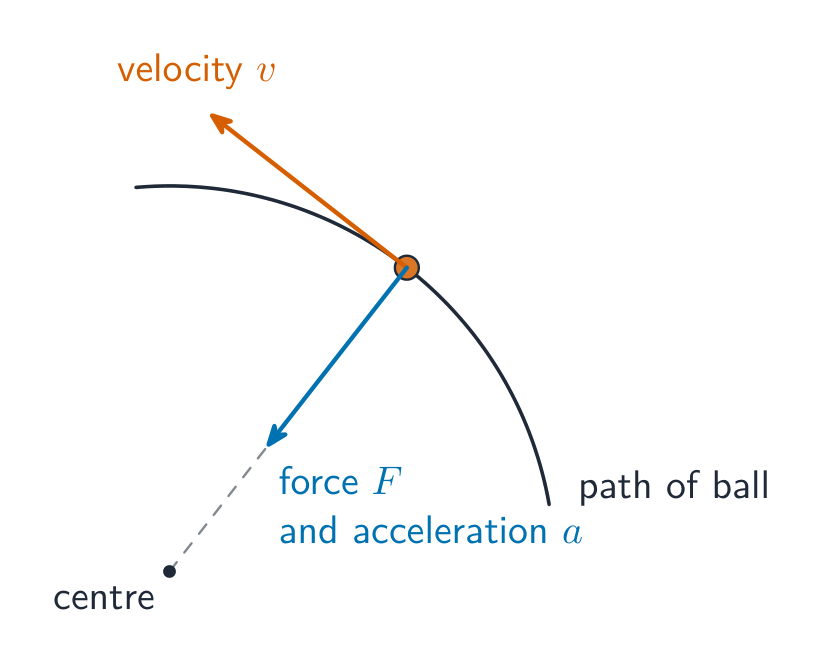
The velocity points along the tangent; the centripetal force 向心力 points to the centre
An object moving in a circle at constant speed is accelerating.
Difficulty 1/5 · 100 coins + a small bonus on first completion today
Its direction changes, so its velocity changes -- that is an acceleration, even at constant speed.
Centripetal acceleration
- The acceleration in a circle is the centripetal acceleration 向心加速度:
- It always points toward the center of the circle.
- Faster motion or a tighter circle (smaller $r$) means a larger inward acceleration.
A car rounds a curve of radius $50\ \text{m}$ at $10\ \tfrac{\text{m}}{\text{s}}$. What is its centripetal acceleration (in $\tfrac{\text{m}}{\text{s}^2}$)?
Difficulty 2/5 · 140 coins + a small bonus on first completion today
$a_c = v^2/r = 100/50 = 2\ \tfrac{\text{m}}{\text{s}^2}$, directed toward the center.
The centripetal acceleration points...
Difficulty 1/5 · 100 coins + a small bonus on first completion today
"Centripetal" means center-seeking -- always toward the center of the circle.
Centripetal force
- By $\sum F = ma$, that inward acceleration needs an inward centripetal force:
- This is not a new kind of force — it is a role filled by tension, gravity, friction, or a normal force.
- Identify which real force points toward the center; that force is the centripetal force.
What provides the centripetal force?
Uniform circular motion needs a net force toward the centre. Match each case to its source.
For a car turning on a flat road, what provides the centripetal force?
Difficulty 1/5 · 100 coins + a small bonus on first completion today
Friction points inward and supplies the centripetal force -- which is why a slippery road makes cars skid outward.
The centripetal force is not a new force -- it is a ____ filled by a real force like tension or gravity.
Difficulty 1/5 · 100 coins + a small bonus on first completion today
Always identify which real inward force is acting; that force is the centripetal force.
A $2\ \text{kg}$ ball swings on a string in a circle of radius $1\ \text{m}$ at $3\ \tfrac{\text{m}}{\text{s}}$. What tension is needed (in N)?
Difficulty 2/5 · 140 coins + a small bonus on first completion today
$F_c = mv^2/r = (2 \times 9)/1 = 18\ \text{N}$, pointing toward the center.
When the speed also changes
- If the object also speeds up or slows down, the force has two parts.
- A tangential 切向 component changes the speed (along the motion).
- The radial (centripetal) component still bends the path inward.
A $0.5\ \text{kg}$ ball on a string swings in a circle of radius $2\ \text{m}$ at $4\ \tfrac{\text{m}}{\text{s}}$.
- Centripetal acceleration: $a_c = \dfrac{v^2}{r} = \dfrac{16}{2} = 8\ \tfrac{\text{m}}{\text{s}^2}$.
- Tension needed: $F_c = \dfrac{mv^2}{r} = \dfrac{0.5 \times 16}{2} = 4\ \text{N}$, pointing inward.
There is no outward "centrifugal force" pushing the ball out. The only real force is the inward tension. The outward feeling comes from your body's inertia trying to go straight — cut the string and the ball proves it by flying off tangent, not outward.
In uniform circular motion, speed is constant but the object still accelerates — the centripetal acceleration $a_c = v^2/r$ points to the center. A real inward force fills the centripetal force role $F_c = mv^2/r$ (tension, gravity, friction...). If the speed also changes, add a tangential component.
Write from a centripetal acceleration of 12
- Speed is 6 m/s on a circle of radius 3 m.
- Find the centripetal acceleration.
An object moves at 6 m/s around a circle of radius 3 m. What is its centripetal acceleration, in m/s squared, and which way does it point?
36 divided by 3 is 12.
What is the centripetal acceleration?
Difficulty 1/5 · 100 coins + a small bonus on first completion today
Speed squared over radius is 36 divided by 3.