Spring Forces
Introduced| English | Meaning |
|---|---|
| Hooke's law/hʊks lɔː/ | The rule that extension is proportional to applied force while a spring remains within its limit of proportionality. |
| displacement/dɪˈspleɪsmənt/ | The straight-line change in position, including direction. |
| spring constant/sprɪŋ ˈkɒnstənt/ | The force required per unit extension of a spring in its linear range. |
| restoring force/rɪˈstɔːrɪŋ fɔːs/ | A force acting towards an object's equilibrium position after displacement. |
| in parallel/ɪn ˈpærəlel/ | in parallel |
| in series/ɪn ˈsɪəriːz/ | in series |
The more you stretch, the harder it pulls
- Pull a spring a little and it tugs back gently; pull it twice as far and it tugs back twice as hard.
- Let go and it snaps toward its rest position every time.
- This tidy, proportional push-back is what makes springs so predictable.
- It is also the recipe for every oscillation in physics.
Hooke's law
- Hooke's law 胡克定律 describes an ideal spring:
- The force is proportional to how far the spring is stretched or squeezed.
- The minus sign says the force always points back toward equilibrium.
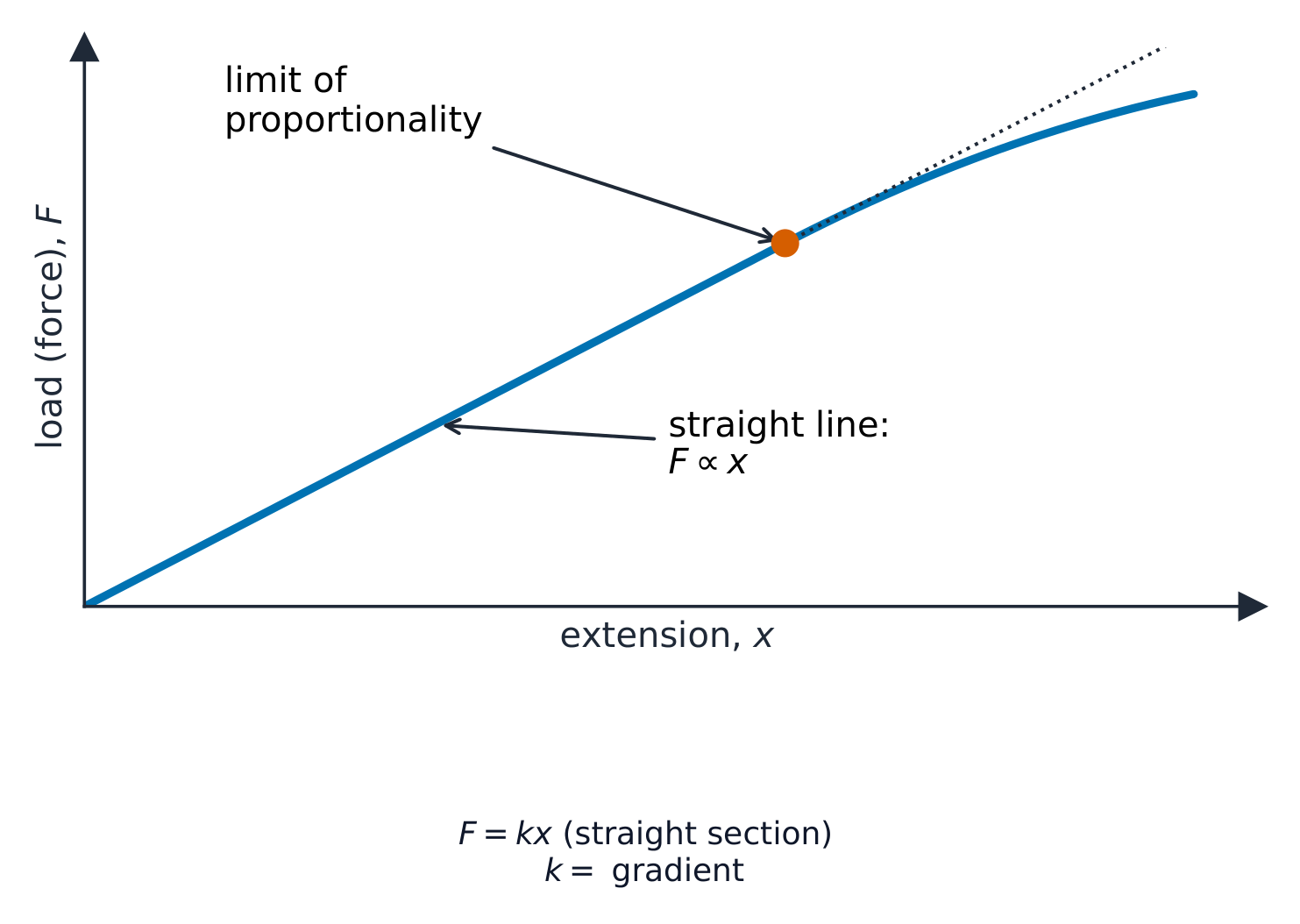
Hooke's law: extension is proportional to load up to the limit of proportionality
Select all true statements about an ideal spring.
Difficulty 2/5 · 140 coins + a small bonus on first completion today
The first two are Hooke's law. The third is backwards -- a stiffer spring has a larger $k$.
Stiffness and displacement
- The spring constant 弹簧劲度系数 $k$ measures stiffness — a bigger $k$ is a harder spring.
- The displacement 位移 $x$ is measured from the spring's natural rest length.
- On a graph of force versus displacement, $k$ is simply the slope.
Hooke's law: F = -kx
Increase the force and watch the spring stretch in proportion -- the slope is the spring constant k.
A $6\ \text{N}$ force stretches a spring by $0.30\ \text{m}$. What is its spring constant (in N/m)?
Difficulty 2/5 · 140 coins + a small bonus on first completion today
$k = F/x = 6/0.30 = 20\ \tfrac{\text{N}}{\text{m}}$.
On a force-versus-displacement graph, the spring constant is the ____ of the line.
Difficulty 1/5 · 100 coins + a small bonus on first completion today
Since $F = kx$ (magnitude), the graph is a straight line whose slope is $k$.
A restoring force
- Because it always points back to the middle, the spring force is a restoring force 回复力.
- Stretch right → it pulls left; compress left → it pushes right.
- That constant "return to center" is exactly what drives a mass on a spring to oscillate.
You stretch a spring to the right. The spring force points...
Difficulty 1/5 · 100 coins + a small bonus on first completion today
A restoring force always opposes the displacement -- stretch right, it pulls left.
The minus sign in $F_s = -kx$ shows that the spring force opposes the displacement.
Difficulty 1/5 · 100 coins + a small bonus on first completion today
Yes -- the sign encodes the "restoring" direction, always back toward equilibrium.
Combining springs
- Springs in parallel 并联 (side by side) act stiffer: $k_{eq} = k_1 + k_2$.
- Springs in series 串联 (end to end) act softer: $\dfrac{1}{k_{eq}} = \dfrac{1}{k_1} + \dfrac{1}{k_2}$.
- It is the exact opposite of how resistors combine.
Two identical springs of $k = 100\ \tfrac{\text{N}}{\text{m}}$ are placed in parallel. What is the equivalent spring constant (in N/m)?
Difficulty 2/5 · 140 coins + a small bonus on first completion today
Parallel springs add, giving $k_{eq} = 100 + 100 = 200\ \tfrac{\text{N}}{\text{m}}$ -- stiffer together.
A spring stretches $0.20\ \text{m}$ when a $10\ \text{N}$ force pulls it.
- Spring constant: $k = \dfrac{F}{x} = \dfrac{10}{0.20} = 50\ \tfrac{\text{N}}{\text{m}}$.
- Stretch it twice as far ($0.40\ \text{m}$) and it pulls back with $20\ \text{N}$ — always toward its rest position.
The minus sign in $F_s = -kx$ is not decoration — it encodes the direction. The spring force is never in the direction you pulled; it always opposes the displacement. Drop the sign and you lose the whole "restoring" idea.
Hooke's law: $F_s = -kx$ — a spring's force is proportional to its displacement and always points back to equilibrium (a restoring force). The spring constant $k$ is its stiffness (the slope of $F$ vs $x$). Parallel springs add stiffness; series springs soften.
Write from a spring constant of 40
- An 8 N force stretches a spring by 0.20 m.
- Find the spring constant.
A force of 8 N stretches a spring by 0.20 m. What is the spring constant, in N/m, and which way does the spring force point?
8 divided by 0.20 is 40.
What is the spring constant?
Difficulty 1/5 · 100 coins + a small bonus on first completion today
Force divided by extension is 8 divided by 0.20. Other options — 20 N/m (the lesson spring); 8 N/m (the force used as k).