Motion in Two or Three Dimensions
Introduced| English | Meaning |
|---|---|
| independent/ˌɪndɪˈpendənt/ | Describing quantities, events or choices that do not depend on one another in the relationship being considered. |
| projectile motion/prəˈdʒektaɪl ˈməʊʃn/ | The motion of an object launched into the air and then moving under gravity, with air resistance neglected in an ideal model. |
A thrown ball does two things at once
- Throw a ball forward and it sails ahead and falls to the ground.
- Amazingly, these two motions do not interfere — they happen side by side.
- Drop one ball and throw another horizontally: they hit the floor at the same time.
- Splitting motion into independent directions is the key to two dimensions.
Components are independent
- Horizontal and vertical motion are independent 独立的 — each obeys its own equations.
- Gravity pulls only down, so it changes the vertical motion but not the horizontal.
- Solve each direction as its own 1-D problem, then combine.
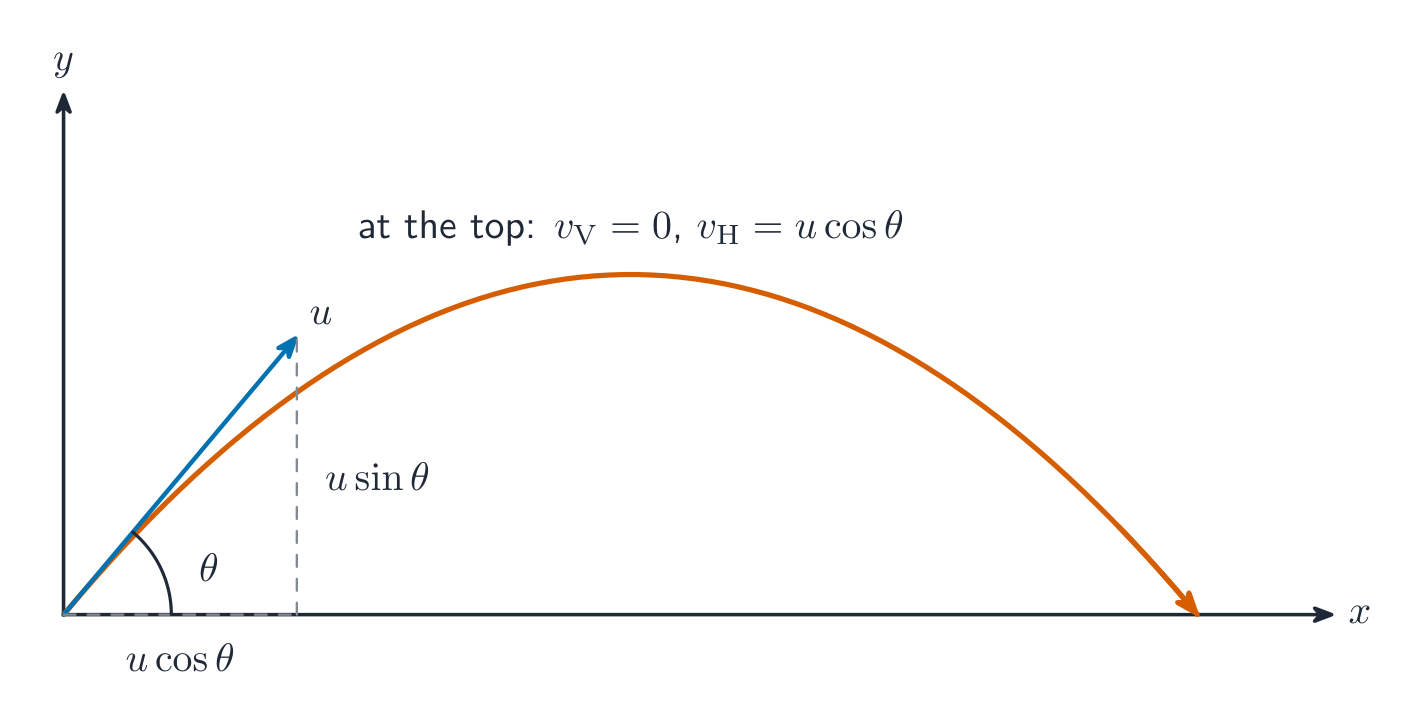
A projectile launched at an angle: the horizontal and vertical motions are independent
A ball dropped from a height and one thrown horizontally from the same height hit the ground at the same time.
Difficulty 1/5 · 100 coins + a small bonus on first completion today
Horizontal and vertical motion are independent -- both have the same vertical drop, so the same fall time.
Projectile motion
- Projectile motion 抛体运动 is the classic case: constant horizontal velocity, constant downward acceleration $g$.
- Horizontally: $x = v_x t$ (no acceleration).
- Vertically: it accelerates just like a dropped object.
A ball is thrown horizontally from a $5\ \text{m}$ table ($g = 10$). How long until it lands (in s)?
Difficulty 2/5 · 140 coins + a small bonus on first completion today
Looking at the vertical direction, $5 = \tfrac{1}{2}(10)t^2$, so $t^2 = 1$ and $t = 1\ \text{s}$. The horizontal speed does not matter for the time.
During projectile flight (ignoring air resistance), the horizontal velocity...
Difficulty 1/5 · 100 coins + a small bonus on first completion today
Gravity acts only vertically, so there is no horizontal acceleration -- $v_x$ is constant.
Vector kinematics
- In 2-D and 3-D, position, velocity, and acceleration are all vectors: $\vec{r}$, $\vec{v}$, $\vec{a}$.
- Each component follows the same calculus chain, $x \to v_x \to a_x$.
- The full motion is just several 1-D motions bundled together.
Motion in two dimensions
Launch a projectile and see the horizontal and vertical motions play out independently.
The horizontal and vertical parts of a projectile's motion share only the ____.
Difficulty 1/5 · 100 coins + a small bonus on first completion today
Time is the only shared variable; otherwise each direction is solved on its own.
Putting it together
- Find the time from one direction (often the vertical), then use it in the other.
- The horizontal range depends on both the launch speed and how long the projectile is in the air.
- Recombine the component velocities to get the true speed and direction.
From that $5\ \text{m}$ table, the ball's horizontal speed is $4\ \tfrac{\text{m}}{\text{s}}$. How far from the base does it land (in m)?
Difficulty 2/5 · 140 coins + a small bonus on first completion today
Using $t = 1\ \text{s}$ from before, $x = v_x t = 4 \times 1 = 4\ \text{m}$.
Select all true statements about projectile motion.
Difficulty 2/5 · 140 coins + a small bonus on first completion today
The two directions are independent -- constant $v_x$, downward $g$ -- and do not affect each other.
A ball is thrown horizontally at $5\ \tfrac{\text{m}}{\text{s}}$ from a $20\ \text{m}$ cliff ($g = 10$).
- Vertical: $20 = \tfrac{1}{2}gt^2$ gives $t = 2\ \text{s}$ to land.
- Horizontal: $x = v_x t = 5 \times 2 = 10\ \text{m}$ from the base.
The horizontal and vertical parts share only time. Do not mix a horizontal velocity into a vertical equation. The vertical motion decides when it lands; the horizontal motion decides how far — keep them in separate columns.
In two dimensions, horizontal and vertical motion are independent and share only the time. Projectile motion has constant horizontal velocity and downward acceleration $g$. Treat $\vec{r}$, $\vec{v}$, $\vec{a}$ component by component — each is its own 1-D problem, then recombine.
Write from a flight time of 2 s and a range of 12 m
- A ball is thrown horizontally from a 20 m cliff. Use g = 10.
- The horizontal speed is 6 m/s. Find the time of flight and the range.
A ball is thrown horizontally at 6 m/s from a 20 m cliff. Use g = 10 m/s squared. How long is it in the air, and how far from the cliff does it land?
Half of 10 is 5, and 20 divided by 5 is 4, so t is 2. Then 6 times 2 is 12.
How far from the cliff does the ball land?
Difficulty 1/5 · 100 coins + a small bonus on first completion today
The ball is airborne for 2 s at 6 m/s horizontally. Other options — 4 m (the lesson range); 20 m (the height of the cliff).