Scalars and Vectors
Introduced| English | Meaning |
|---|---|
| scalar/ˈskeɪlə/ | A quantity described by magnitude alone, with no direction. |
| vector/ˈvektə/ | A quantity with both magnitude and direction. |
| magnitude/ˈmæɡnɪtjuːd/ | The size or numerical value of a quantity. |
| components/kəmˈpəʊnənts/ | The parts of a vector resolved along specified directions. |
"Go 5 km" — but which way?
- Tell a friend to "walk 5 km" and they could end up anywhere on a circle around you.
- Say "walk 5 km north" and there is exactly one destination.
- Some quantities need only a size; others need a direction too.
- Sorting them out is the first step in all of mechanics.
Scalars and vectors
- A scalar 标量 has only a size (magnitude) — like temperature or time.
- A vector 矢量 has a size and a direction — like a push or a velocity.
- Getting the type right changes how you add them.
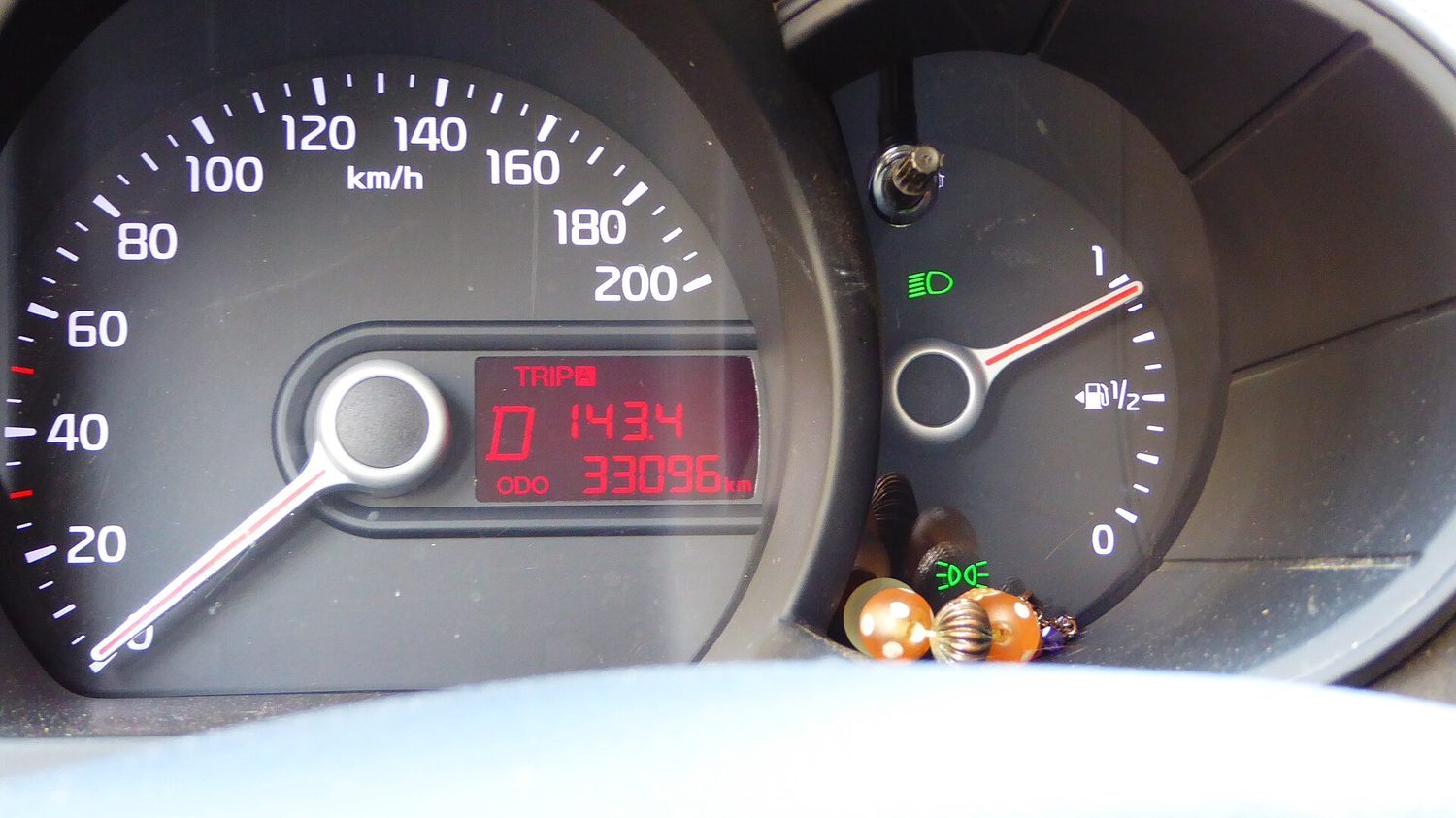
A car speedometer: speed is the magnitude of velocity— a scalar rate of motion
A quantity with both a size and a direction is called a ____.
Difficulty 1/5 · 100 coins + a small bonus on first completion today
A vector has magnitude and direction; a scalar has only magnitude.
Which is which
- Scalars: distance, speed, mass, energy, time.
- Vectors: displacement, velocity, acceleration, force, momentum.
- The vector twin of a scalar carries the extra "which way" information.
Scalar or vector?
Sort each quantity by whether it needs a direction.
Which of these is a vector?
Difficulty 1/5 · 100 coins + a small bonus on first completion today
Velocity has a size and a direction, so it is a vector. Temperature, mass, and time are scalars.
Select all scalars.
Difficulty 2/5 · 140 coins + a small bonus on first completion today
Speed and energy are scalars (size only). Force and displacement are vectors.
Adding vectors
- Vectors add tip-to-tail, not just by numbers.
- The easiest method: break each into components 分量 along the axes, then add the components.
- Two forces of $3\ \text{N}$ can sum to anything from $0$ to $6\ \text{N}$, depending on their directions.
You walk $9\ \text{km}$ east then $12\ \text{km}$ north. How far are you from the start (in km)?
Difficulty 2/5 · 140 coins + a small bonus on first completion today
The displacement magnitude is $\sqrt{9^2 + 12^2} = \sqrt{225} = 15\ \text{km}$ -- not $21$.
Two $4\ \text{N}$ forces always add up to $8\ \text{N}$.
Difficulty 1/5 · 100 coins + a small bonus on first completion today
Only if they point the same way. At right angles they give $\sqrt{4^2+4^2} \approx 5.7\ \text{N}$; opposite, $0$.
Magnitude and direction
- From components $(A_x, A_y)$, the magnitude 大小 is $|\vec{A}| = \sqrt{A_x^2 + A_y^2}$.
- The direction is the angle $\theta = \tan^{-1}(A_y/A_x)$.
- Components and magnitude-angle are just two languages for the same vector.
A vector has components $A_x = 6$, $A_y = 8$. What is its magnitude?
Difficulty 2/5 · 140 coins + a small bonus on first completion today
$|\vec{A}| = \sqrt{6^2 + 8^2} = \sqrt{100} = 10$.
A vector has components $A_x = 3$, $A_y = 4$.
- Magnitude: $|\vec{A}| = \sqrt{3^2 + 4^2} = \sqrt{25} = 5$.
- Direction: $\theta = \tan^{-1}(4/3) \approx 53^\circ$ above the x-axis.
You cannot add vectors like plain numbers. Walking $3\ \text{km}$ east then $4\ \text{km}$ north leaves you $5\ \text{km}$ away — not $7$. Only when two vectors point the same way do their magnitudes simply add.
A scalar has size only; a vector has size and direction. Add vectors by components ($A_x$, $A_y$), then recover the magnitude $\sqrt{A_x^2 + A_y^2}$ and angle. Distance and speed are scalars; displacement, velocity, and force are vectors.
Write from a displacement of 17 km
- Walk 8 km east and then 15 km north.
- Find the straight-line displacement.
You walk 8 km east and then 15 km north. How far are you from the start, in km?
8-15-17 is a right triangle. 64 plus 225 is 289.
What is the displacement from the start?
Difficulty 1/5 · 100 coins + a small bonus on first completion today
The straight-line result of 8 east and 15 north is 17 km. Other options — 23 km (the path length); 15 km (the lesson displacement).