Profit-Maximizing Behavior in Competitive Factor Markets
Introduced| English | Meaning |
|---|---|
| perfectly competitive factor market/ˈpɜːfektlɪ kəmˈpetɪtɪv ˈfæktə ˈmɑːkɪt/ | An input market with many buyers and sellers in which individual participants take the input price as given. |
| wage taker/weɪdʒ ˈteɪkə/ | An employer or worker too small relative to a competitive labour market to influence its prevailing wage. |
| cost-minimizing rule/kɒst ˈmɪnɪmaɪzɪŋ ruːl/ | Produce a given output using the least costly feasible input combination; at an interior optimum, marginal product per unit of expenditure is equal across inputs. |
Hiring when you're one of many
- Imagine thousands of firms all hiring the same kind of worker.
- No single firm is big enough to change the going wage.
- Each simply pays the market wage and decides how many to hire.
- This is a perfectly competitive factor market 完全竞争要素市场.
A wage taker hires where MRP = W
- Each firm is a wage taker 工资接受者 — it can hire all it wants at the market wage.
- So its marginal factor cost is constant and equal to the wage, $W$.
- The hiring rule simplifies to $MRP = W$.
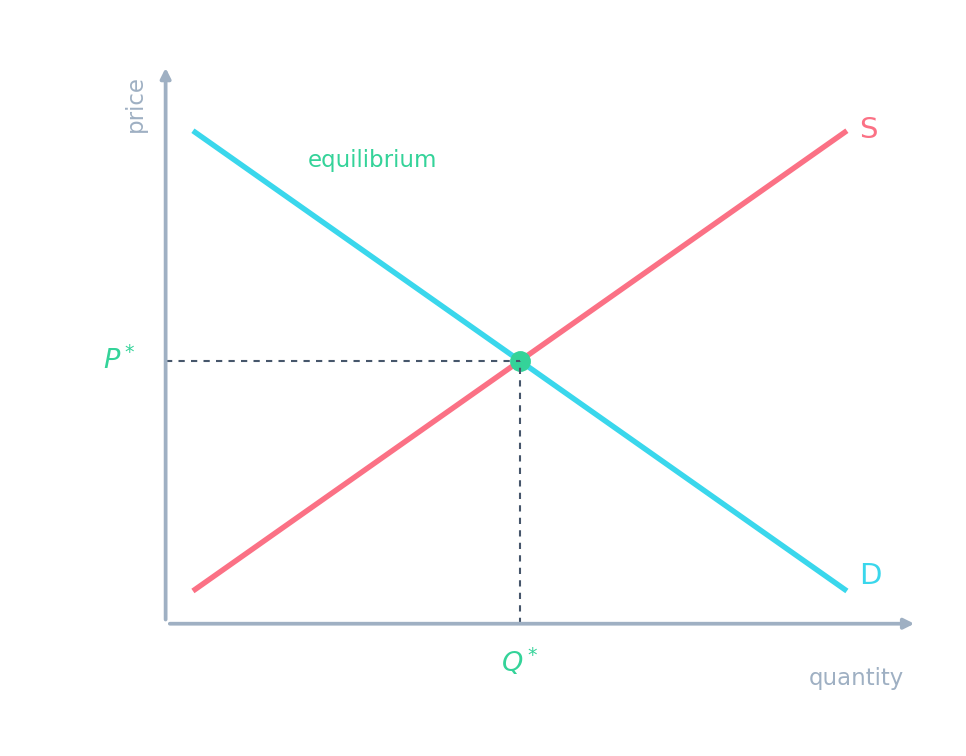
The labour market
In a competitive factor market the wage is set by market supply and demand; each firm takes that wage and hires where its MRP meets it.
A firm in a competitive factor market is a wage taker, so its marginal factor cost is:
Difficulty 1/5 · 100 coins + a small bonus on first completion today
It can hire any number at the market wage, so each extra worker costs exactly that wage.
In a competitive factor market the hiring rule simplifies to MRP = ______.
Difficulty 1/5 · 100 coins + a small bonus on first completion today
Since MFC equals the wage W, the firm hires where MRP = W.
A single wage-taking firm can lower the market wage by hiring fewer workers.
Difficulty 1/5 · 100 coins + a small bonus on first completion today
It is too small to affect the market wage — it simply takes the going wage.
The cost-minimizing rule
- When a firm uses several inputs, it should spend its budget so the last dollar on each brings the same extra output.
- The cost-minimizing rule 成本最小化法则: $\dfrac{MP_L}{P_L} = \dfrac{MP_K}{P_K}$.
- If one input gives more output per dollar, shift spending toward it until the ratios equalise.
The cost-minimizing combination of inputs sets:
Difficulty 1/5 · 100 coins + a small bonus on first completion today
Equalising MP/P across inputs means the last dollar buys the same extra output everywhere.
A worked case
- Labour costs 20 with a marginal product of 40, so $MP_L/P_L = 40/20 = 2$ units per dollar.
- Capital costs 10 with a marginal product of 30, so $MP_K/P_K = 30/10 = 3$ units per dollar.
- Capital gives more output per dollar, so use more capital and less labour until the ratios meet.
- That balance gives the chosen output at the lowest total cost.
Capital costs 10 with a marginal product of 30. What is its marginal product per dollar (MP/P)?
Difficulty 2/5 · 140 coins + a small bonus on first completion today
MP_K/P_K = 30/10 = 3 units per dollar — more than labour's 2, so use more capital.
Labour gives 2 units per dollar and capital gives 3. To cut costs, the firm should use:
Difficulty 1/5 · 100 coins + a small bonus on first completion today
Capital gives more output per dollar, so shift toward it until MP/P equalises.
In a perfectly competitive factor market each firm is a wage taker and hires where $MRP = W$. With several inputs, follow the cost-minimizing rule $\dfrac{MP_L}{P_L} = \dfrac{MP_K}{P_K}$ — shift toward whichever input gives more output per dollar.
Write from 3 units per dollar of labour
- Labour has marginal product 24 and costs 8.
- Capital has marginal product 18 and costs 9.
Labour has marginal product 24 and costs 8. Capital has marginal product 18 and costs 9. What is each input's marginal product per dollar, and which should the firm use more of?
24 divided by 8 is 3, and 18 divided by 9 is 2.
Which input gives more output per dollar?
Difficulty 1/5 · 100 coins + a small bonus on first completion today
3 is greater than 2, so the next dollar should buy labour.