Monopsonistic Markets
Introduced| English | Meaning |
|---|---|
| monopsony/məˈnɒpsəni/ | A market with a single buyer of a good, service or factor of production. |
| marginal factor cost/ˈmɑːdʒɪnl ˈfæktə kɒst/ | The additional total cost of employing one more unit of an input. |
| supply curve/səˈplaɪ kɜːv/ | A graph showing the quantity suppliers are willing and able to sell at different prices, other conditions unchanged. |
| minimum wage/ˈmɪnɪməm weɪdʒ/ | The lowest wage rate that an employer is legally permitted to pay covered workers. |
The only employer in town
- One factory in a small town, and it is the only place hiring.
- Workers have nowhere else to go — so who holds the power now?
- This is the mirror image of a monopoly: a single buyer of labour.
- It is called a monopsony 买方垄断.
A monopsony is a factor market with:
Difficulty 1/5 · 100 coins + a small bonus on first completion today
It is the mirror image of a monopoly — one buyer instead of one seller.
Marginal factor cost above the wage
- Because the monopsonist is the whole market, to hire more it must raise the wage — and pay it to every worker, not just the last.
- So the marginal factor cost 边际要素成本 of one more worker is above the wage on the supply curve.
- This mirrors a monopolist, whose marginal revenue is below its price.
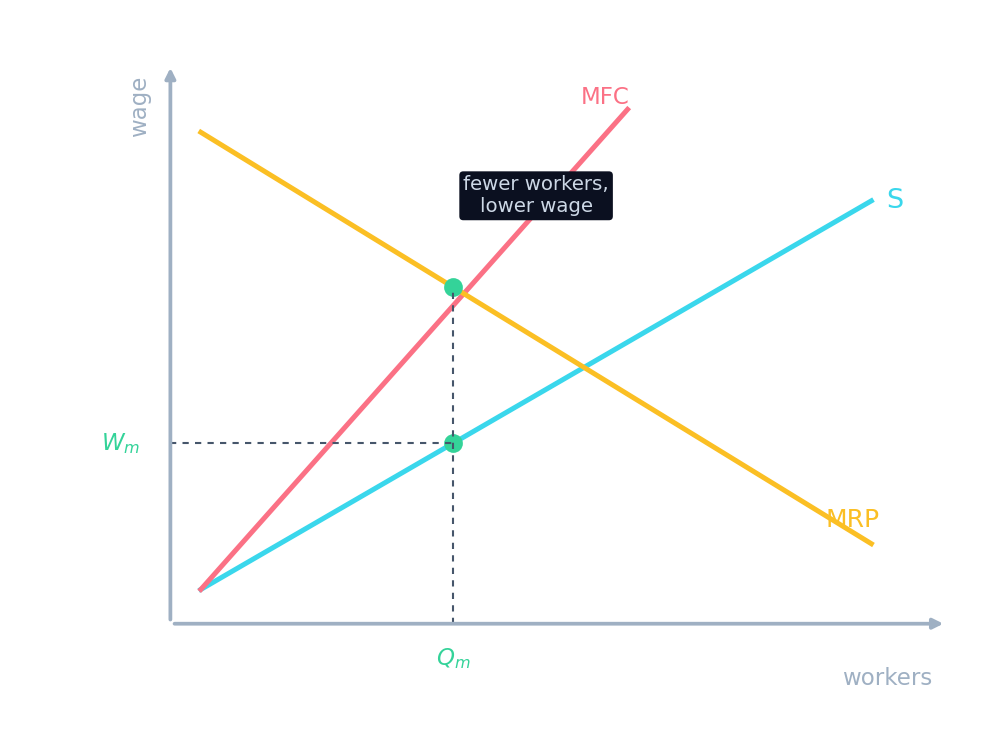
For a monopsony, the marginal factor cost of one more worker is above the wage on the supply curve.
Difficulty 1/5 · 100 coins + a small bonus on first completion today
To hire one more it must raise the wage for every worker, so MFC exceeds the wage.
Fewer workers, lower wage
- The monopsonist still hires where $MRP = MFC$, then reads the wage off the supply curve 供给曲线 at that quantity.
- The result: it hires fewer workers than a competitive market, and pays a lower wage.
- That is why a monopsony is inefficient — workers are paid less than the value they add.
Competitive vs monopsony
A monopsony's marginal factor cost lies above the supply wage, so it hires fewer workers at a lower wage than a competitive market would.
Compared with a competitive factor market, a monopsony:
Difficulty 1/5 · 100 coins + a small bonus on first completion today
It hires where MRP = MFC but pays the lower wage off supply — fewer workers, lower pay.
A monopsonist chooses its quantity where MRP equals ______, then reads the wage off supply.
Difficulty 1/5 · 100 coins + a small bonus on first completion today
MRP = MFC gives the quantity; the wage comes from the supply curve, which is lower.
Match each market to what it pays workers.
Difficulty 2/5 · 140 coins + a small bonus on first completion today
Competition pays the MRP; a monopsony pays less, which is why it is inefficient.
The minimum-wage twist
- In a competitive market, a minimum wage 最低工资 above equilibrium causes unemployment.
- But in a monopsony, a well-set minimum wage removes the employer's power to push the wage down.
- So it can raise both the wage and the number employed at the same time — a surprising result.
In a monopsony, a well-set minimum wage can:
Difficulty 1/5 · 100 coins + a small bonus on first completion today
It removes the employer's power to hold the wage down, so wage and employment can both rise.
A monopsony is a single buyer of labour, so its marginal factor cost lies above the supply-curve wage. It hires where $MRP = MFC$ but pays the lower wage off supply — fewer workers, lower wage. A well-set minimum wage can raise both wage and employment.
Write from a monopsony hire of 60
- A competitive labour market would hire 80 workers at a wage of 25.
- The only employer hires 60 and pays 18.
A competitive labour market would hire 80 workers at wage 25. The town's only employer hires 60 and pays 18. What does the monopsony comparison show?
60 is below 80, and 18 is below 25.
What does the monopsony do?
Difficulty 1/5 · 100 coins + a small bonus on first completion today
The single buyer restricts hiring to 60 and pays 18.