Monopoly
Introduced| English | Meaning |
|---|---|
| monopoly/məˈnɒpəli/ | A market structure in which a single seller supplies a good or service with no close substitutes. |
| price maker/praɪs ˈmeɪkə/ | A firm with enough market power to choose a price along its demand curve, rather than accepting a single market price. |
| marginal revenue/ˈmɑːdʒɪnl ˈrevənjuː/ | The additional total revenue obtained from selling one extra unit of output. |
| deadweight loss/ˈdedweɪt lɒs/ | The loss of total economic surplus when a market produces an inefficient quantity. |
| allocatively inefficient/ˈæləkətɪvli ɪnɪˈfɪʃənt/ | Describing an allocation where changing output could increase total social benefit net of social cost. |
| natural monopoly/ˈnætʃərəl məˈnɒpəli/ | A market in which one firm can supply total demand at a lower average cost than competing firms could. |
The only game in town
- One water company. One railway. One patent-holding drug maker.
- When a firm is the sole seller of something with no close substitute, the rules change.
- It no longer takes the price — it makes it.
- That is a monopoly 垄断.
A price maker with MR below price
- A monopoly is a price maker 价格制定者 — it chooses the price by choosing how much to produce.
- To sell one more unit, it must lower the price on every unit.
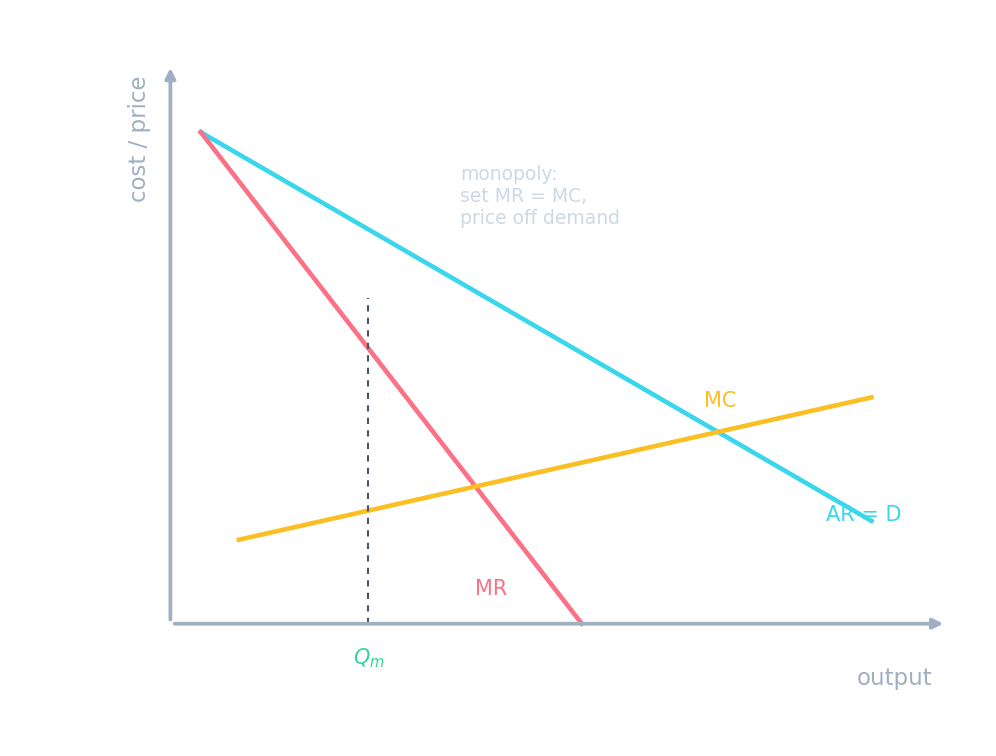
- So its marginal revenue 边际收入 is less than the price — the MR curve lies below demand.
Extra sales and the price cut on earlier units
Separate extra-unit receipts from the revenue lost on earlier units. Distinguish interval MR from the point derivative.
A monopoly is a price maker, which means it:
Difficulty 1/5 · 100 coins + a small bonus on first completion today
With no rivals, the monopolist picks the point on the demand curve that maximises profit.
For a monopoly, marginal revenue is below the price because it must cut the price on every unit to sell more.
Difficulty 1/5 · 100 coins + a small bonus on first completion today
Lowering the price on all units makes the extra revenue (MR) smaller than the price.
Find the monopoly outcome
- The monopolist still obeys the rule: produce where $MR = MC$ to get $Q_M$.
- Then go up to the demand curve to read the price $P_M$.
- Because $P_M > MC$, the last unit is worth more to buyers than it costs to make — but the monopolist won't make it.
- Those lost trades are the deadweight loss 无谓损失, so a monopoly is allocatively inefficient 配置无效率.
The firm's cost curves
A monopolist still produces where marginal revenue meets marginal cost — but then charges a higher price off its downward-sloping demand.
Demand is P = 100 − Q, so MR = 100 − 2Q. With MC = 20, what is the monopoly quantity where MR = MC?
Difficulty 2/5 · 140 coins + a small bonus on first completion today
Set 100 − 2Q = 20 → 2Q = 80 → Q = 40.
Using the same demand P = 100 − Q, what price does the monopolist charge at Q = 40?
Difficulty 2/5 · 140 coins + a small bonus on first completion today
Read the price off demand: P = 100 − 40 = 60. Since 60 > MC = 20, there is a deadweight loss.
A monopoly is allocatively inefficient because at its output:
Difficulty 1/5 · 100 coins + a small bonus on first completion today
P > MC means the last unit is worth more than it costs, yet it is not made — a deadweight loss.
Natural monopoly
- A natural monopoly 自然垄断 has such large fixed costs (a water or power network) that one firm serves the whole market at lower average cost than two could.
- Here, competition would waste resources by duplicating the network.
A market best served by one firm because of huge fixed costs is a ______ monopoly.
Difficulty 1/5 · 100 coins + a small bonus on first completion today
A natural monopoly (like a water network) has one firm serve everyone at lower average cost.
Worked examples
1. A monopolist faces $P = 100 - 2Q$, so $MR = 100 - 4Q$, and $MC = 20$. Set $MR = MC$: $100 - 4Q = 20$, so $Q = 20$ and, from the demand curve, $P = 100 - 2 \times 20 = 60$. With constant $ATC = 20$, profit $= (60 - 20) \times 20 = 800$.
2. A competitive market would produce where $P = MC$: $100 - 2Q = 20$, so $Q = 40$. Deadweight loss is the triangle $\tfrac12 \times (40 - 20) \times (60 - 20) = 400$.
Demand is P = 50 minus Q, so marginal revenue is 50 minus 2Q. Marginal cost is 10. What quantity and price does a single-price monopoly choose?
40 divided by 2 is 20, and 50 minus 20 is 30.
What price does the monopolist charge?
Difficulty 1/5 · 100 coins + a small bonus on first completion today
Quantity 20 on the demand curve gives price 30. Other options — 60 (the lesson monopoly price); 10 (the marginal cost).
A monopoly is the sole seller and a price maker, with marginal revenue below price. It sets $Q_M$ where $MR = MC$, then charges $P_M$ off the demand curve. Because $P_M > MC$ it is allocatively inefficient — a deadweight loss. A natural monopoly is cheapest served by one firm.
Write from a monopoly quantity of 20
- Demand is P = 50 minus Q, so marginal revenue is 50 minus 2Q.
- Marginal cost is 10. Find quantity and price.