Price Discrimination
Introduced| English | Meaning |
|---|---|
| price discrimination/praɪs dɪˌskrɪmɪˈneɪʃn/ | Charging different buyers different prices for the same product for reasons not explained by corresponding differences in cost. |
| market power/ˈmɑːkɪt ˈpaʊə/ | The ability of a seller or buyer to influence market prices or trading conditions. |
| willingness to pay/ˈwɪlɪŋnəs tə peɪ/ | The maximum amount a buyer would give up to obtain a specified unit of a good or service. |
| resale/ˈriːseɪl/ | Selling again an item that has already been purchased. |
| perfect price discrimination/ˈpɜːfekt praɪs dɪˌskrɪmɪˈneɪʃn/ | Charging each buyer their maximum willingness to pay for each unit, rather than a single price for all units. |
| first-degree/fɜːst dɪˈɡriː/ | Describing perfect price discrimination, in which each unit is sold at the buyer's maximum willingness to pay. |
| allocatively efficient/ˈæləkətɪvli ɪˈfɪʃənt/ | Describing an output level where marginal social benefit equals marginal social cost, so resources are directed to their most valued uses. |
| consumer surplus/kənˈsuːmə ˈsɜːpləs/ | The difference between what buyers are willing to pay and what they actually pay, summed across purchases. |
| producer surplus/prəˈdjuːsə ˈsɜːpləs/ | The amount sellers receive above the minimum they would accept for the units sold; in the standard supply model, revenue minus variable cost. |
Same seat, different prices
- The person next to you on the plane may have paid half what you did.
- Students, seniors, and early bookers all get their own price.
- This is no accident — it is a deliberate strategy to squeeze out more profit.
- It is called price discrimination 价格歧视.
Price discrimination means:
Difficulty 1/5 · 100 coins + a small bonus on first completion today
It bases each buyer's price on their willingness to pay.
Three conditions
- The firm needs market power 市场势力 — it must be a price maker.
- It must sort buyers by their willingness to pay 支付意愿.
- It must prevent resale 转售, so cheap buyers cannot resell to expensive ones.
- Miss any one condition and price discrimination falls apart.
Can the firm price-discriminate?
Price discrimination needs market power, sortable buyers, and no resale. If any condition fails, one price must be charged.
Select all conditions needed for price discrimination.
Difficulty 2/5 · 140 coins + a small bonus on first completion today
Market power, sortable buyers, and no resale — perfect competition rules it out.
If buyers can freely resell the good to one another, price discrimination breaks down.
Difficulty 1/5 · 100 coins + a small bonus on first completion today
Cheap buyers would resell to expensive ones, undercutting the firm's scheme.
Perfect price discrimination
- In perfect price discrimination 完全价格歧视 (also first-degree 一级), the firm charges each buyer their exact maximum willingness to pay.
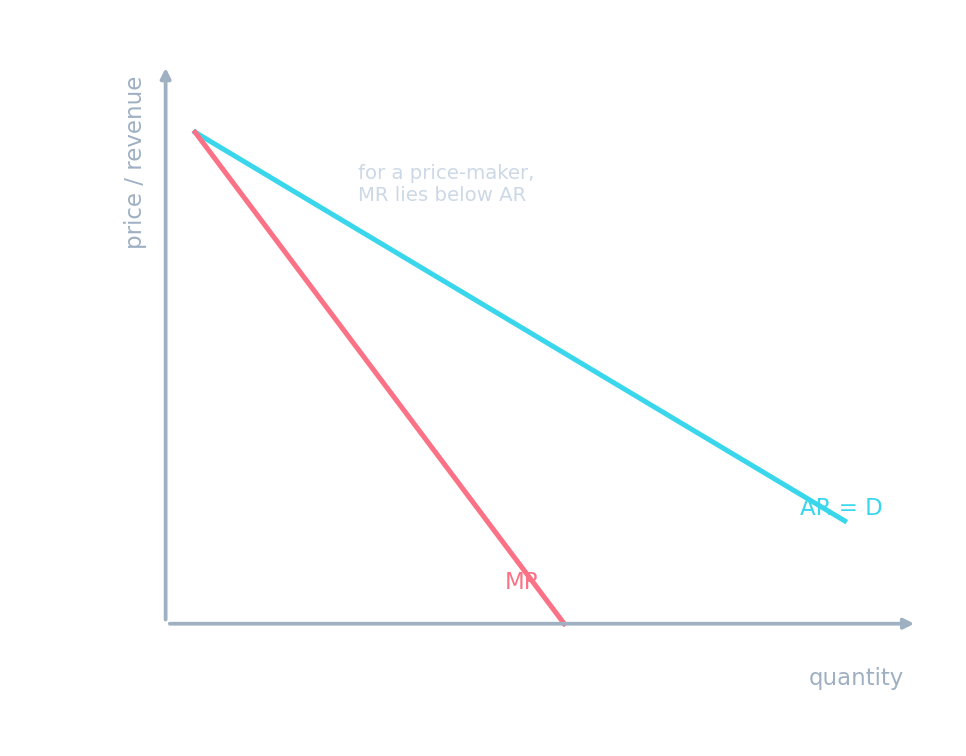
- Now no price cut on earlier units is needed, so the demand curve becomes the marginal-revenue curve.
- The firm keeps selling until $P = MC$ — the allocatively efficient 配置有效率 quantity, with no deadweight loss.
Demand is P = 100 − Q and MC = 20. A perfect price discriminator sells until P = MC. What quantity does it produce?
Difficulty 2/5 · 140 coins + a small bonus on first completion today
Set 100 − Q = 20 → Q = 80 — the efficient quantity, double the single-price monopoly's 40.
Because it produces where P = MC, perfect price discrimination has no ______ loss.
Difficulty 1/5 · 100 coins + a small bonus on first completion today
It reaches the allocatively efficient quantity — the same as perfect competition.
Who gets the surplus
- The efficiency is real, but the welfare split is brutal.
- All consumer surplus 消费者剩余 is captured by the firm.
- Producer surplus 生产者剩余 swells to include the entire gains-from-trade triangle.
Under perfect price discrimination, consumer surplus is:
Difficulty 1/5 · 100 coins + a small bonus on first completion today
The firm charges each buyer their maximum willingness to pay, so no consumer surplus is left.
Price discrimination charges different buyers different prices; it needs market power, sortable willingness to pay, and no resale. Perfect price discrimination reaches the efficient $P = MC$ quantity with no deadweight loss — but the firm captures all the consumer surplus.
Write from a discriminating quantity of 40
- Demand is P = 50 minus Q and marginal cost is 10.
- A perfect price discriminator sells until price equals marginal cost.
Demand is P = 50 minus Q and marginal cost is 10. What quantity does a perfect price discriminator sell?
50 minus 10 is 40.
What quantity does the perfect price discriminator sell?
Difficulty 1/5 · 100 coins + a small bonus on first completion today
50 minus 10 is 40, where price meets marginal cost. Other options — 20 (the single-price quantity on this demand); 80 (the lesson discriminator).