Introduction to Imperfectly Competitive Markets
Introduced| English | Meaning |
|---|---|
| market power/ˈmɑːkɪt ˈpaʊə/ | The ability of a seller or buyer to influence market prices or trading conditions. |
| imperfectly competitive market/ɪmˈpɜːfektlɪ kəmˈpetɪtɪv ˈmɑːkɪt/ | A market in which at least some participants have market power rather than all firms taking price as given. |
| price taker/praɪs ˈteɪkə/ | A producer or consumer that must accept the prevailing market price because its own actions cannot materially influence it. |
| downward-sloping demand curve/ˈdaʊnwəd ˈsləʊpɪŋ dɪˈmænd kɜːv/ | A demand curve showing that a larger quantity is demanded at a lower price, other conditions held constant. |
| monopoly/məˈnɒpəli/ | A market structure in which a single seller supplies a good or service with no close substitutes. |
| monopolistic competition/məˈnɒpəlɪstɪk ˌkɒmpəˈtɪʃn/ | A market structure with many firms offering differentiated products and relatively easy entry and exit. |
| oligopoly/ˌɒlɪˈɡɒpəli/ | A market dominated by a small number of interdependent large firms. |
| monopsony/məˈnɒpsəni/ | A market with a single buyer of a good, service or factor of production. |
| barriers to entry/ˈbærɪəz tʊ ˈentri/ | Obstacles that make it difficult for new firms to enter a market. |
| economic profit/ˌiːkəˈnɒmɪk ˈprɒfɪt/ | Total revenue minus all economic costs, including explicit payments and the opportunity costs of owned resources. |
Most markets aren't "perfect"
- Perfect competition is a useful benchmark — but almost no real market matches it.
- Your phone network, favourite cafe, and local cinema all set their own prices.
- Any firm that can nudge its price has some market power 市场势力.
- The markets where this happens are called imperfectly competitive markets 不完全竞争市场.
Market power means a downward demand curve
- A price taker 价格接受者 faces a flat demand curve — it sells all it wants at the market price.
- An imperfect competitor faces a downward-sloping demand curve 向下倾斜的需求曲线 — to sell more, it must lower its price.
- That is exactly what market power is: the ability to set price above marginal cost.
A firm with market power faces a demand curve that is:
Difficulty 1/5 · 100 coins + a small bonus on first completion today
To sell more it must lower its price — a downward-sloping demand curve.
A price taker can raise its price above the market price and still sell everything.
Difficulty 1/5 · 100 coins + a small bonus on first completion today
A price taker must accept the market price; charging more loses all its buyers.
Four imperfect structures
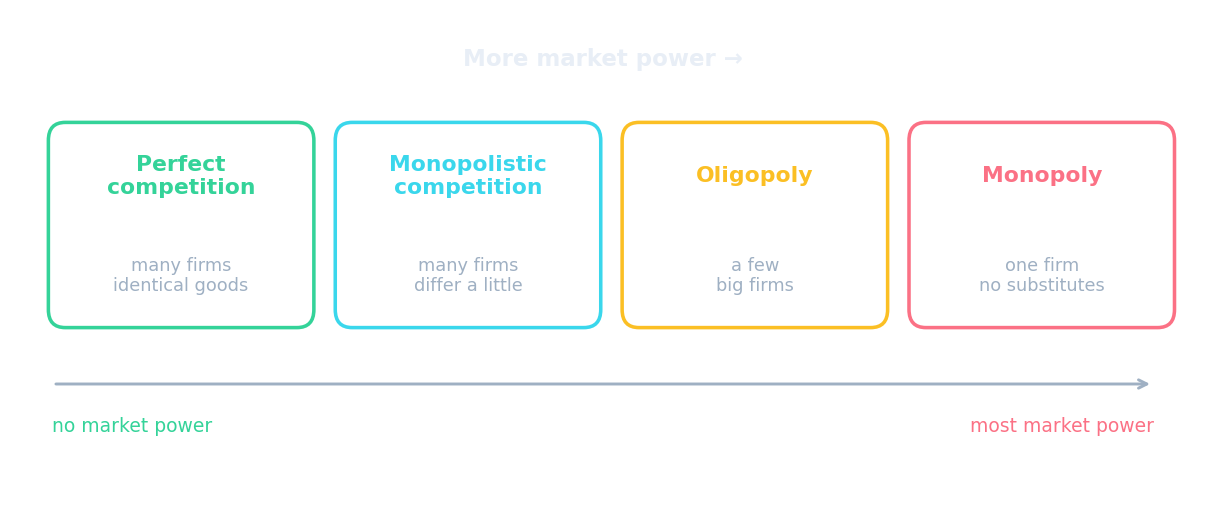
- Monopoly 垄断: one firm, no close substitutes.
- Oligopoly 寡头垄断: a few large firms that watch each other.
- Monopolistic competition 垄断竞争: many firms selling slightly different products.
- Monopsony 买方垄断: one big buyer — the mirror image of monopoly.
Which market structure?
Structures differ by how many firms there are and how similar their products are — from perfect competition to monopoly.
Match each structure to its defining feature.
Difficulty 2/5 · 140 coins + a small bonus on first completion today
They differ by number of firms, product similarity, and (for monopsony) being a buyer.
Barriers to entry
- What lets these firms keep economic profit 经济利润 even in the long run is barriers to entry 进入壁垒.
- A barrier is anything that stops new firms coming in to compete the profit away.
- Common barriers: large start-up costs, control of a key resource, patents, and government licences.
Anything that stops new firms from entering a market is a ______ to entry.
Difficulty 1/5 · 100 coins + a small bonus on first completion today
Barriers to entry protect economic profit in the long run.
Select all that are barriers to entry.
Difficulty 2/5 · 140 coins + a small bonus on first completion today
Patents, key resources and high start-up costs block entry; many competitors is the opposite.
An imperfectly competitive firm has market power — a downward-sloping demand curve and price above marginal cost. The four structures are monopoly, oligopoly, monopolistic competition, and monopsony. Barriers to entry protect their long-run profit.
Write from one water seller
- One firm sells all the town's water.
- Four large rivals set prices while watching each other.
One firm sells all the town's water. Four other large firms in a different market watch each other's prices. Name each market structure.
A single seller is a monopoly. A few interdependent sellers are an oligopoly.
What structure is the single water firm?
Difficulty 1/5 · 100 coins + a small bonus on first completion today
One seller of the town's water is a monopoly. Other options — An oligopoly (because water is a big industry); Perfect competition (because households buy water).