Supply
Introduced| English | Meaning |
|---|---|
| supply/səˈplaɪ/ | The quantity sellers are willing and able to offer at different prices over a specified period. |
| law of supply/lɔː ɒv səˈplaɪ/ | The tendency for quantity supplied to rise as price rises, with other relevant factors held constant. |
| quantity supplied/ˈkwɒntɪti səˈplaɪd/ | The amount sellers are willing and able to offer at a particular price over a specified period. |
| direct relationship/daɪˈrekt rɪˈleɪʃənʃɪp/ | A relationship in which two variables move in the same direction, other relevant factors held constant. |
| marginal cost/ˈmɑːdʒɪnl kɒst/ | The additional total cost of producing one more unit of output. |
| technology/tekˈnɒlədʒi/ | The application of knowledge, methods and tools to practical tasks. |
| inputs/ˈɪnpʊts/ | Resources or values used by a process to produce outputs. |
| subsidy/ˈsʌbsɪdi/ | Financial assistance, usually from government, that reduces costs or supports a particular activity. |
Why a higher price brings more sellers
- Offer more money for something, and more of it appears for sale.
- Farmers plant more, factories add a shift, sellers dig out old stock.
- Supply is the mirror image of demand — but it slopes the other way.
- It starts with the law of supply 供给定律.
The law of supply
- Supply 供给 is the whole relationship between price and how much sellers offer at each price.
- Quantity supplied 供给量 is the amount offered at one price.
- The law of supply: price up → quantity supplied up; price down → quantity supplied down. A direct relationship 正向关系.
- The curve slopes up because making extra units adds to marginal cost 边际成本 — a higher price is needed to cover it.
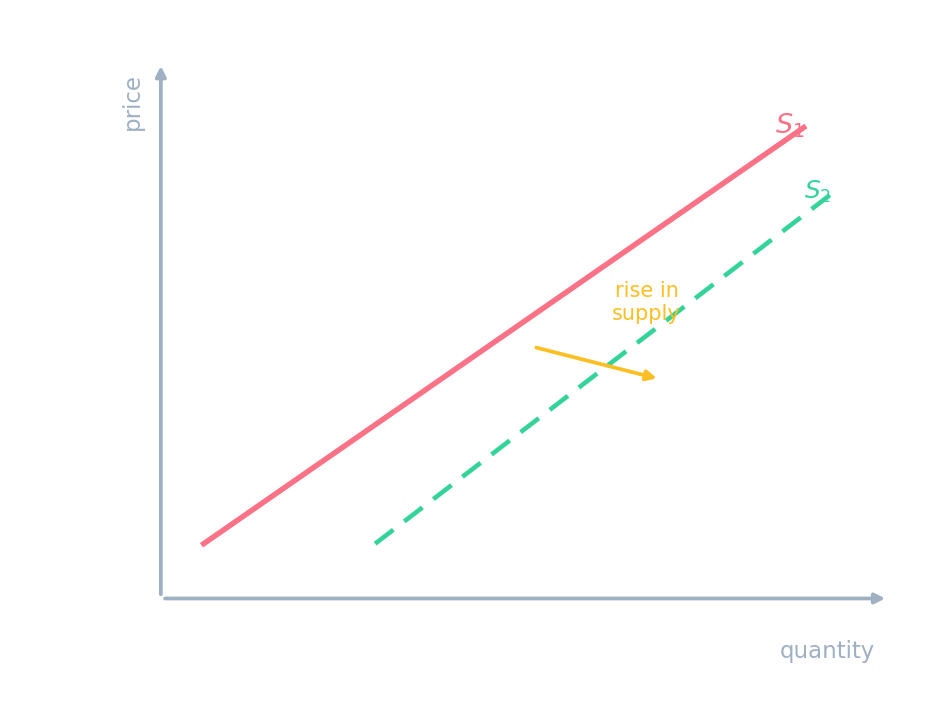
Supply and demand
The supply curve slopes up — a higher price draws out more. Cheaper inputs or better technology shift the whole curve right.
The law of supply says that, other things equal, when price rises the quantity supplied:
Difficulty 1/5 · 100 coins + a small bonus on first completion today
Price and quantity supplied move in the same direction — a direct relationship.
The supply curve slopes upward mainly because:
Difficulty 1/5 · 100 coins + a small bonus on first completion today
Each extra unit adds to marginal cost, so a higher price is needed to draw out more.
At a price of 6 dollars, Farm A offers 20 crates and Farm B offers 30 crates. What is the market quantity supplied at that price?
Difficulty 2/5 · 140 coins + a small bonus on first completion today
Market supply is horizontal summation: add quantities across sellers, $20 + 30 = 50$.
Movement vs shift
- A change in the good's own price → a movement along the supply curve.
- A change in anything else → a shift of the whole curve.
Same trap as demand: only the good's own price moves you along the curve. Costs, technology, or taxes shift it. Label your diagram carefully.
A fall in the price of raw materials causes a movement along the supply curve.
Difficulty 1/5 · 100 coins + a small bonus on first completion today
Input prices are not the good's own price — cheaper inputs shift the whole curve right.
What shifts supply — TITEN
- Technology 技术: better technology lowers cost → supply right.
- Input prices: cheaper inputs 投入 → supply right; dearer inputs → left.
- Taxes and subsidies 补贴: a tax on the seller shifts supply left; a subsidy shifts it right.
- Expectations of higher prices later → supply less now. Number of sellers rises → supply right.
A government payment of a fixed amount per unit to sellers is a ______, which shifts supply right.
Difficulty 1/5 · 100 coins + a small bonus on first completion today
A subsidy lowers sellers' costs, shifting the supply curve to the right.
Select all that shift the supply curve to the right (increase supply).
Difficulty 2/5 · 140 coins + a small bonus on first completion today
Technology, cheaper inputs and more sellers raise supply; a tax shifts it left.
Supply slopes up (the law of supply) because rising marginal cost needs a higher price. The good's own price = a movement along; any other factor (TITEN) = a shift of the whole curve.
Write from a market supply of 40
- At 9 dollars, farm C offers 15 crates and farm D offers 25 crates.
- Find market quantity supplied.
At a price of 9 dollars, farm C offers 15 crates and farm D offers 25 crates. What is the market quantity supplied?
15 plus 25 is 40.
What is the market quantity supplied at 9 dollars?
Difficulty 1/5 · 100 coins + a small bonus on first completion today
15 plus 25 is 40 crates. Other options — 50 crates (the lesson total); 9 crates (the price used as a quantity).