Price Elasticity of Demand
Introduced| English | Meaning |
|---|---|
| price elasticity of demand/praɪs ɪlæˈstɪsɪti ɒv dɪˈmænd/ | The percentage change in quantity demanded divided by the percentage change in price. |
| absolute value/ˈæbsəluːt ˈvæljuː/ | The non-negative magnitude of a number without its sign; often used when reporting price elasticity of demand. |
| midpoint method/ˈmɪdpɔɪnt ˈmeθəd/ | Calculating percentage changes using the average of the initial and final values as the base, so the result is independent of direction. |
| elastic/ɪˈlæstɪk/ | Describing demand or supply whose percentage response exceeds the percentage change in its determining price or income. |
| inelastic/ɪnɪˈlæstɪk/ | Describing demand or supply whose percentage response is smaller than the percentage change in its determining price or income. |
| unit elastic/ˈjuːnɪt ɪˈlæstɪk/ | Having an elasticity with absolute value one, so equal percentage changes in the relevant variables occur. |
| total revenue/ˈtəʊtl ˈrevənjuː/ | The total income received from selling goods or services before costs are deducted. |
Should the shop cut its price?
- Cut the price and you sell more — but each sale earns less.
- Sometimes the extra sales win; sometimes the lower price wins.
- Which one happens depends on how sensitive buyers are to price.
- That sensitivity has a name: price elasticity of demand 需求价格弹性 (PED).
Measuring PED
- PED answers: "if price changes by 1%, by what % does quantity demanded change?"
- Formula: $\text{PED} = \dfrac{\%\,\Delta\,\text{quantity demanded}}{\%\,\Delta\,\text{price}}$.
- Because price and quantity move in opposite directions, PED is negative — so we read its absolute value 绝对值.
- To get one clean answer, AP uses the midpoint method 中点法: divide each change by the average of the start and end values.
Price elasticity of demand is calculated as:
Difficulty 1/5 · 100 coins + a small bonus on first completion today
PED divides the percentage change in quantity by the percentage change in price.
Put the midpoint-method steps to find PED in order.
Difficulty 3/5 · 200 coins + a small bonus on first completion today
The midpoint method divides each change by the average of the two values, then you take |PED|.
Elastic, inelastic, or unit elastic
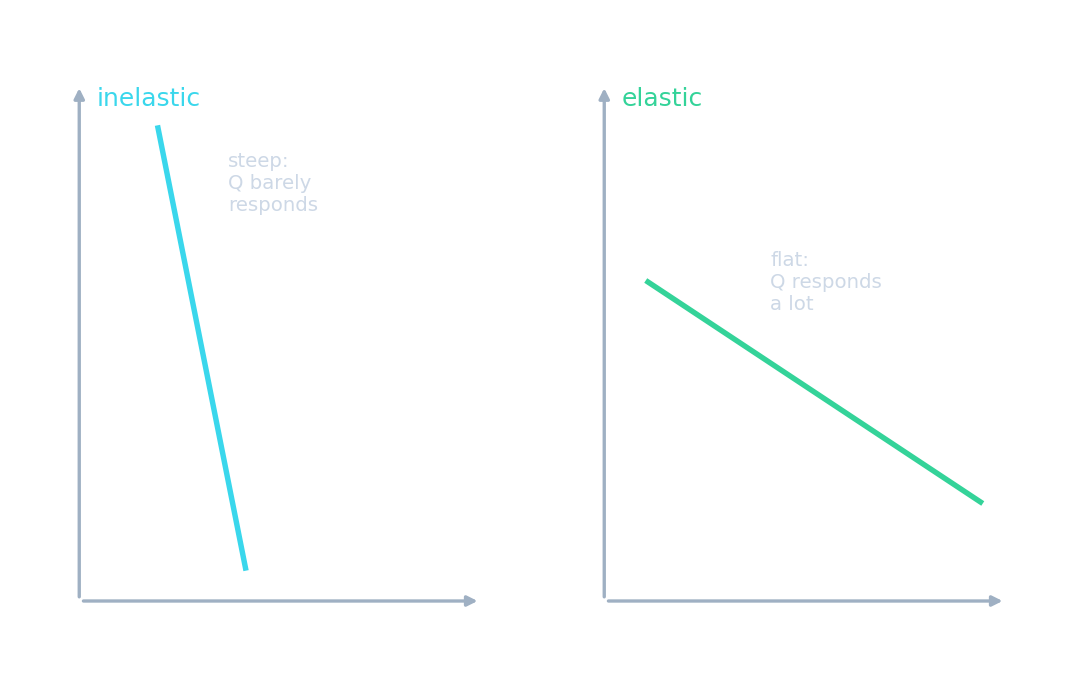
- Elastic 富有弹性: $|\text{PED}| > 1$ — quantity responds strongly (buyers are sensitive).
- Inelastic 缺乏弹性: $|\text{PED}| < 1$ — quantity barely responds.
- Unit elastic 单位弹性: $|\text{PED}| = 1$ — the two percentages are equal.
Price rises from 4 to 6; quantity demanded falls from 120 to 80. Using the midpoint method, what is |PED|?
Difficulty 2/5 · 140 coins + a small bonus on first completion today
%ΔQ = -40/100 = -0.40 and %ΔP = 2/5 = 0.40, so PED = -1 and |PED| = 1 (unit elastic).
When |PED| equals exactly 1, demand is said to be ______ elastic.
Difficulty 1/5 · 100 coins + a small bonus on first completion today
Unit elastic means the two percentage changes are equal; total revenue is at its maximum.
PED and total revenue
- Total revenue 总收入 is $\text{TR} = P \times Q$.
- The total revenue test: if demand is elastic, price and TR move in opposite directions (cut price → TR rises).
- If demand is inelastic, price and TR move in the same direction (raise price → TR rises).
- If demand is unit elastic, total revenue is at its maximum.
Demand for a good is inelastic. To raise total revenue, the firm should:
Difficulty 1/5 · 100 coins + a small bonus on first completion today
With inelastic demand, price and total revenue move together — raising price raises TR.
What makes demand elastic
- More substitutes available → more elastic (easy to switch away).
- A larger share of income spent on the good → more elastic.
- More time to adjust → more elastic in the long run.
Select all that make demand more elastic.
Difficulty 2/5 · 140 coins + a small bonus on first completion today
Substitutes, a big income share and more time raise elasticity; a necessity with no substitute is inelastic.
Worked examples
1. The price rises from 4 to 6 and quantity demanded falls from 100 to 80. Midpoint method: $\%\Delta Q = \dfrac{80-100}{90} = -22.2\%$ and $\%\Delta P = \dfrac{6-4}{5} = 40\%$, so $|\text{PED}| = \dfrac{22.2}{40} = 0.56$: inelastic.
2. Check with the total revenue test: TR rises from $4 \times 100 = 400$ to $6 \times 80 = 480$. With inelastic demand, price and TR move together.
Percentage responsiveness and total revenue
State the percentage base and compare both revenue totals. PED magnitude measures percentage responsiveness, not slope alone.
Price rises from 10 to 14 and quantity demanded falls from 90 to 60. Using the midpoint method, what is the absolute price elasticity of demand, and what happens to total revenue if price rises?
0.40 divided by one third is 1.2, which is above 1.
What is the absolute elasticity, and the revenue effect of a higher price?
Difficulty 1/5 · 100 coins + a small bonus on first completion today
0.40 divided by one third is 1.2, so the price rise cuts revenue.
PED = %ΔQ ÷ %ΔP (read as an absolute value, via the midpoint method). $|\text{PED}|>1$ is elastic, $<1$ inelastic, $=1$ unit elastic. The total revenue test: cut price when elastic, raise it when inelastic. More substitutes, a bigger income share, and more time all raise elasticity.
Write from a midpoint elasticity of 1.2
- Price rises from 10 to 14. Quantity demanded falls from 90 to 60.
- Find the absolute price elasticity with the midpoint method.