Scarcity
Introduced| English | Meaning |
|---|---|
| economics/ˌiːkəˈnɒmɪks/ | The study of choices about allocating scarce resources and of the production, distribution and consumption of goods and services. |
| scarcity/ˈskeəsɪti/ | The condition in which available resources are insufficient to satisfy all competing wants. |
| trade-off/treɪd ɒf/ | A choice that involves giving up some benefit or objective to gain another. |
| production possibilities curve/prəˈdʌkʃn ˌpɒsəˈbɪlɪtiz kɜːv/ | A curve showing the maximum attainable combinations of two outputs using given resources and technology efficiently. |
| efficient/ɪˈfɪʃənt/ | Using resources without avoidable waste, or allocating them to maximise the relevant net benefit. |
| opportunity cost/ɒpəˈtjuːnɪti kɒst/ | The value of the best alternative forgone when a choice is made. |
| margin/ˈmɑːdʒɪn/ | The point at which a decision involves a small additional unit or change rather than the entire activity. |
You can't have it all
- Imagine you have $20 and a food court full of things you want.
- Buy the noodles and you can't also buy the bubble tea and the dumplings.
- Every choice quietly closes off other choices.
- This simple fact — wanting more than you can have — is where all of economics starts.
Scarcity: limited resources, unlimited wants
- Scarcity 稀缺 means our wants are unlimited but our resources are limited.
- It applies to money, time, land, workers, and raw materials.
- Because of scarcity, we cannot produce or buy everything — we must choose.
- Even the richest person and the largest country face scarcity of some resource (often time).
Scarcity exists because...
Difficulty 1/5 · 100 coins + a small bonus on first completion today
Scarcity is the gap between unlimited wants and the limited resources available to satisfy them.
Only poor people and poor countries face scarcity.
Difficulty 1/5 · 100 coins + a small bonus on first completion today
Everyone faces scarcity of some resource — even the wealthy run short of time.
Scarcity forces a trade-off
- A country can use its resources to make different things — say food and phones.
- The production possibilities curve 生产可能性曲线 shows the most it can make of two goods.
- Points on the curve are efficient 有效率; points inside waste resources; points outside are impossible.
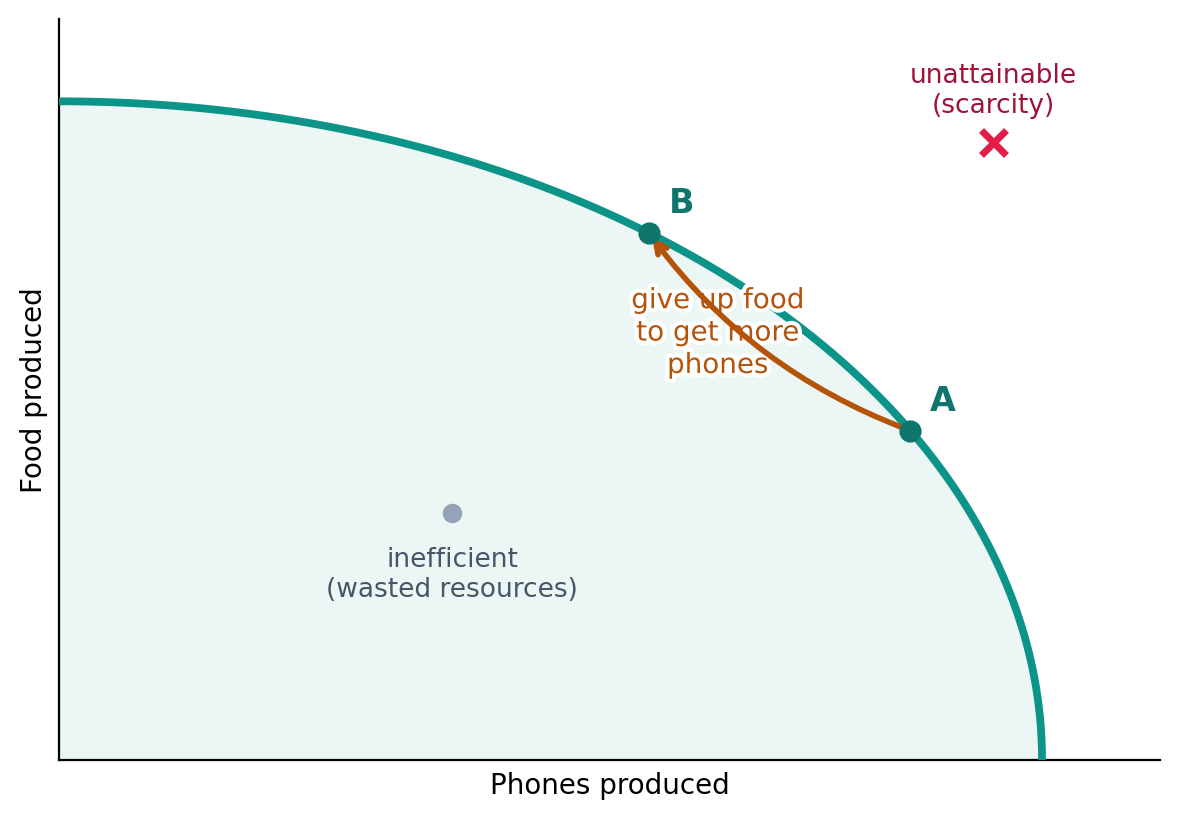
Where is each point?
Sort production points as efficient, inefficient, or unattainable.
Select all true statements about the production possibilities curve.
Difficulty 2/5 · 140 coins + a small bonus on first completion today
On = efficient, inside = wasteful, outside = impossible. Moving along the curve always involves a trade-off.
Opportunity cost
- To move along the curve and make more phones, you must give up some food.
- A trade-off 权衡取舍 is giving up one thing to get another.
- The opportunity cost 机会成本 of a choice is the value of the single best alternative you gave up.
- It is measured in what you sacrificed, not in dollars.
The value of the single best alternative you give up is the ____ cost.
Difficulty 1/5 · 100 coins + a small bonus on first completion today
Opportunity cost is what you sacrifice — the next-best choice — when you decide.
A farm can grow 100 tonnes of wheat OR 40 tonnes of corn. What is the opportunity cost, in tonnes of wheat, of 1 tonne of corn?
Difficulty 2/5 · 140 coins + a small bonus on first completion today
Giving up all corn frees enough resources for 100 wheat, so each tonne of corn costs $100/40 = 2.5$ tonnes of wheat.
Opportunity cost is only the next-best option you gave up — not everything you could have done. If you choose sleep over studying or a movie, the opportunity cost is whichever one you would have picked next, not both.
You rank your evening options: (1) study, (2) friends, (3) film — and choose to study. The opportunity cost is...
Difficulty 1/5 · 100 coins + a small bonus on first completion today
Opportunity cost is only the next-best option you gave up — seeing friends.
What economists study
- Economics 经济学 is the study of how people and societies make choices under scarcity.
- Because resources are scarce, good decisions weigh costs against benefits.
- People tend to think at the margin 边际 — deciding one more unit at a time.
- The rest of this course is really about how these choices are made in markets.
You have one free evening and three options you'd enjoy, ranked: (1) study, (2) see friends, (3) watch a film.
- You choose to study.
- The opportunity cost is seeing friends — your next-best option.
- Watching the film is not part of the cost: you would not have chosen it anyway.
Scarcity (unlimited wants, limited resources) forces every economy to choose. Each choice has an opportunity cost — the value of the single best alternative given up. The production possibilities curve shows these trade-offs, and economics is the study of how we make them.
Write from an opportunity cost of 4
- A farm can grow 80 tonnes of wheat or 20 tonnes of rice.
- Find the opportunity cost of one tonne of rice.
A farm can grow 80 tonnes of wheat or 20 tonnes of rice. What is the opportunity cost of one tonne of rice, in tonnes of wheat?
80 divided by 20 is 4.
What is the opportunity cost of one tonne of rice?
Difficulty 1/5 · 100 coins + a small bonus on first completion today
80 divided by 20 is 4 tonnes of wheat. Other options — 2.5 tonnes of wheat (the lesson corn figure); 80 tonnes (the whole wheat crop).