Economic Systems
Introduced| English | Meaning |
|---|---|
| economic system/ˌiːkəˈnɒmɪk ˈsɪstəm/ | The institutions and rules through which a society organises production, allocation and distribution. |
| market economy/ˈmɑːkɪt ɪˈkɒnəmi/ | An economy in which prices and resource allocation are largely determined by buyers and sellers through markets. |
| command economy/kəˈmænd ɪˈkɒnəmi/ | An economic system in which central authorities direct major production and resource-allocation decisions. |
| mixed economy/mɪkst ɪˈkɒnəmi/ | An economy combining market allocation and private ownership with government intervention and public provision. |
| signal/ˈsɪɡnl/ | Information, such as price changes, that guides decisions about buying, selling and allocating resources. |
| incentive/ɪnˈsentɪv/ | A reward, penalty or other influence that encourages a particular action or choice. |
| invisible hand/ɪnˈvɪzɪbl hænd/ | The idea that individuals pursuing their own interests can coordinate economic activity through market prices under suitable conditions. |
| efficient/ɪˈfɪʃənt/ | Using resources without avoidable waste, or allocating them to maximise the relevant net benefit. |
Who decides what gets made?
- No one orders a baker to make bread, yet every morning the shelves are full.
- No official assigns you a job, yet almost every job somehow gets done.
- So who answers the big questions — what to make, how to make it, and for whom?
- The answer depends on a country's economic system 经济体制.
Every economic system must answer three questions. Which set is correct?
Difficulty 1/5 · 100 coins + a small bonus on first completion today
Scarcity forces every economy to decide what goods, how they are made, and for whom.
Three ways to allocate resources
- A market economy 市场经济: private buyers and sellers decide, guided by prices — no central planner.
- A command economy 计划经济: a central government owns the resources and makes the decisions.
- A mixed economy 混合经济: markets set most prices, but government provides some goods and fixes some problems.
- The pure types are just the two ends of a scale — almost every real country is mixed.
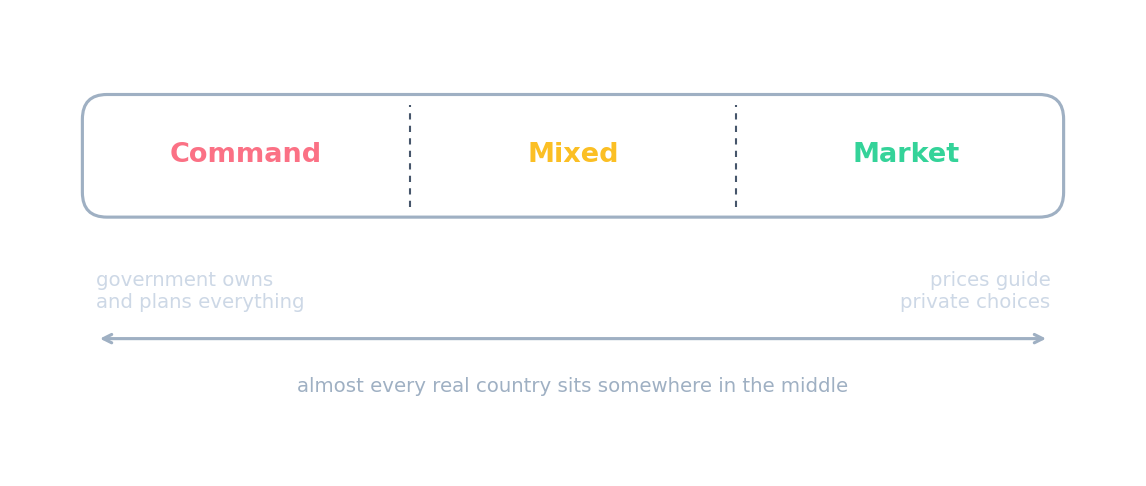
Market, command, or mixed?
Each feature belongs to a way of allocating resources. Markets use prices; command uses a central plan; mixed blends the two.
Which is a feature of a command economy?
Difficulty 1/5 · 100 coins + a small bonus on first completion today
In a command economy the state owns resources and plans production centrally.
How prices coordinate a market
- In a market, prices do the coordinating — nobody is in charge.
- A price is a signal 信号: a high price says "this is scarce or strongly wanted."
- A price is also an incentive 激励: it rewards producers who make more of it.
- Adam Smith called this self-organising order the invisible hand 看不见的手 — resources flow toward what people value most, with no one planning it.
In a pure market economy, a central planner sets the prices.
Difficulty 1/5 · 100 coins + a small bonus on first completion today
No one sets them — prices emerge from buyers and sellers. That is the invisible hand.
A price does two jobs: it is a signal and an ______.
Difficulty 1/5 · 100 coins + a small bonus on first completion today
The signal carries information; the incentive rewards producers who respond.
Every system has a trade-off
- Markets are usually efficient 有效率, but can leave some people behind and under-provide things like clean air.
- Command systems aim for fairness and can chase national goals, but without price signals they often waste resources and slow innovation.
- That is exactly why most countries are mixed — they try to keep the efficiency of markets while filling the gaps.
Match each economy to what it is best known for.
Difficulty 2/5 · 140 coins + a small bonus on first completion today
Each system trades something off; the mixed economy tries to get the best of both.
Select all common drawbacks of a command economy.
Difficulty 2/5 · 140 coins + a small bonus on first completion today
Without prices to signal value, command systems often waste resources and slow innovation.
Who grows the coffee you drink? No government agency planned it.
- A high coffee price signals that people want more, and rewards the farmers who grow it.
- Farmers, shippers, and cafés each just follow the prices — and the coffee appears on your table.
- That is the invisible hand: private choices, coordinated by price, not by a planner.
An economic system decides what, how, and for whom. A market economy uses prices — a signal and an incentive, the invisible hand. A command economy uses a central plan. A mixed economy blends both — and almost every real country is mixed.
Write from 7 plots allocated by price
- A village has 12 plots.
- Prices put 7 into vegetables and a command plan puts all 12 into grain.
A village has 12 plots. Prices put 7 into vegetables. A command plan puts all 12 into grain. How many vegetable plots does the price system use that the plan does not, and which system is using prices?
12 minus 5 grain plots under the price split is 7 vegetable plots.
How many plots do prices put into vegetables?
Difficulty 1/5 · 100 coins + a small bonus on first completion today
The price system uses 7 of the 12 plots for vegetables. Other options — 12 (the command plan's grain total); 0 (because a plan ignores prices).