The Crowding-Out Effect
Introduced| English | Meaning |
|---|---|
| loanable funds/ˈləʊnəbl fʌndz/ | Funds available for borrowing in a model that connects saving and lending with borrowing for investment and other uses. |
| crowding out/ˈkraʊdɪŋ aʊt/ | A reduction in private spending or investment caused by increased government activity, often through higher interest rates. |
| real interest rate/rɪəl ˈɪntrest reɪt/ | An interest rate adjusted for inflation, approximately the nominal rate minus the inflation rate when rates are small. |
| private investment/ˈpraɪvət ɪnˈvestmənt/ | Spending by private-sector producers on productive capital and inventories; in national accounts it does not mean simply purchasing existing financial assets. |
Two borrowers, one pool of savings
- Firms borrow to invest; the government borrows to fund a deficit.
- They draw from the same pool — the market for loanable funds 可贷资金.
- When the government borrows a lot, it competes with firms for those savings.
- The result has a name: crowding out 挤出效应.
Firms and the government both borrow from the market for:
Difficulty 1/5 · 100 coins + a small bonus on first completion today
The loanable-funds market channels savings to borrowers.
Government deficit spending shifts the demand for loanable funds:
Difficulty 1/5 · 100 coins + a small bonus on first completion today
More borrowing demand at each rate shifts demand right and raises the rate.
How the interest rate rises
- Government deficit spending raises the demand for loanable funds — the demand curve shifts right.
- More borrowers chasing the same savings pushes the real interest rate 实际利率 up.
- Draw it in the loanable-funds market: demand right → the equilibrium real rate climbs.
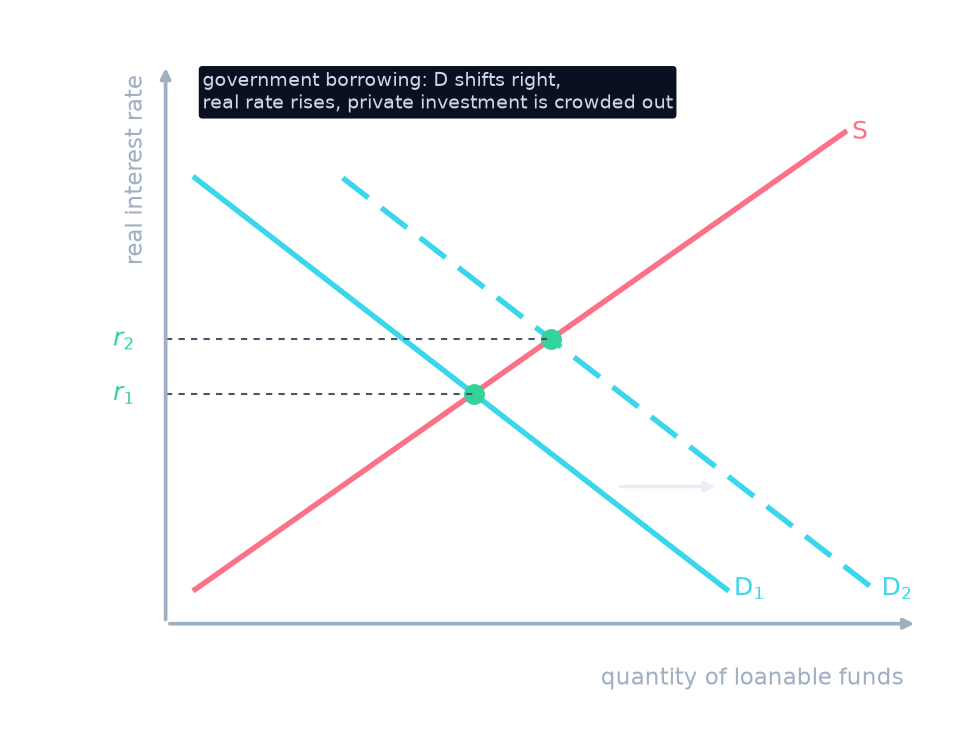
Higher rates cut private investment from 400 to 360. By how much did investment fall?
Difficulty 2/5 · 140 coins + a small bonus on first completion today
400 − 360 = 40 crowded out.
When higher rates reduce private investment, we say it has been ______ out.
Difficulty 1/5 · 100 coins + a small bonus on first completion today
The government "crowds out" private borrowers by pushing up the rate.
Why private investment falls
- A higher real interest rate makes borrowing more expensive for firms.
- So private investment 私人投资 falls — the government has crowded it out.
- Worked idea. Government borrowing pushes the real rate from $3\%$ to $5\%$. Firms cut investment from $400$ to $360$ — a fall of $40$.
- This weakens the boost that the deficit spending was meant to give.
Crowding out is strongest when the economy is:
Difficulty 1/5 · 100 coins + a small bonus on first completion today
Scarce savings mean extra government borrowing bids the rate up sharply.
Crowding out makes expansionary fiscal policy partly self-defeating.
Difficulty 1/5 · 100 coins + a small bonus on first completion today
Some of the demand boost is cancelled by lost private investment.
The bottom line for fiscal policy
- Crowding out means expansionary fiscal policy is partly self-defeating: some private spending is lost.
- It is strongest when the economy is near full employment (savings are scarce).
- It is weakest in a deep recession (idle savings, rates barely move).
- So the timing of deficit spending matters — a recession, not a boom, is when it crowds out least.
The crowding-out effect
Follow how extra government borrowing can push out private investment.
Crowding out: government borrowing raises the demand for loanable funds, pushing the real interest rate up (e.g. $3\% \to 5\%$), which lowers private investment ($400 \to 360$). It makes expansionary fiscal policy partly self-defeating, and is strongest near full employment.
Write from investment crowded out by 60
- Higher interest rates cut private investment from 250 to 190.
- Find how much investment was crowded out.
A government deficit pushes interest rates up, and private investment falls from 250 to 190. By how much was investment crowded out?
250 minus 190 is 60.
How much private investment was crowded out?
Difficulty 1/5 · 100 coins + a small bonus on first completion today
250 minus 190 is 60 of investment that no longer happens. Other options — 40 (the lesson fall); 250 (the original investment).