Long-Run Self-Adjustment
Introduced| English | Meaning |
|---|---|
| self-stabilizing/self ˈsteɪbɪlaɪzɪŋ/ | Describing an adjustment process that tends to move an economy back towards equilibrium without a new discretionary policy intervention. |
The economy heals itself — slowly
- What if the government does nothing about a gap?
- The AD-AS model says the economy will heal on its own, over the long run.
- The engine is the slow adjustment of the sticky wages and input prices that fixed SRAS.
- It just takes time — sometimes a painful amount of it.
Closing a recessionary gap
- Output is below potential, so unemployment is high.
- With many workers looking, they eventually accept lower nominal wages, and input costs fall.
- Lower costs shift SRAS rightward, along the fixed AD.
- Output rises back to potential and the price level falls — full employment returns on its own.
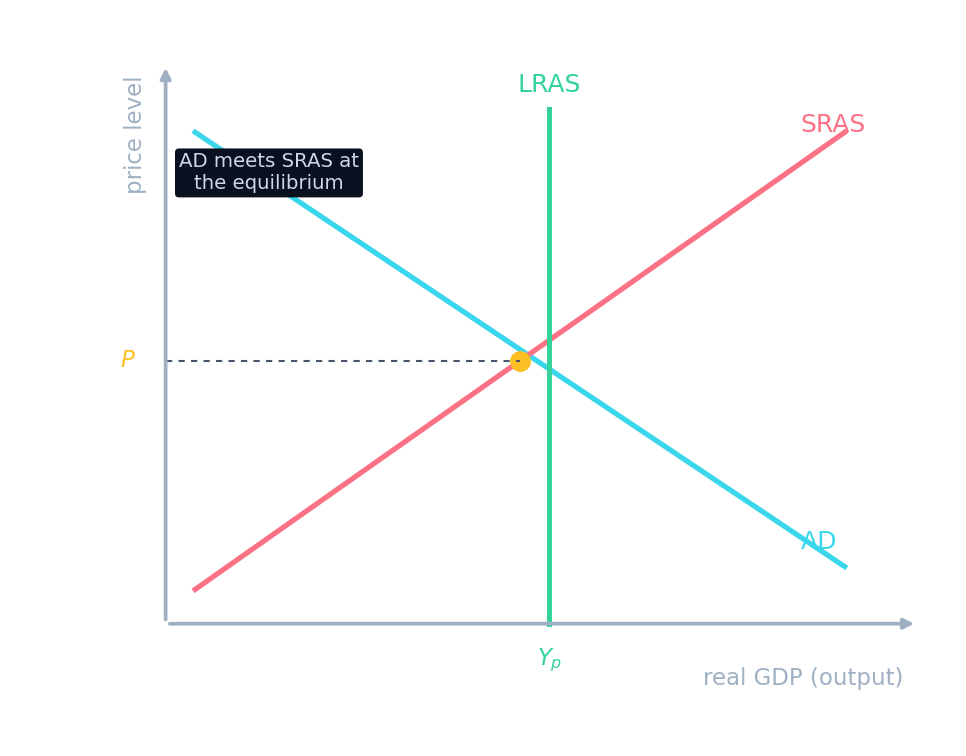
The AD-AS model
Left alone, an economy in a gap heals by shifting SRAS — wages fall in a slump, rise in a boom — until output returns to potential.
To close a recessionary gap on its own, the economy relies on:
Difficulty 1/5 · 100 coins + a small bonus on first completion today
High unemployment eventually lowers wages, cutting costs and shifting SRAS right toward potential.
Closing an inflationary gap
- Output is above potential, so labour and materials are scarce.
- Workers win higher nominal wages, and input prices rise.
- Higher costs shift SRAS leftward; output falls back to potential while the price level rises further.
- Either way, self-adjustment moves SRAS, not AD, until the crossing returns to LRAS.
To close an inflationary gap on its own, nominal wages:
Difficulty 1/5 · 100 coins + a small bonus on first completion today
Scarce labour wins higher wages, raising costs and shifting SRAS left back to potential.
Self-adjustment works by shifting the ______ curve, not AD, back onto LRAS.
Difficulty 1/5 · 100 coins + a small bonus on first completion today
Wages and input prices move SRAS until the crossing lands on LRAS at potential.
Long run vs short run
- Real output always returns to potential — in the long run the economy is self-stabilizing 自我稳定.
- The price level does not return to where it started: a recessionary gap ends at a lower price level, an inflationary gap at a higher one.
- So a shift in AD changes output only temporarily; its lasting effect is on the price level alone.
- This is why LRAS is vertical: in the long run, only prices move.
In the long run, self-adjustment always returns real output to potential.
Difficulty 1/5 · 100 coins + a small bonus on first completion today
Output is fixed by real resources in the long run, so it always heals back to potential.
After a recessionary gap self-corrects, the price level ends up:
Difficulty 1/5 · 100 coins + a small bonus on first completion today
Output returns to potential, but a recessionary gap self-corrects to a lower price level.
Because output always returns to potential, the economy is said to be self-stabilizing in the long run.
Difficulty 1/5 · 100 coins + a small bonus on first completion today
A shift in AD changes output only temporarily; its lasting effect is on the price level.
Left alone, the economy self-adjusts by shifting SRAS: a recessionary gap pulls wages down (SRAS right), an inflationary gap pushes wages up (SRAS left), until output returns to potential. Output always recovers; the price level ends lower (recession) or higher (boom) than before.
Write from a return to potential output of 1000
- A recessionary gap has output at 900. Potential is 1000.
- Describe the self-correction.
Output is 900 and potential output is 1000. With no new policy, how does the economy close the gap, and where does output end?
Unemployment puts downward pressure on wages until output is back at potential.
Where does output end after self-correction?
Difficulty 1/5 · 100 coins + a small bonus on first completion today
Long-run output returns to potential. The price level is what stays lower.