Fiscal Policy
Introduced| English | Meaning |
|---|---|
| fiscal policy/ˈfɪskl ˈpɒlɪsi/ | Government decisions about taxation and spending used to influence economic activity. |
| expansionary/ekˈspænʃənəri/ | Describing an economic policy intended to increase aggregate demand or economic activity. |
| contractionary/kənˈtrækʃənəri/ | Describing an economic policy intended to reduce aggregate demand or restrain economic activity. |
Speeding up the cure
- Self-adjustment eventually works, but it can be painfully slow — years of high unemployment.
- So the government often acts deliberately to speed things up.
- It uses its own spending and taxes to steer aggregate demand.
- This is fiscal policy 财政政策.
Expansionary fiscal policy
- Expansionary 扩张性 fiscal policy increases AD: the government raises spending or cuts taxes.
- More spending adds directly to $G$; a tax cut leaves households more to spend, raising $C$.
- AD shifts right.
- Use it to fight a recessionary gap.
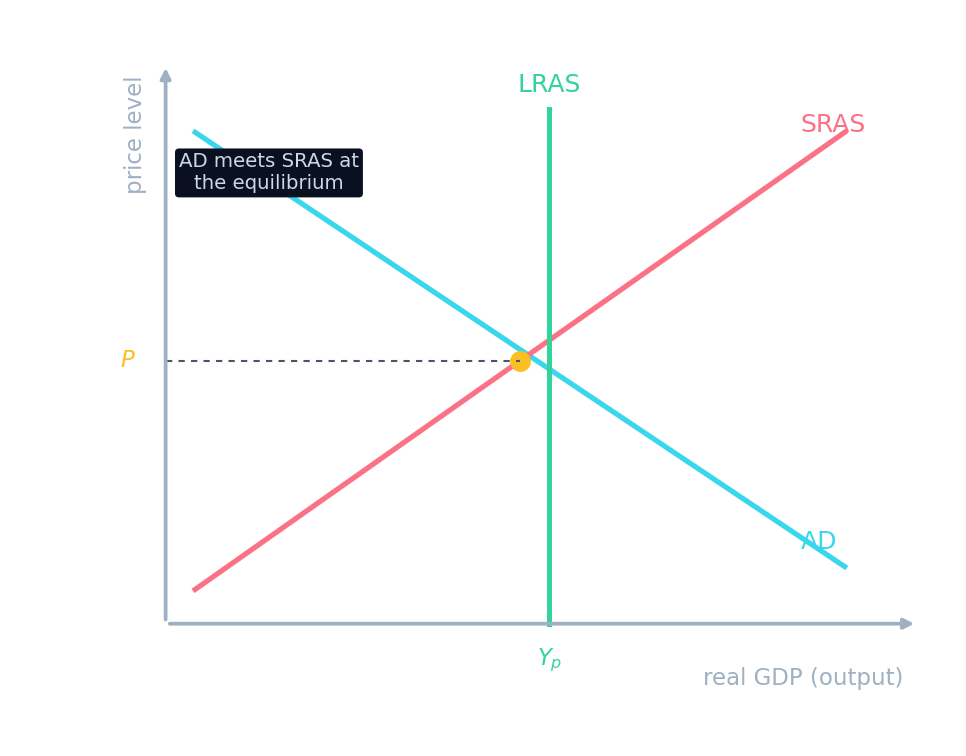
Fiscal policy in the AD-AS model
Expansionary fiscal policy shifts AD right to close a recessionary gap; contractionary policy shifts AD left to cool an inflationary gap.
Expansionary fiscal policy means the government:
Difficulty 1/5 · 100 coins + a small bonus on first completion today
More spending or lower taxes shifts AD right — used to fight a recessionary gap.
Select all tools of fiscal policy.
Difficulty 2/5 · 140 coins + a small bonus on first completion today
Fiscal policy works through spending, taxes and transfers; the money supply is monetary policy.
Contractionary fiscal policy
- Contractionary 紧缩性 fiscal policy decreases AD: the government cuts spending or raises taxes.
- AD shifts left.
- Use it to cool an inflationary gap and tame demand-pull inflation.
- Match the tool to the gap: recessionary → expansionary; inflationary → contractionary.
Match each gap to the right fiscal policy.
Difficulty 2/5 · 140 coins + a small bonus on first completion today
Push AD toward potential: right for a recession, left for an inflationary boom.
To cool an inflationary gap, the government should increase spending and cut taxes.
Difficulty 1/5 · 100 coins + a small bonus on first completion today
False. That is expansionary policy, which would widen the gap. Cooling it needs contractionary fiscal policy: cut spending or raise taxes to shift AD left.
Powered by the multiplier
- Fiscal policy is powerful because of the multiplier — the government need not close the whole gap by itself.
- $\Delta \text{GDP} = \text{spending multiplier} \times \Delta G$.
- Worked idea. A recessionary gap is 200b and $MPC = 0.8$, so the spending multiplier is 5.
- To close the gap, $\Delta G = 200 \div 5 = 40$b — just 40b of spending, magnified fivefold.
A recessionary gap is 200 and the spending multiplier is 5. How much extra government spending closes it?
Difficulty 2/5 · 140 coins + a small bonus on first completion today
ΔG = gap ÷ multiplier = 200 ÷ 5 = 40 — magnified fivefold to shift AD by 200.
To close the same gap, a tax cut must be larger than a spending rise because:
Difficulty 1/5 · 100 coins + a small bonus on first completion today
The tax multiplier is smaller than the spending multiplier, so a bigger tax change is needed.
Fiscal policy uses government spending and taxes to steer AD. Expansionary (more spending / lower taxes) shifts AD right to fight a recessionary gap; contractionary (less spending / higher taxes) shifts AD left to cool an inflationary gap. The multiplier magnifies each action.
Write from extra spending of 50
- The recessionary gap is 150. The spending multiplier is 3.
- Find the government-spending rise that closes it.
A recessionary gap is 150 and the spending multiplier is 3. How much extra government spending closes the gap?
150 divided by 3 is 50.
How much extra government spending closes the gap?
Difficulty 1/5 · 100 coins + a small bonus on first completion today
A multiplier of 3 turns spending of 50 into a shift of 150. Other options — 40 (the lesson spending); 150 (the whole gap in the first round).