Changes in the AD-AS Model in the Short Run
Introduced| English | Meaning |
|---|---|
| demand-pull inflation/dɪˈmænd pʊl ɪnˈfleɪʃn/ | A rise in the general price level caused by aggregate demand growing beyond the economy's available output capacity. |
| stagflation/stæɡˈfleɪʃn/ | A combination of inflation with stagnant economic activity and high unemployment. |
| stagnant/ˈstæɡnənt/ | Describing economic activity or output showing little or no growth over the relevant period. |
When a curve moves
- The AD-AS model earns its keep when something shifts a curve.
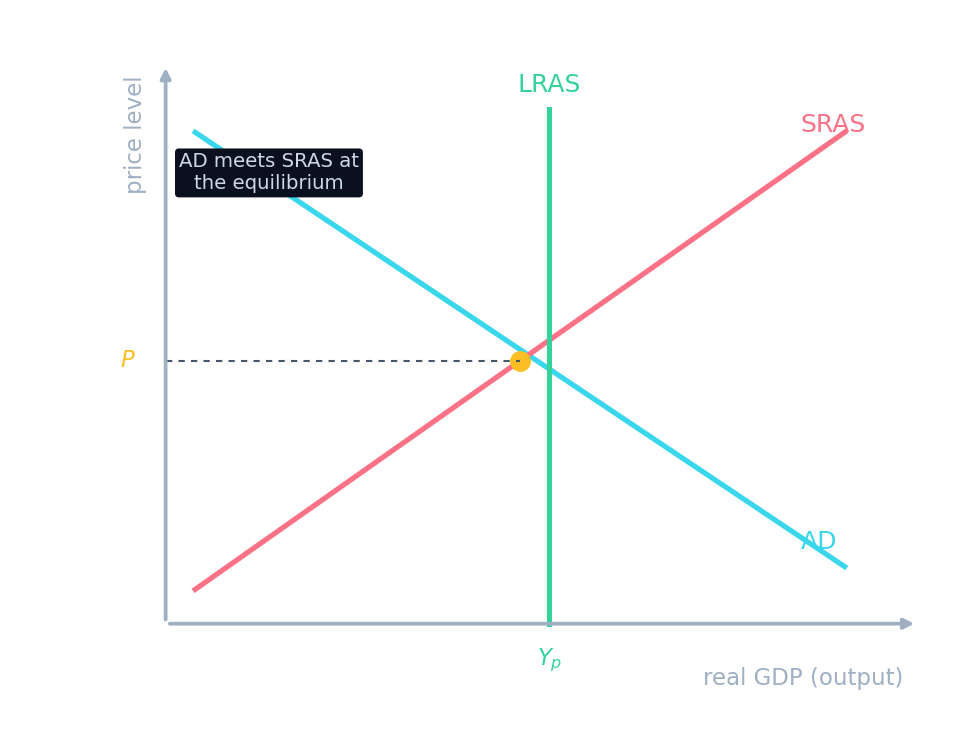
- Shift AD, and read the new crossing with SRAS.
- Shift SRAS, and read the new crossing with AD.
- The direction the price level and output move tells you which curve shifted.
A shift in aggregate demand
- Shift AD right (more confidence, a tax cut, more government spending). Along the upward SRAS, the new crossing is higher.
- The price level rises — this is demand-pull inflation 需求拉动型通货膨胀.
- Real output rises and unemployment falls.
- Signature of an AD shift: price level and output move the same direction.
Shock the economy
An AD shift moves price and output the same way (demand-pull inflation); a supply shock moves them opposite (stagflation). Try each.
A rightward shift in AD causes, in the short run:
Difficulty 1/5 · 100 coins + a small bonus on first completion today
Along the upward SRAS, more demand raises both price and output — price and output move together.
Inflation driven by a rightward shift in AD (too much spending) is called ______-pull inflation.
Difficulty 1/5 · 100 coins + a small bonus on first completion today
Demand-pull inflation comes from AD rising faster than supply.
A supply shock
- A negative supply shock shifts SRAS left. Along the downward AD, the new crossing is higher and to the left.
- The price level rises while real output falls — the opposite directions.
- This painful combination is stagflation 滞胀: a stagnant 停滞 economy and rising prices at once.
- It is hard to cure: fighting the inflation deepens the slump, and vice versa.
A negative supply shock (SRAS shifts left) causes:
Difficulty 1/5 · 100 coins + a small bonus on first completion today
Along the downward AD, less supply raises the price level while cutting output.
Stagflation is rising output and falling unemployment together with rising prices.
Difficulty 1/5 · 100 coins + a small bonus on first completion today
False. Stagflation is falling output and rising unemployment together with rising prices, the mix an adverse supply shock produces.
Why is stagflation hard to cure with demand policy?
Difficulty 1/5 · 100 coins + a small bonus on first completion today
The two problems pull demand policy in opposite directions, so no single AD move solves both.
Two different signatures
- Worked idea. A drought sharply raises food and energy costs — a supply shock. SRAS shifts left, so the price level rises (say index 110 → 115) while output falls (1,000b → 960b): higher prices with lower output is stagflation.
- Contrast a rightward AD shift, which raises price and output together.
- Demand shifts never cause stagflation.
- Read the two directions, and you know which shock hit.
Price level and output moving in opposite directions is the signature of:
Difficulty 1/5 · 100 coins + a small bonus on first completion today
Demand shifts move them together; only a supply shock moves them apart.
An AD shift moves the price level and output the same direction (a rightward shift gives demand-pull inflation). A supply shock moves them opposite — a leftward SRAS shift gives stagflation (falling output with rising prices), which is hard to cure.
Write from output rising to 760
- Aggregate demand shifts right. The price level rises from 100 to 106 and output rises from 700 to 760.
- Say what kind of shock this is.
After a shift, the price level rises from 100 to 106 and output rises from 700 to 760. Which curve shifted, and what is the new output?
700 plus 60 is 760, and the price level rose too.
What kind of shift fits a rise in both price and output?
Difficulty 1/5 · 100 coins + a small bonus on first completion today
Demand shifts move price and output in the same direction.