Changes as a Result of the World Economy
Introduced| English | Meaning |
|---|---|
| outsourcing/aʊtˈsɔːsɪŋ/ | Obtaining a task or service from an external provider instead of carrying it out within the organisation. |
| newly industrialised countries/ˈnjuːli ɪnˈdʌstrɪəlaɪzd ˈkʌntriz/ | Countries experiencing substantial growth in manufacturing and industrial employment; membership of this descriptive category varies by source. |
| special economic zones/ˈspeʃl ˌiːkəˈnɒmɪk zəʊnz/ | Designated areas operating under particular economic rules or incentives intended to attract investment, trade or industrial activity. |
Production goes global
- The world economy moves production to lower-cost countries.
- Outsourcing 外包 sends work to firms in cheaper locations.
- Offshoring moves a company's own operations abroad.
Sending a company's work to a firm in a cheaper location is called...
Difficulty 1/5 · 100 coins + a small bonus on first completion today
Outsourcing shifts work to lower-cost firms elsewhere.
Rising economies
- Newly industrialised countries (NICs) 新兴工业化国家 grew fast by making goods for export.
- Special economic zones 经济特区 attract investment with tax breaks and light rules.
- These policies moved some countries from periphery toward core.
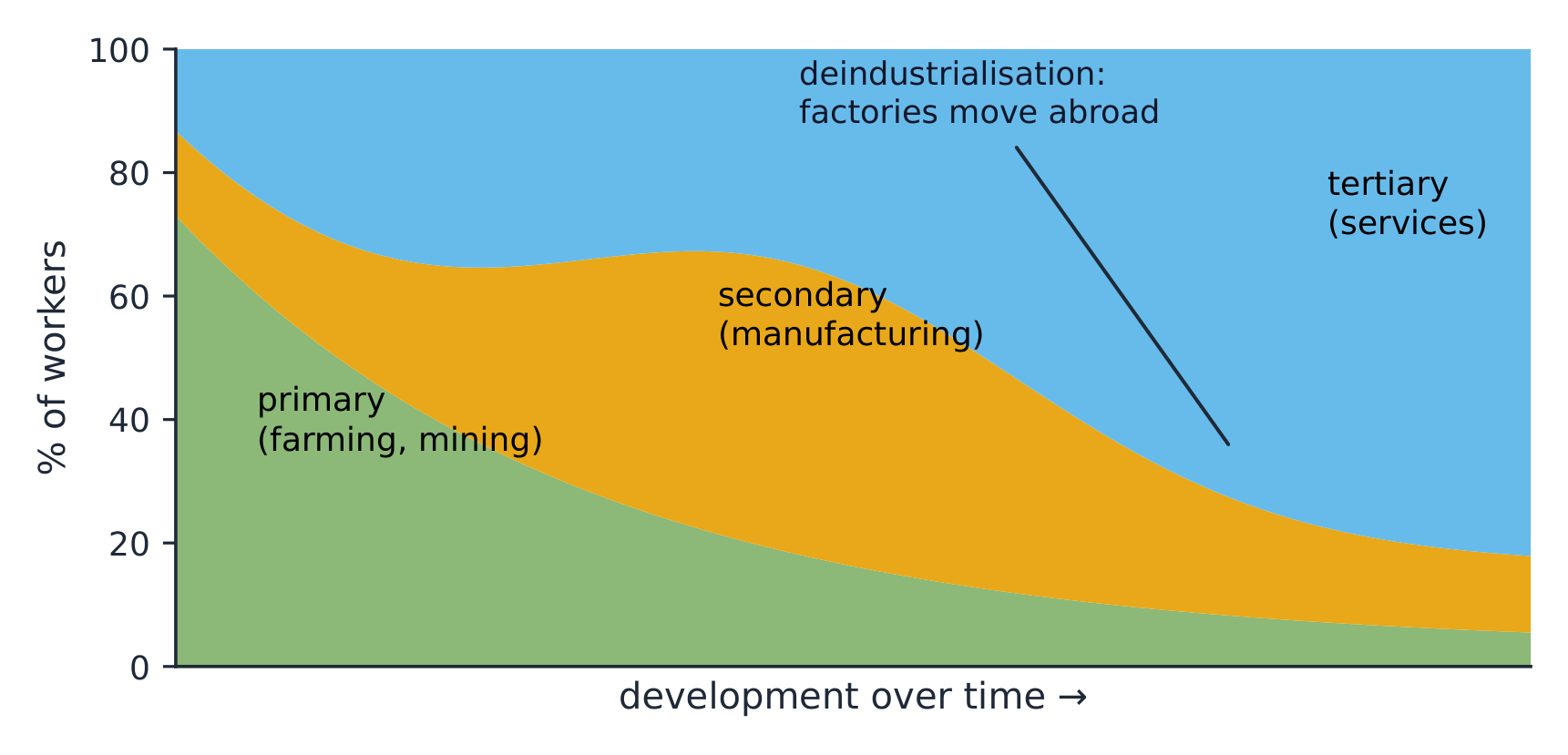
As economies develop, work shifts from primary to secondary to tertiary (illustrative)
Which concept?
Match each example to the world-economy concept it shows.
Areas offering tax breaks and light rules to attract foreign investment are special economic ____.
Difficulty 1/5 · 100 coins + a small bonus on first completion today
Special economic zones attract investment and factories.
Select all true statements.
Difficulty 2/5 · 140 coins + a small bonus on first completion today
Outsourcing, NIC growth, and SEZ tax breaks are true; global production does have downsides.
Match each term to its meaning.
Difficulty 2/5 · 140 coins + a small bonus on first completion today
Outsourcing = send work; SEZ = tax-break zone; NIC = fast industrialiser.
Winners and costs
- Global production creates jobs and growth in developing countries.
- But it can bring low wages, poor conditions, and pollution.
- It also costs jobs in the countries the work moved from.
Moving production abroad can both create jobs in the destination and cost jobs in the origin.
Difficulty 1/5 · 100 coins + a small bonus on first completion today
It is a double-edged change with winners and losers on both ends.
Moving production abroad is a double-edged change. It can lift a developing country toward the core (as with the NICs) and leave behind low wages, poor conditions, and lost jobs in the origin country. Weigh gains against costs on both ends.
A company outsources its factory work to a country with a special economic zone offering tax breaks. That country gains jobs and grows into a newly industrialised country — but workers there may face low pay, while factory workers in the origin country lose their jobs.
The world economy shifts production abroad via outsourcing and offshoring. Special economic zones and export-led growth turned some countries into newly industrialised countries (NICs), moving them toward the core — but with costs: low wages, pollution, and lost jobs in origin countries.
Write from an outsourced call centre
- A firm closes its call centre at home.
- It hires a company in another country to answer the same calls.
What global-production change is this?
Outsourcing sends a business function to another firm or country.
What happened to the call-centre work?
Difficulty 1/5 · 100 coins + a small bonus on first completion today
Another country now does the same service.