Challenges of Urban Changes
Introduced| English | Meaning |
|---|---|
| residential segregation/ˌrezɪˈdenʃl ˌseɡrɪˈɡeɪʃn/ | The spatial separation of groups into different residential areas, shaped by social, economic and political processes. |
| suburbanization/səˌbɜːbənaɪˈzeɪʃn/ | The growth of settlements and movement of people or activities towards the outskirts of a city. |
| gentrification/ˌdʒentrɪfɪˈkeɪʃn/ | The arrival of higher-income residents and investment in a neighbourhood, often raising costs and displacing existing residents. |
| congestion/kənˈdʒestʃn/ | Crowding of a transport network that slows travel because demand approaches or exceeds its effective capacity. |
Housing and inequality
- Fast urban change brings social challenges.
- Housing shortages push up rents and create homelessness.
- Residential segregation 居住隔离 separates groups by income or ethnicity.
Separating groups by income or ethnicity into different neighbourhoods is residential...
Difficulty 1/5 · 100 coins + a small bonus on first completion today
Residential segregation divides groups spatially in a city.
Select all social challenges of urban change.
Difficulty 2/5 · 140 coins + a small bonus on first completion today
Housing, segregation, and displacement are challenges; farmland is not created by urban change.
Movement and decline
- Suburbanization drew wealth and jobs out of some inner cities.
- This can cause inner-city decline and a shrinking tax base.
- Gentrification later reverses it but displaces poorer residents.
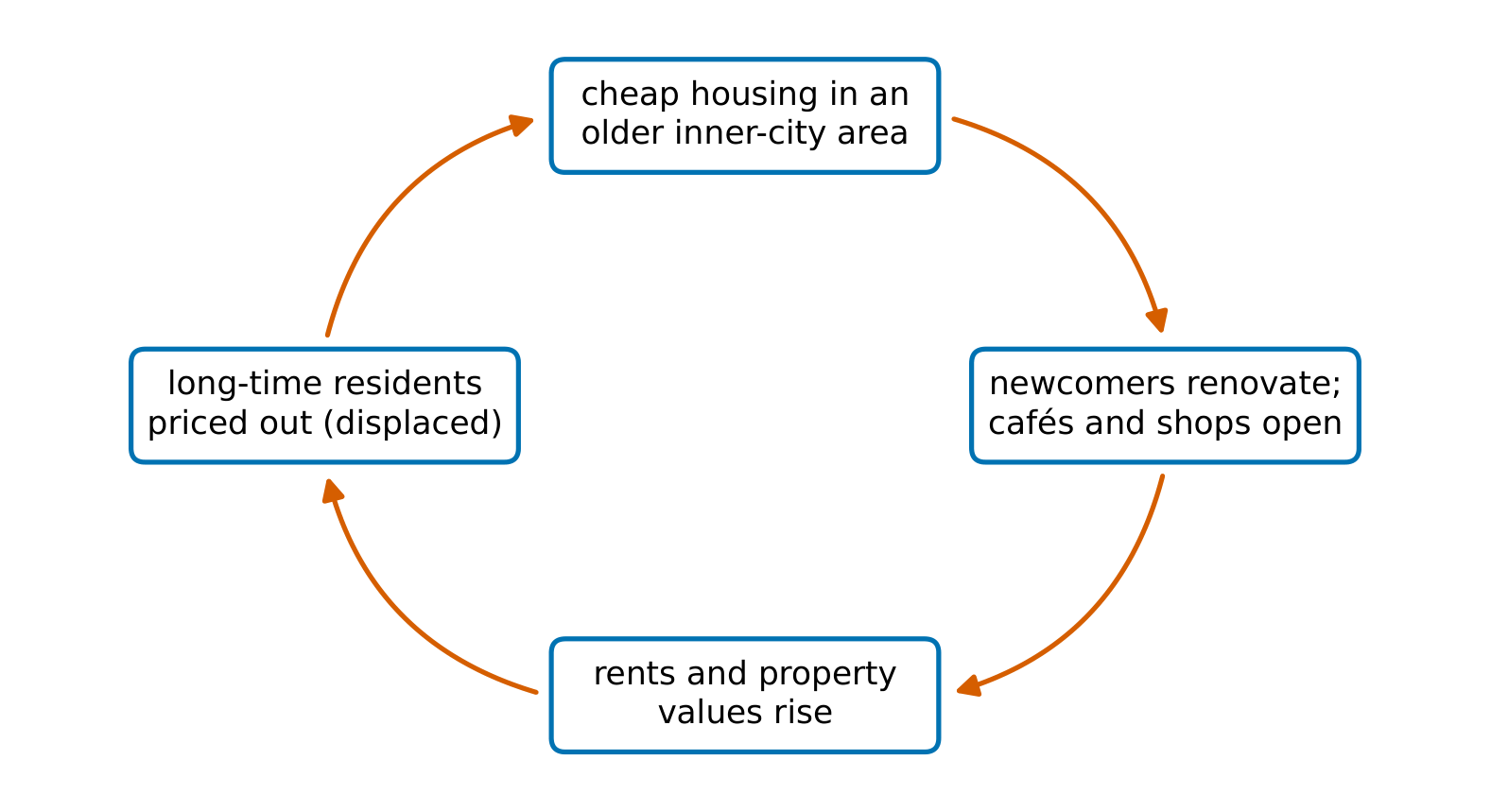
The gentrification cycle
Which urban challenge?
Match each example to the urban challenge it shows.
Suburbanization can drain jobs and tax money from inner cities, causing decline.
Difficulty 1/5 · 100 coins + a small bonus on first completion today
Wealth moving to suburbs can leave the inner city in decline.
Match each challenge to its description.
Difficulty 2/5 · 140 coins + a small bonus on first completion today
Segregation = split groups; decline = wealth leaves; congestion = traffic.
Sprawl and congestion
- Urban sprawl eats farmland and locks people into long car commutes.
- It causes congestion 拥堵, pollution, and high infrastructure costs.
- Managing growth fairly and efficiently is the core urban challenge.
Urban sprawl and car dependence cause traffic ____ and pollution.
Difficulty 1/5 · 100 coins + a small bonus on first completion today
Sprawl locks people into cars, causing congestion.
Urban problems are linked, not separate. Suburbanization can drain the inner city; that decline invites gentrification; gentrification then displaces the poor. On the exam, connect the challenges as a chain, not a list.
As wealthier families moved to the suburbs, an inner-city district lost jobs and tax money and declined. Decades later, its cheap old buildings attracted new investment — but rising rents from gentrification then displaced the low-income residents who had stayed.
Urban change brings housing shortages, residential segregation, inner-city decline from suburbanization, later gentrification and displacement, and sprawl causing congestion and pollution. These challenges connect as a chain and require fair, efficient management.
Write from a map as redlining
- A bank map shades one neighbourhood and refuses home loans there.
- The refusal follows the neighbourhood, not a review of each applicant's income.
What discriminatory practice is the map?
Redlining withholds investment from mapped neighbourhoods.
What is a loan refusal based on the neighbourhood alone?
Difficulty 1/5 · 100 coins + a small bonus on first completion today
The shaded area, not the applicant, drove the refusal.