Comparing Forms of Political Power
IntroducedThree forms, not two
- Compare the different forms of political power that developed in Europe from 1648 to 1815.
- The unit supplies three: absolutism (3.7), constitutional monarchy (3.2), and oligarchic republic (3.5).
- A two-way comparison leaves out the model that best shows how commerce shaped politics.
Select all three forms the unit supplies.
Difficulty 2/5 · 140 coins + a small bonus on first completion today
Mass democracy is not a form available in this period.
Three axes that work on all of them
- Where sovereignty sits: in the ruler, shared with a body, or in a small governing group.
- What happened to the nobility: excluded from governance, kept in it, or replaced by a commercial elite.
- How revenue is raised: by decree, by consent, or by a government of the people who pay it.
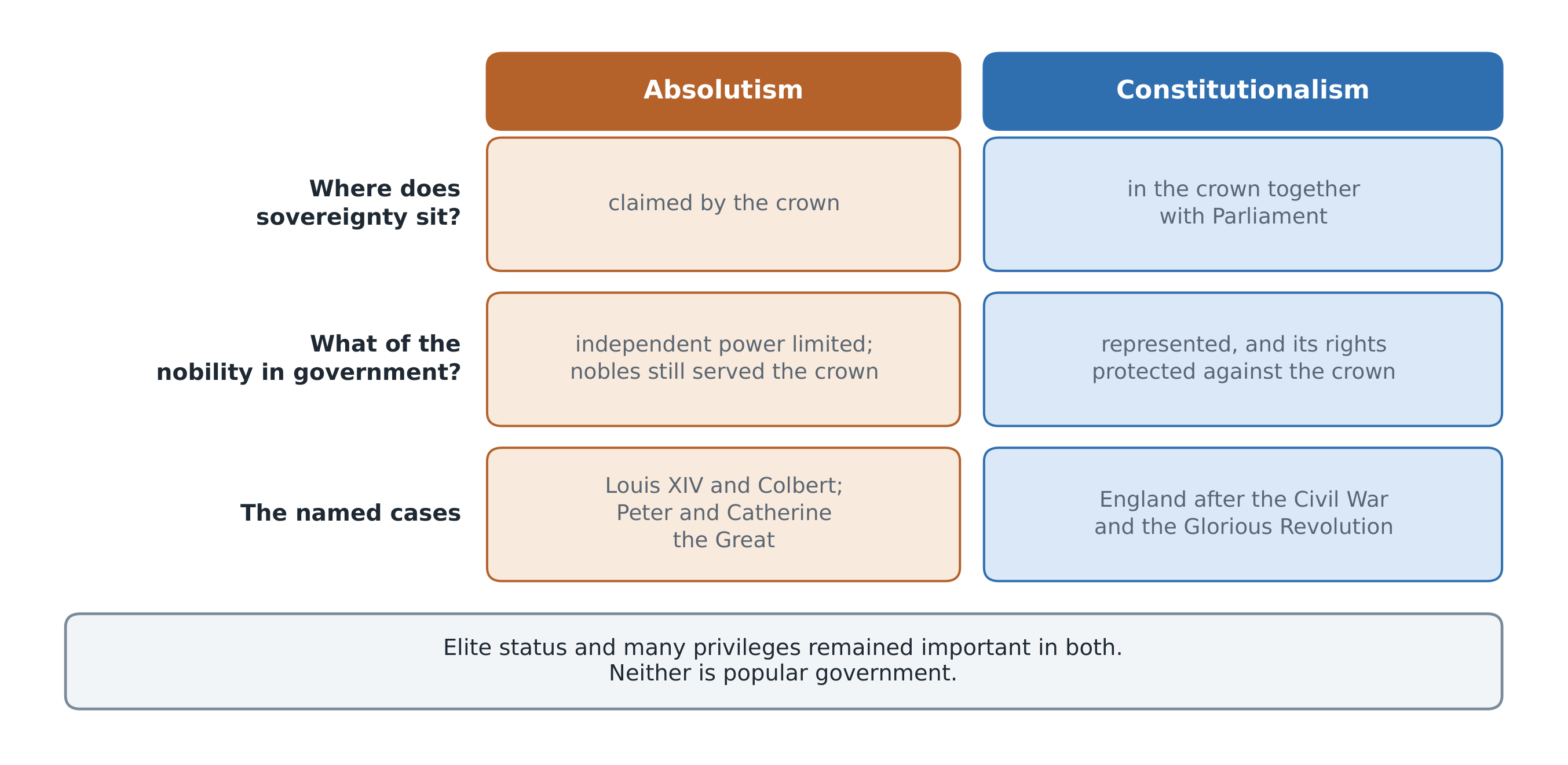
Compare institutional authority and elite participation in France and England
Select all three comparison axes this lesson gives.
Difficulty 2/5 · 140 coins + a small bonus on first completion today
Language is not a form of political power.
What all three shared
- Every state faced 3.6's military revolution and its fiscal demands.
- Every state had to settle with an existing nobility, and every one preserved some privileges.
- So the forms are three answers to one problem, which is what makes them comparable at all.
Which form does this describe?
Sort each feature by the form of political power it belongs to.
All three forms answered one shared problem: the fiscal demands of the ____ revolution.
Difficulty 1/5 · 100 coins + a small bonus on first completion today
That shared problem is what makes them comparable at all.
The unit supplies three forms, not two. Absolutism and constitutional monarchy are the familiar pair, but the Dutch oligarchic republic is the case that shows a commercial elite governing directly — and 3.8 asks about different forms, plural.
Every one of the three states abolished aristocratic privilege.
Difficulty 1/5 · 100 coins + a small bonus on first completion today
False. Each preserved some aristocratic privileges, because every state had to settle with an existing nobility.
And the economy runs underneath
- The CED's third review statement is the expansion of European commerce accelerated the growth of a worldwide economic network.
- That network funded absolutist armies, parliamentary settlements and Dutch fleets alike.
- So an answer that connects a political form to its revenue base is using the unit's own structure.
Put the comparison routine in order.
Difficulty 3/5 · 200 coins + a small bonus on first completion today
The shared problem comes first, because it is what makes a comparison possible.
A comparison routine
- Choose two of the three forms. Run all three axes across both, one axis per paragraph.
- Name the shared problem in the opening sentence: the fiscal demands of the military revolution.
- Close by naming which difference mattered most for what each state could then do abroad.
Three states need a fleet. One builds it by royal decree and a national tax; one by a parliamentary grant tied to conditions; one because the men voting for it own the cargoes it will protect. Same fleet, three constitutions — and the third is the one a two-way comparison loses.
Compare the different forms of political power that developed from 1648 to 1815 — the unit supplies three: absolutism, constitutional monarchy, and the Dutch oligarchic republic. Run three axes across two cases: where sovereignty sits, what happened to the nobility, and how revenue is raised. All three answered one shared problem — the fiscal demands of the military revolution.