Understanding the Scoring Guidelines
Introduced| English | Meaning |
|---|---|
| scoring guidelines/ˈskɔːrɪŋ ˈɡaɪdlaɪnz/ | Criteria describing how a piece of work is assessed and how marks or scores are assigned. |
| preponderance of evidence/prɪˈpɒndərəns ɒv ˈevɪdəns/ | The overall weight and pattern of relevant evidence used to make a judgement across a body of work. |
Build to the rubric
- Both sections are scored against published scoring guidelines 评分标准 — know the rows to build toward them.
- Sustained Investigation rows: inquiry; practice/experimentation/revision; materials/processes/ideas; skills; synthesis.
- Selected Works criteria: written evidence; drawing skills; synthesis.
Which rubric level?
Sort each described evidence by its rubric descriptor.
AP portfolios are scored by ____.
Difficulty 1/5 · 100 coins + a small bonus on first completion today
Preponderance of evidence, not an all-or-nothing checklist.
The language ladder
- The rubric language runs rudimentary → moderate → good → advanced — aim at the top descriptors.
- Scores are given by preponderance of evidence 证据的总体倾向, not a checklist of every criterion.
- Knowing the ladder tells you what "advanced" evidence actually looks like.
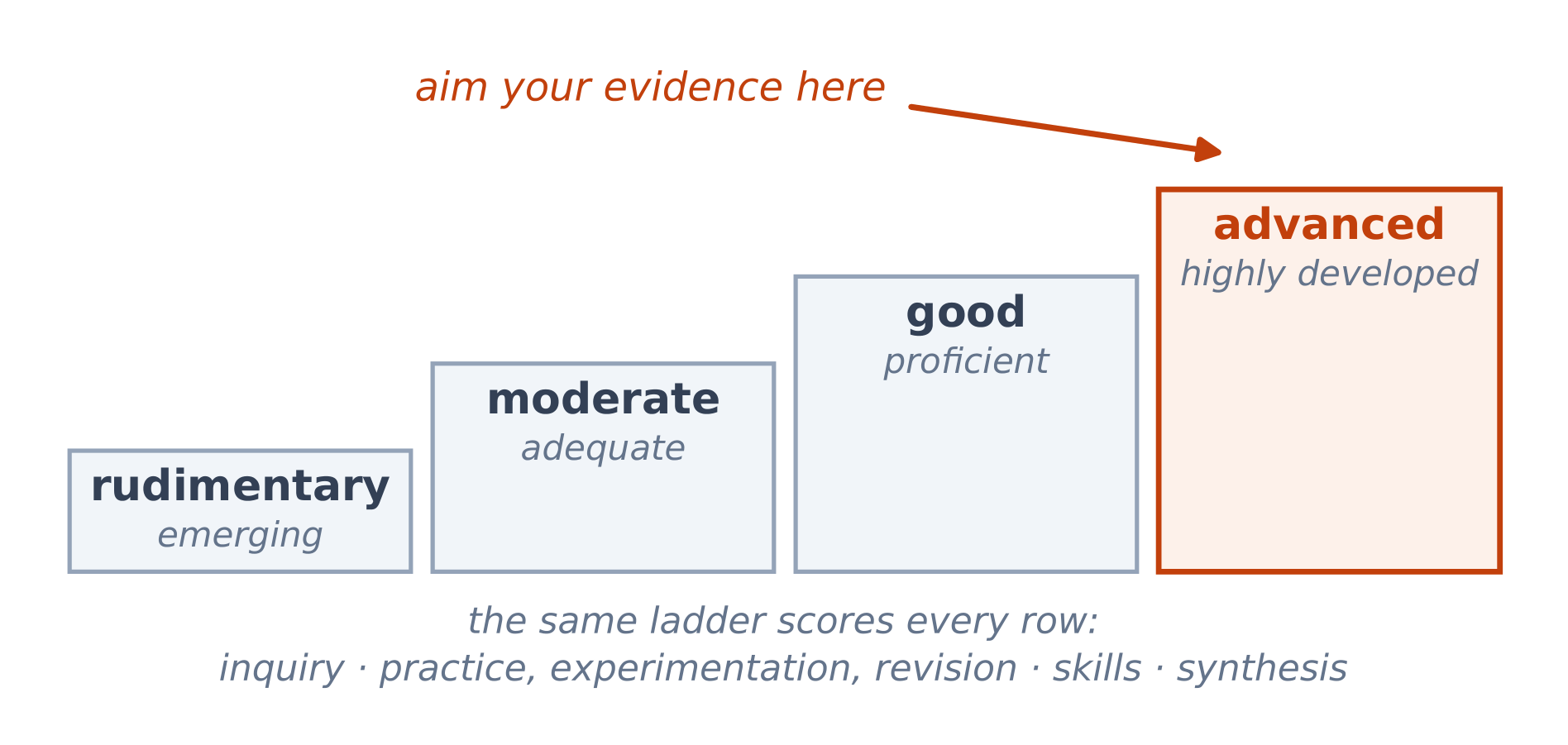
The scoring guidelines' language ladder
You should read the scoring guidelines early, not in April.
Difficulty 1/5 · 100 coins + a small bonus on first completion today
You cannot build toward an unseen target.
Select all Sustained Investigation rubric rows.
Difficulty 2/5 · 140 coins + a small bonus on first completion today
Frame quality is not a rubric row.
Score yourself each term
- Score your own mock portfolio against the rubric each term; the gaps write your to-do list.
- Every rubric row asks for visual evidence — show it, then name it.
- Scores 1-5 arrive in July; the rubric habits are the real prize.
The rubric descriptor ladder runs rudimentary, moderate, good, ____.
Difficulty 1/5 · 100 coins + a small bonus on first completion today
Aim at the top descriptor.
Match the descriptor to its meaning.
Difficulty 2/5 · 140 coins + a small bonus on first completion today
The language ladder.
Waiting until April to read the scoring guidelines wastes the whole year — you cannot build toward a target you have not seen. Read the rubric in September and self-score every term.
Self-scoring in January reveals: strong skills (good), clear inquiry (good), but synthesis only rudimentary — the materials feel interchangeable. That one gap becomes the spring's whole to-do list: experiment with materials that mean something.
Both sections score against published scoring guidelines by preponderance of evidence, on a rudimentary → advanced ladder. Read them early, self-score each term, and aim every piece of evidence at the top descriptors.
Write from real drawing experiments
- The sustained investigation shows only finished drawings.
- The student considers notes about experiments that never happened.
A sustained investigation shows only finished drawings. The student thinks of writing notes about experiments that never happened. What should they do instead?
The rubric describes work that happened. It is not a script for invented evidence.
What should be added?
Difficulty 1/5 · 100 coins + a small bonus on first completion today
Only experiments that happened can show practice, experimentation, and revision.