Contour Drawing
Introduced| English | Meaning |
|---|---|
| contour line/ˈkɒntʊə laɪn/ | A line describing the edge or boundary of a shape or form. |
| blind contour/blaɪnd ˈkɒntʊə/ | Drawing a subject's contours while looking at the subject rather than checking the drawing. |
| cross-contour lines/krɒs ˈkɒntʊə laɪnz/ | Lines that appear to travel across a form's surface, helping describe its volume and direction. |
Slow looking
- A contour line 轮廓线 traces the edges of a form — outer edges and inner ones (folds, creases, overlaps).
- Contour drawing trains eye-hand coordination through slow, careful observation.
- Match the speed of your eye along the edge to the speed of your pencil.
Cross-contour lines mainly describe ____.
Difficulty 1/5 · 100 coins + a small bonus on first completion today
They travel across the surface, showing how the form swells — volume.
Select all things a contour line may follow.
Difficulty 2/5 · 140 coins + a small bonus on first completion today
Contours follow edges of every kind; colour is not an edge.
Blind contour
- In blind contour 盲画轮廓 you draw without looking at the paper at all.
- The result looks strange — that is fine; the exercise trains pure observation.
- Do it daily: hands, shoes, faces. Five minutes is enough.
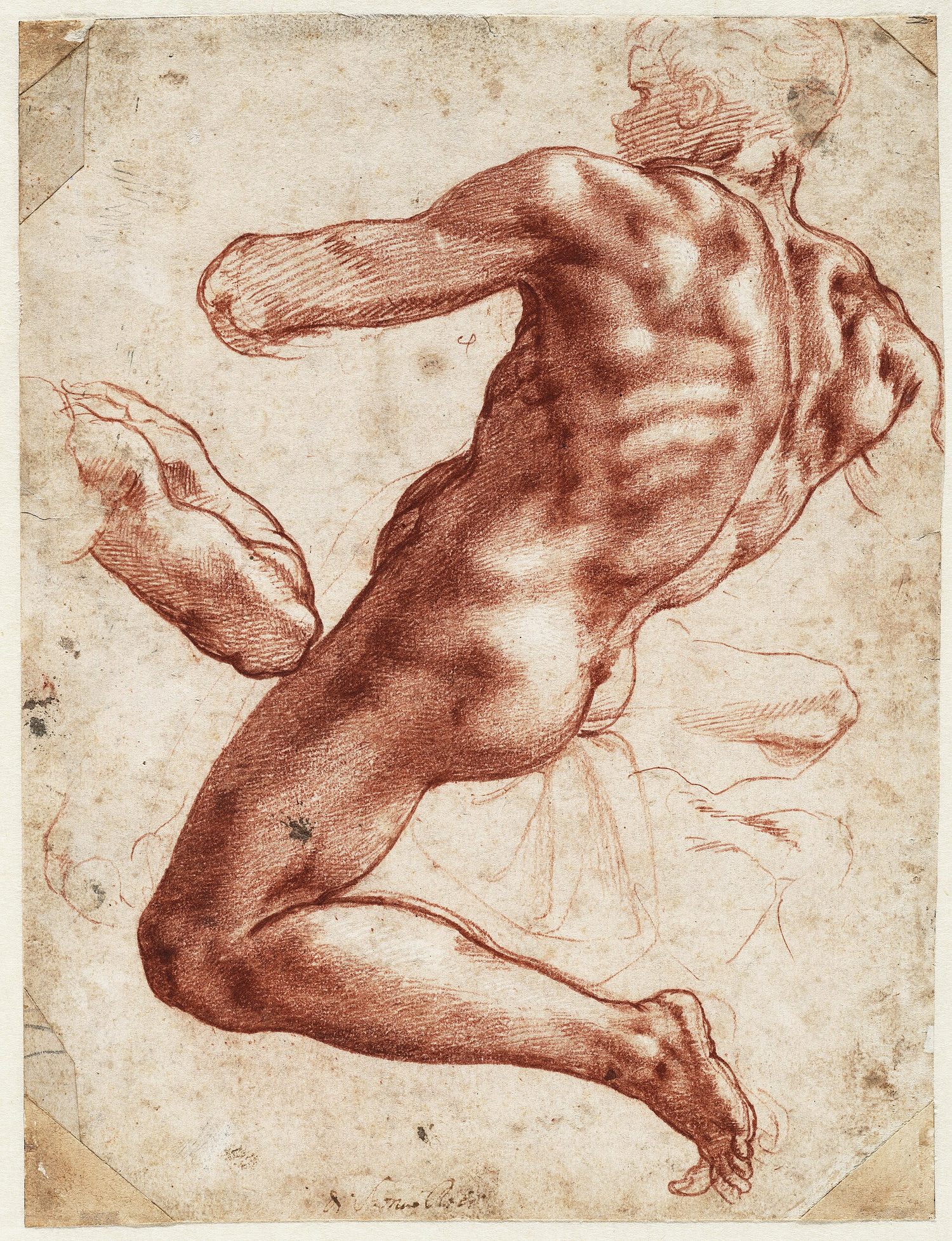
Gesture and contour from a master study: line records form in one continuous look
Contour, blind contour, or cross-contour?
Sort each activity by the drawing exercise it describes.
In blind contour drawing you may glance at the paper occasionally.
Difficulty 1/5 · 100 coins + a small bonus on first completion today
Blind contour means never looking at the paper — that is the whole exercise.
Cross-contour: over the surface
- Cross-contour lines 横截轮廓线 travel across the form like latitude lines on a globe.
- They describe volume, not edges — the drawing bulges where the form bulges.
- Overlapping contours create instant depth: a near edge covering a far one says "closer".
One edge passing in front of another — an overlapping contour — instantly creates ____.
Difficulty 1/5 · 100 coins + a small bonus on first completion today
Overlap is the fastest depth cue.
Match the exercise to what it trains.
Difficulty 2/5 · 140 coins + a small bonus on first completion today
Each contour exercise targets one skill.
Contour drawing fails when you draw what you remember (a symbol of a hand) instead of what you see (this hand, these folds). Keep your eye on the subject at least 80% of the time.
Draw your non-drawing hand in blind contour: eye crawls along the knuckle, pencil crawls at the same speed; a wrinkle turns inward — the line follows it inward. The page shows a tangled but observed hand.
Contour follows edges slowly; blind contour trains the eye by hiding the paper; cross-contour travels over the surface and describes volume. All three are observation exercises first, pictures second.
Write from 4 edges seen before drawing
- A student looks at a cup for several minutes and names 4 edges before making a mark.
Before drawing a cup, a student spends time looking and names 4 edges. Why does that looking come before the first mark?
Naming what is seen keeps the drawing attached to the object.
What do the 4 named edges show?
Difficulty 1/5 · 100 coins + a small bonus on first completion today
The edges were found by looking, so the drawing can follow them.