Exploring Behaviors of Implicit Relations
Introduced| English | Meaning |
|---|---|
| implicit relations/ɪmˈplɪsɪt rɪˈleɪʃnz/ | Equations connecting variables without necessarily expressing one variable explicitly as a function of the other. |
| implicit differentiation/ɪmˈplɪsɪt ˌdɪfəˌrenʃɪˈeɪʃn/ | Differentiating an equation involving two variables while treating one variable as a function of the other. |
Analyzing curves that aren't functions
- Circles, ellipses, and other implicit relations 隐关系 fail the vertical-line test — they aren't $y=f(x)$.
- But the calculus tools still work through implicit differentiation 隐函数求导.
- You can find their tangent slopes, spot horizontal and vertical tangents, and even their concavity.
- This lesson applies Unit 3's implicit method to Unit 5's analysis questions.
Horizontal tangents: numerator zero
- From implicit differentiation you get $\tfrac{dy}{dx}$ as a fraction.
- A horizontal tangent occurs where $\tfrac{dy}{dx}=0$ — set the numerator to zero (with denominator $\neq0$).
- For $x^2+y^2=25$: $\tfrac{dy}{dx}=-\tfrac{x}{y}=0$ when $x=0$, i.e. at $(0,5)$ and $(0,-5)$ (top and bottom).
- These are the highest and lowest points of the curve.
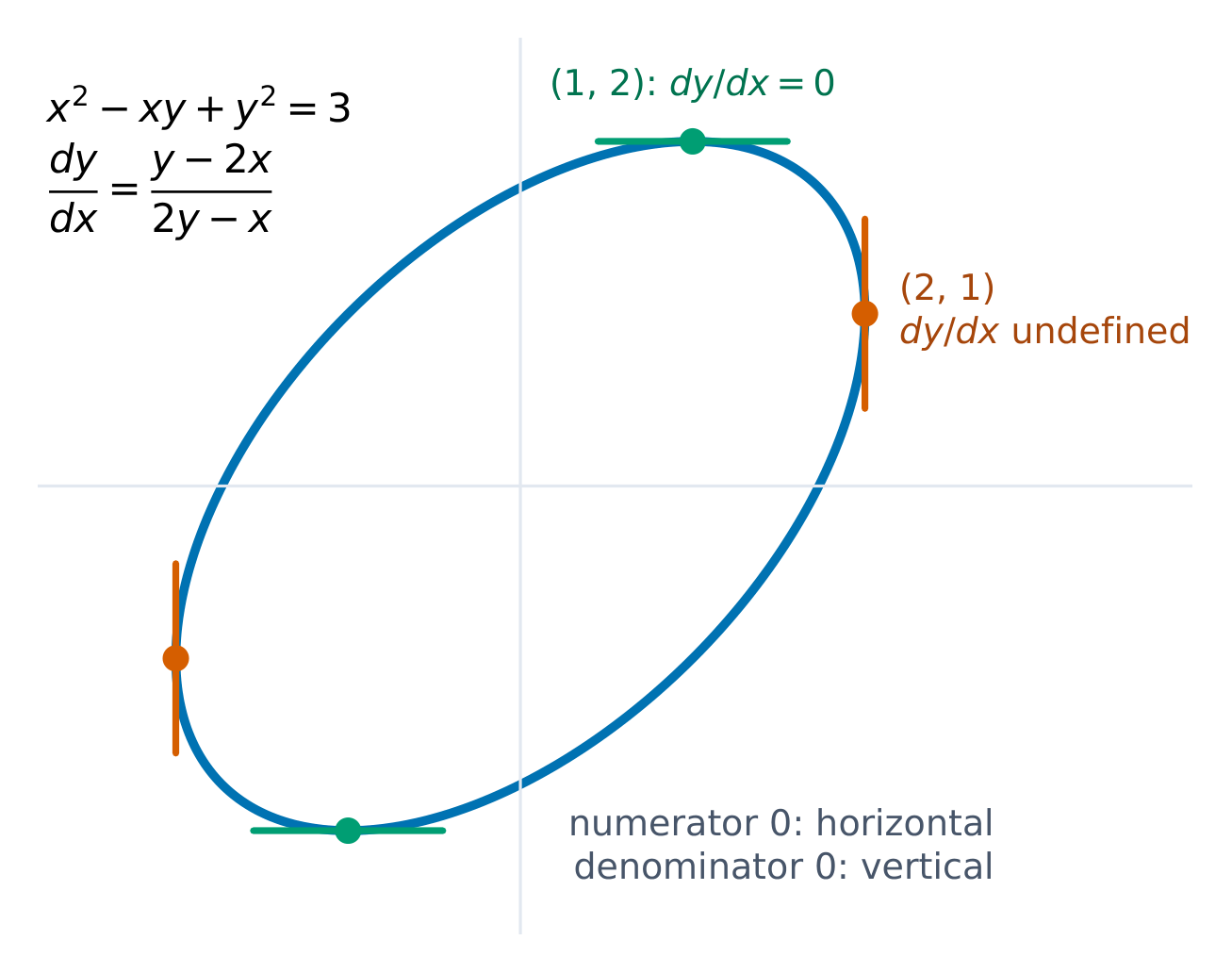
Horizontal tangents where dy/dx = 0; vertical tangents where it is undefined
Tangents on a circle
y = √(25 − x²) (upper half)
On $x^2+y^2=25$ the top and bottom have horizontal tangents; the left and right have vertical tangents.
A horizontal tangent on an implicit curve occurs where $\tfrac{dy}{dx}$...
Difficulty 1/5 · 100 coins + a small bonus on first completion today
Horizontal ⇔ slope $0$ ⇔ numerator of $\tfrac{dy}{dx}$ is zero.
For $x^2+y^2=25$ ($\tfrac{dy}{dx}=-\tfrac{x}{y}$), select all points with a horizontal tangent.
Difficulty 2/5 · 140 coins + a small bonus on first completion today
$\tfrac{dy}{dx}=0$ when $x=0$: the top and bottom points.
Vertical tangents: denominator zero
- A vertical tangent occurs where $\tfrac{dy}{dx}$ is undefined — set the denominator to zero (with numerator $\neq0$).
- For $x^2+y^2=25$: $-\tfrac{x}{y}$ is undefined when $y=0$, i.e. at $(5,0)$ and $(-5,0)$ (left and right).
- The tangent line is vertical there — the curve turns straight up and down.
- Numerator zero → horizontal; denominator zero → vertical.
A vertical tangent occurs where the ____ of $\tfrac{dy}{dx}$ is zero.
Difficulty 1/5 · 100 coins + a small bonus on first completion today
Denominator zero ⇒ slope undefined ⇒ vertical tangent.
Setting the denominator of $\tfrac{dy}{dx}$ to zero finds tangents that are...
Difficulty 1/5 · 100 coins + a small bonus on first completion today
Denominator zero ⇒ vertical tangent (numerator zero ⇒ horizontal).
Concavity: the implicit second derivative
- To get concavity, differentiate $\tfrac{dy}{dx}$ again, implicitly, to find $\tfrac{d^2y}{dx^2}$.
- Remember every $y$ still depends on $x$, so the chain rule reappears, and you substitute the known $\tfrac{dy}{dx}$.
- The sign of $\tfrac{d^2y}{dx^2}$ gives concave up/down at a point, just as before.
- It's more algebra, but the same ideas: $f''>0$ up, $f''<0$ down.
A candidate point must satisfy the original equation (lie on the curve) to count.
Difficulty 1/5 · 100 coins + a small bonus on first completion today
Check the point is actually on the curve, not just the slope condition.
To find concavity on an implicit curve you...
Difficulty 1/5 · 100 coins + a small bonus on first completion today
The implicit second derivative $\tfrac{d^2y}{dx^2}$ gives concavity by its sign.
For horizontal tangents set the numerator of $\tfrac{dy}{dx}$ to zero; for vertical tangents set the denominator to zero — don't swap them. And a point only qualifies if it actually lies on the curve: check it satisfies the original equation, not just the derivative condition.
Find the horizontal and vertical tangents of $x^2+y^2=25$.
- $2x+2y\tfrac{dy}{dx}=0\Rightarrow\tfrac{dy}{dx}=-\tfrac{x}{y}$.
- Horizontal ($\tfrac{dy}{dx}=0$): $x=0\Rightarrow(0,5),(0,-5)$.
- Vertical ($\tfrac{dy}{dx}$ undefined): $y=0\Rightarrow(5,0),(-5,0)$.
Analyze an implicit relation with implicit differentiation: $\tfrac{dy}{dx}=0$ (numerator zero) gives horizontal tangents; $\tfrac{dy}{dx}$ undefined (denominator zero) gives vertical tangents. Differentiate again implicitly for $\tfrac{d^2y}{dx^2}$ and read concavity from its sign. Always confirm points lie on the curve.
Write from a horizontal tangent
- Implicit differentiation gives dy/dx = (2x) / (3y).
- At a point on the curve, x = 0 and y = 2.
What kind of tangent is this, and what would a zero denominator mean?
Numerator 0 and denominator 6 gives slope 0.
dy/dx = 2x / (3y) at (0, 2). The tangent is what?
Difficulty 1/5 · 100 coins + a small bonus on first completion today
The numerator is 0 and the denominator is 6.