Using the Second Derivative Test to Determine Extrema
Introduced| English | Meaning |
|---|---|
| Second Derivative Test/ˈsekənd dɪˈrɪvətɪv test/ | At a stationary point where the second derivative exists, a positive second derivative implies a local minimum and a negative one a local maximum; zero is inconclusive. |
| inconclusive/ɪŋkənˈkluːsɪv/ | Describing a test result that does not determine the answer, so another method or more information is needed. |
Classify an extremum with one number
- The First Derivative Test reads sign changes; the Second Derivative Test 二阶导数判别法 is often quicker.
- At a critical point where $f'(c)=0$, just check the sign of $f''(c)$.
- Concave up at a flat spot → a valley; concave down at a flat spot → a peak.
- One evaluation of $f''$ can settle it — no sign chart needed.
$f''(c) > 0$: a minimum
- If $f'(c)=0$ and $f''(c)>0$, then $f$ has a relative minimum at $c$.
- Concave up (a cup) with a horizontal tangent = the bottom of a valley.
- Intuition: the slope is zero and increasing, so the curve turns upward.
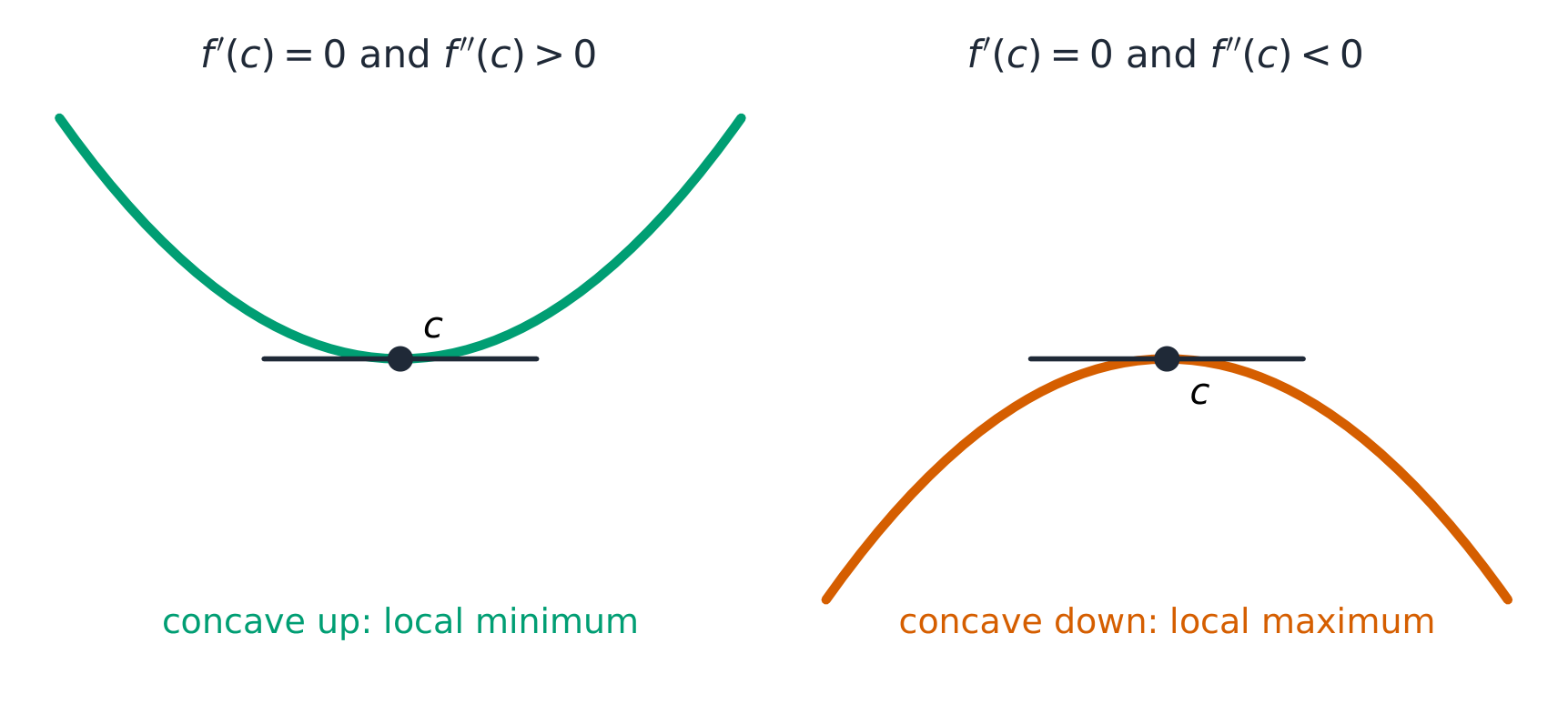
At a critical point f″ > 0 gives a local minimum and f″ < 0 a local maximum
Cup at the min, cap at the max
y = ax³ + cx
At the local min the curve is concave up ($f''>0$); at the local max it is concave down ($f''<0$).
If $f'(c)=0$ and $f''(c)>0$, then $c$ is a...
Difficulty 1/5 · 100 coins + a small bonus on first completion today
Concave up at a flat spot = minimum.
$f''(c) < 0$: a maximum
- If $f'(c)=0$ and $f''(c)<0$, then $f$ has a relative maximum at $c$.
- Concave down (a cap) with a horizontal tangent = the top of a hill.
- The slope is zero and decreasing, so the curve turns downward.
If $f'(c)=0$ and $f''(c)<0$, then $c$ is a relative ____.
Difficulty 1/5 · 100 coins + a small bonus on first completion today
Concave down at a flat spot = maximum.
When it says nothing
- If $f''(c)=0$, the test is inconclusive 无法判定 — it gives no answer.
- The point could be a max, a min, or neither (like $y=x^3$ at $0$, or $y=x^4$ at $0$).
- Fall back on the First Derivative Test (sign change of $f'$) in that case.
- So: use the Second Derivative Test first if $f''$ is easy; switch to the first test if $f''(c)=0$.
If $f''(c)=0$, the Second Derivative Test proves there is no extremum at $c$.
Difficulty 1/5 · 100 coins + a small bonus on first completion today
It is inconclusive — use the First Derivative Test instead.
For $f(x)=x^3-3x$ ($f''=6x$), classify $x=-1$.
Difficulty 1/5 · 100 coins + a small bonus on first completion today
$f''(-1)=-6<0$ → relative maximum.
The Second Derivative Test is applied at a critical point where...
Difficulty 1/5 · 100 coins + a small bonus on first completion today
It classifies critical points where the tangent is horizontal, $f'(c)=0$.
When should you fall back on the First Derivative Test?
Difficulty 2/5 · 140 coins + a small bonus on first completion today
The first test always works; the second is just often faster.
The Second Derivative Test needs $f'(c)=0$ first — it classifies critical points where the tangent is horizontal. And $f''(c)=0$ is inconclusive, not "neither": you must then use the First Derivative Test. Don't conclude "no extremum" just because $f''(c)=0$.
Classify the critical points of $f(x)=x^3-3x$ using $f''$.
- $f'(x)=3x^2-3=0$ at $x=\pm1$; $\;f''(x)=6x$.
- At $x=1$: $f''(1)=6>0$ → relative minimum.
- At $x=-1$: $f''(-1)=-6<0$ → relative maximum.
The Second Derivative Test: at a critical point with $f'(c)=0$, $f''(c)>0$ gives a relative minimum and $f''(c)<0$ a relative maximum. If $f''(c)=0$ the test is inconclusive — fall back on the First Derivative Test.
Write from a second-derivative minimum
- f prime of 0 is 0.
- f double prime of 0 is 2.
What kind of extremum is this, and when would the test fail?
The cup shape around a flat point is a minimum.
f prime of c = 0 and f double prime of c is positive. The point is what?
Difficulty 1/5 · 100 coins + a small bonus on first completion today
A positive second derivative gives a minimum.