Disruptions in Ecosystems
Introduced| English | Meaning |
|---|---|
| disruption/dɪsˈrʌpʃn/ | An event that disturbs a community and its environment. |
| invasive species/ɪnˈveɪsɪv ˈspiːsiːz/ | A species introduced outside its native range that spreads and causes harm. |
| succession/səkˈseʃn/ | succession |
When the balance is upset
- An ecosystem in balance can be thrown off by a sudden event.
- A fire, a flood, or a bulldozer can change everything.
- Some disturbances are natural; some are caused by people.
- How an ecosystem copes depends on the disturbance and its own resilience.
Natural disruptions
- A disruption 干扰 is an event that disturbs a community and its environment.
- Fires, storms, floods, and disease are natural disruptions.
- Many have happened for millions of years, and ecosystems are used to them.
- Life often recovers once the disturbance passes.
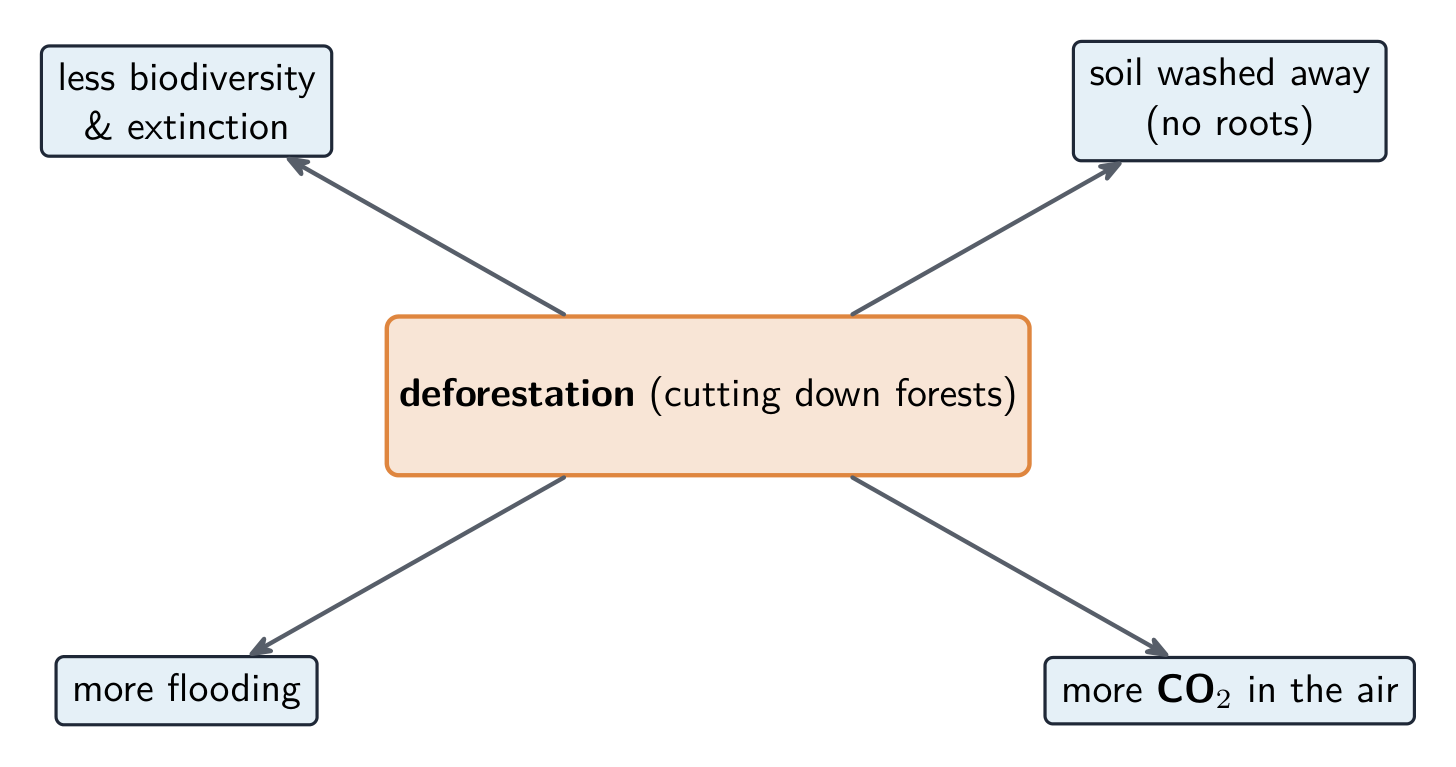
Deforestation lowers biodiversity and causes erosion, flooding, and higher CO2
A disruption to an ecosystem is…
Difficulty 1/5 · 100 coins + a small bonus on first completion today
A disruption is an event — natural or human — that disturbs an ecosystem's balance.
Human disruptions
- People disturb ecosystems by clearing habitats, polluting, and overhunting.
- We also move species around, creating invasive species 入侵物种.
- An invasive species can outcompete or eat the natives, wrecking the community.
- Human disruptions are often faster and larger than natural ones.
An invasive species is one that…
Difficulty 1/5 · 100 coins + a small bonus on first completion today
An invasive species is brought to a new place and spreads, outcompeting or eating the natives.
Recovery: succession
- After a disturbance, a community can slowly rebuild itself.
- This gradual recovery is called succession 演替.
- Pioneer species arrive first, then more and more, until the community is restored.
- A resilient ecosystem can recover — but only if the damage is not too severe.
Natural or human disruption?
Sort each disturbance by whether it is a natural event or caused by humans.
The gradual recovery of a community after a disturbance is called ____.
Difficulty 1/5 · 100 coins + a small bonus on first completion today
In succession, species return step by step, slowly rebuilding the community after a disturbance.
Many ecosystems can recover from a natural disturbance over time.
Difficulty 1/5 · 100 coins + a small bonus on first completion today
After a natural disturbance, succession often rebuilds the community — though severe human damage can be too much.
Select all true statements about disruptions.
Difficulty 2/5 · 140 coins + a small bonus on first completion today
Many disturbances are recoverable through succession. The other three are correct.
Not all disruptions are equal. Ecosystems evolved with natural ones (like fire) and often recover through succession. But human disruptions can be too fast, too large, or permanent — a paved-over wetland or an extinct species may never come back. Resilience has limits.
An invasive species runs wild:
- Cane toads were brought to Australia to control beetles.
- With no natural predators, they spread out of control.
- They poison the native animals that try to eat them — a human-caused disruption that still harms ecosystems today.
A disruption disturbs an ecosystem — naturally (fire, storm, disease) or through humans (pollution, habitat loss, invasive species). Ecosystems can often recover through succession, gradually rebuilding the community. But severe or permanent human damage can push an ecosystem past its ability to recover.
Write from a keystone species
- Sea otters eat sea urchins.
- Removing otters lets urchins destroy the kelp forest, and many other species decline.
What role do the otters play?
Keystone species hold a community structure in place.
What is the otter in this kelp forest?
Difficulty 1/5 · 100 coins + a small bonus on first completion today
Removing otters restructures the whole forest.