Environmental Impacts on Enzyme Function
Introduced| English | Meaning |
|---|---|
| optimum/ˈɒptɪməm/ | The condition or value at which a process performs best under the stated criteria. |
| denature/ˈdenətʃə/ | To alter a biological molecule's structure enough to disrupt its normal function, without necessarily breaking its primary covalent structure. |
Enzymes are fussy
- An enzyme works fast only under the right conditions.
- Change the temperature or the pH and its speed changes too.
- Push those conditions too far and the enzyme stops for good.
- This is why your body keeps its inside so carefully controlled.
Temperature: up to a point
- Warming things up speeds most reactions — molecules collide more often.
- So enzyme rate rises with temperature up to the optimum 最适.
- Past the optimum, more heat starts to break the enzyme apart.
- The rate then crashes as the enzyme is destroyed.
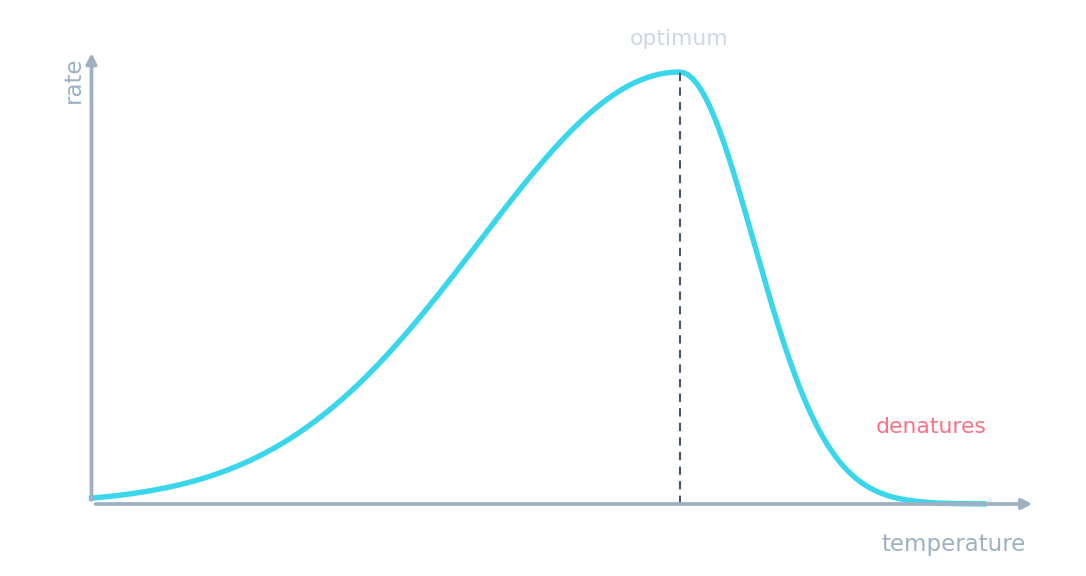
The temperature at which an enzyme works fastest is its…
Difficulty 1/5 · 100 coins + a small bonus on first completion today
Each enzyme has an optimum temperature where it works fastest — often around body temperature.
pH matters too
- Each enzyme also has a best, or optimum, pH.
- Too acidic or too alkaline and the active site changes shape.
- Stomach enzymes like acid; gut enzymes like a mild base.
- Away from its optimum pH, an enzyme slows and then fails.
What happens if the temperature rises far above the optimum?
Difficulty 1/5 · 100 coins + a small bonus on first completion today
Too much heat breaks the bonds holding the enzyme's shape — it denatures and the active site is lost.
Each enzyme also has an optimum pH at which it works best.
Difficulty 1/5 · 100 coins + a small bonus on first completion today
The wrong pH also changes the active site's shape, so each enzyme has a best pH too.
Denaturation
- Extreme heat or wrong pH makes an enzyme denature 变性.
- The bonds holding its fold break, and the active site loses its shape.
- The substrate no longer fits, so the enzyme cannot work.
- Denaturation is usually permanent — the shape does not come back.
What happens to the enzyme?
Sort each condition by its effect on how fast the enzyme works.
When heat or pH destroys an enzyme's shape, we say it has ____.
Difficulty 1/5 · 100 coins + a small bonus on first completion today
A denatured enzyme has lost its active-site shape, so the substrate no longer fits.
Select all true statements about conditions and enzymes.
Difficulty 2/5 · 140 coins + a small bonus on first completion today
Past the optimum, more heat makes it worse (denatured), not better. The other three are correct.
Past the optimum, hotter is worse, not better. It feels like more heat should mean more speed, but above the optimum the enzyme denatures and the rate falls off a cliff. There is a sweet spot, not "the more the merrier".
Two enzymes, two pH homes:
- Pepsin works in your stomach, which is strongly acidic (about pH 2).
- Enzymes in your small intestine work in a mild base (about pH 8).
- Each is denatured by the other's home — the right pH is part of the design.
An enzyme works fastest at its optimum temperature and pH. Below the optimum it is slow; far above it, heat or the wrong pH makes the enzyme denature — its active site loses shape and it stops working. Conditions must stay in a narrow, controlled range.
Write from an optimum pH of 2
- Pepsin works in the stomach.
- The same protein is tested at pH 2 and at pH 8.
Which pH is pepsin's optimum?
Stomach pepsin is adapted to strong acid.
What is pepsin's optimum pH in this case?
Difficulty 1/5 · 100 coins + a small bonus on first completion today
Pepsin's peak is in acid.