Cellular Energy
Introduced| English | Meaning |
|---|---|
| ATP/ˌeɪ tiː ˈpiː/ | The energy currency every cell runs on. |
| currency/ˈkʌrənsi/ | currency |
| phosphate/ˈfɒsfeɪt/ | phosphate |
| ADP/ˌeɪ diː ˈpiː/ | ADP |
The cell's energy money
- A cell cannot spend a whole glucose molecule the way you cannot pay with a gold bar.
- It needs energy in small, standard packets it can use anywhere.
- That packet is a molecule called ATP.
- ATP is the energy currency every cell runs on.
What ATP is
- ATP 腺苷三磷酸 stands for adenosine triphosphate — it carries three phosphate 磷酸基 groups.
- Energy is stored in the bond to the third phosphate.
- It is the cell's ready-to-spend energy, its energy currency 能量货币.
- Every part of the cell can use it.
What is the main job of ATP in a cell?
Difficulty 1/5 · 100 coins + a small bonus on first completion today
ATP is the cell's energy currency — it delivers energy in small, usable packets.
Spending: ATP to ADP
- To release energy, ATP breaks off its third phosphate.
- What remains is ADP 二磷酸腺苷 (adenosine diphosphate) — two phosphates.
- The energy freed powers the cell's work.
- This happens billions of times a second across your body.
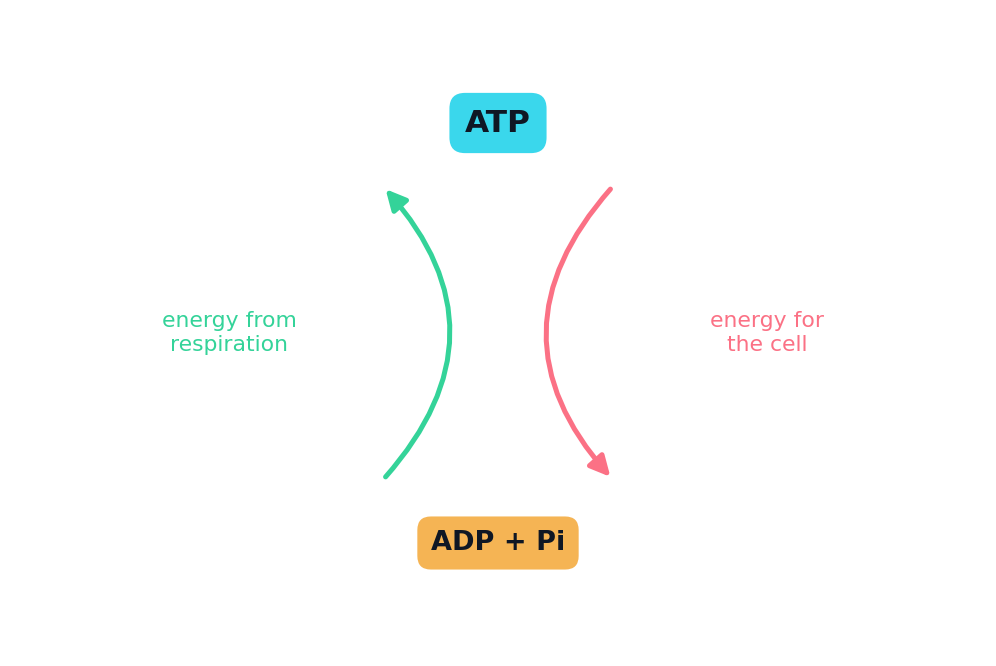
The ATP-ADP cycle
Step around the cycle — ATP loses a phosphate to power the cell, then respiration recharges ADP back to ATP.
ATP releases energy when it…
Difficulty 1/5 · 100 coins + a small bonus on first completion today
Breaking off the third phosphate turns ATP into ADP and releases usable energy.
Recharging: ADP to ATP
- ADP is not thrown away — it is recharged.
- Energy from respiration attaches a phosphate back onto ADP.
- This remakes ATP, ready for the next job.
- ATP and ADP cycle round and round, all day long.
ADP is recharged back into ATP using energy from respiration.
Difficulty 1/5 · 100 coins + a small bonus on first completion today
Respiration provides the energy to add a phosphate back to ADP, remaking ATP.
Select all true statements about ATP.
Difficulty 2/5 · 140 coins + a small bonus on first completion today
DNA stores genetic information, not ATP. The other three are correct.
Cells do not store big piles of ATP. It is made just as fast as it is spent, moment to moment. A cell holds only seconds' worth at a time — it is a currency in constant circulation, not a savings account.
Because it carries small usable packets of energy, ATP is called the cell's energy ____.
Difficulty 1/5 · 100 coins + a small bonus on first completion today
ATP is the energy currency — spent and remade constantly, like money in an economy.
Why a sprinter tires so fast:
- Muscle contraction spends ATP at a huge rate.
- The stored ATP lasts only a few seconds of all-out effort.
- After that, the muscle depends entirely on how fast respiration can recharge ADP.
ATP is the cell's energy currency — a molecule with three phosphate groups. Spending energy breaks one off, turning ATP into ADP; respiration then recharges ADP back to ATP. This ATP-ADP cycle delivers energy in small, usable packets everywhere in the cell.
Write from ATP with 3 phosphates
- ATP is hydrolysed to ADP and inorganic phosphate.
- Energy from that change can drive cell work.
How many phosphate groups does ATP have before it is hydrolysed?
The T in ATP is tri, three phosphates.
How many phosphates are on ATP?
Difficulty 1/5 · 100 coins + a small bonus on first completion today
Hydrolysis to ADP removes one of the three.