Sources of Ideas and Experiences
Introduced| English | Meaning |
|---|---|
| experiences/ekˈspɪərɪənsɪz/ | Things the artist has lived through and can draw on. |
| observation/ɒbzəˈveɪʃn/ | Information obtained by carefully watching, measuring or examining something. |
| documentation/ˌdɒkjuːmənˈteɪʃn/ | A record of work, processes, decisions or development, using images, notes or other evidence. |
Where ideas come from
- Artists' and designers' experiences 经历 inform why, how, and what they make.
- An experience is any event — real surroundings, imagined ideas, or research.
- Reflecting on experience sparks questions and inspires investigation.
According to the AP framework, what mainly informs why and what artists make?
Difficulty 1/5 · 100 coins + a small bonus on first completion today
Artists' experiences inform their thinking and making.
Observation and beyond
- Ideas come from observation 观察, memory, other disciplines, and other artists' work.
- Looking closely at the world is one of the richest sources.
- Research — reading, looking, talking — deepens ideas.
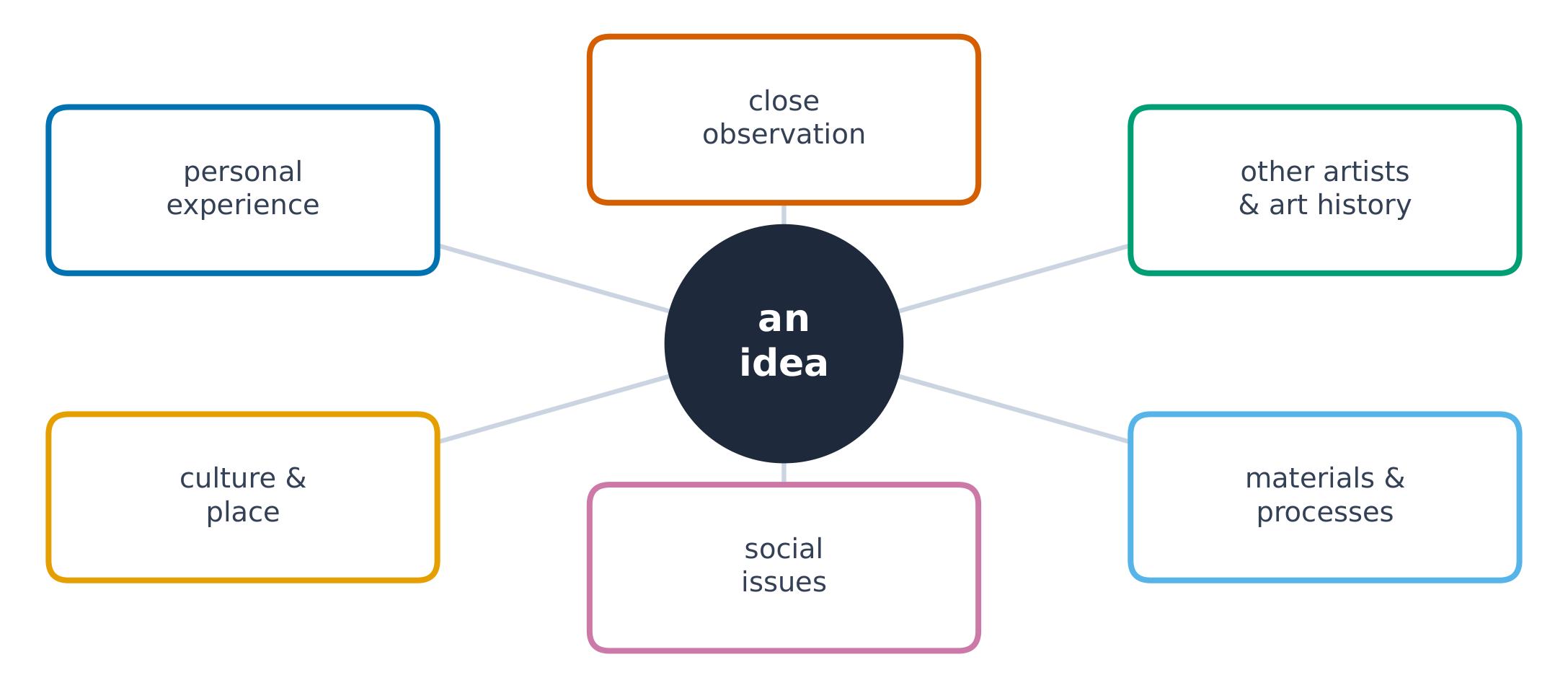
Where ideas for a sustained investigation come from
A source of ideas or not?
Sort each as a genuine source of ideas or not a source.
Careful observation of the world is a rich source of ideas.
Difficulty 1/5 · 100 coins + a small bonus on first completion today
Observation is one of the richest sources of ideas.
Select all genuine sources of artistic ideas.
Difficulty 2/5 · 140 coins + a small bonus on first completion today
Observation, memory, and research generate ideas; thoughtless copying does not.
Match each term to its meaning.
Difficulty 2/5 · 140 coins + a small bonus on first completion today
Experiences = events; observation = looking; documentation = recording.
Turn experience into a resource
- Experiences can be documented with drawings, photos, notes, or sound.
- That documentation becomes a resource you return to.
- Keeping a rich store of sources fuels a sustained investigation.
Recording experiences with sketches, photos, or notes is called ____.
Difficulty 1/5 · 100 coins + a small bonus on first completion today
Documentation turns experiences into a lasting resource.
Do not wait for a "big idea" to strike. Ideas grow from experiences and observation you actively gather and reflect on. Artists who look closely, research widely, and record what they find never run short of material — the source is a habit, not a lucky flash.
An artist curious about cities spends a week observing and photographing shadows on walls, sketching passers-by, and reading about urban light. That gathered experience, all documented, becomes the raw material for a whole sustained investigation.
Ideas come from experiences — real surroundings, imagination, and research — and from observation of the world. Reflecting on experience sparks questions. Documenting experiences turns them into a resource for a sustained investigation.
Write from 3 sources
- The student uses a museum visit, a photo they took, and a short poem.
- They change the composition instead of copying one picture.
A student builds an idea from a museum visit, a photo they took, and a short poem, then changes the composition. How many sources are in use, and why is the changed composition better than copying one picture?
Sources are starting points. The student's own choices have to follow.
How many sources are combined here?
Difficulty 1/5 · 100 coins + a small bonus on first completion today
The visit, the photo and the poem are three sources. Other options — 1 (because only the photo is visual); None (because a poem is not allowed).