Fundamental particles
| English | Chinese | Pinyin |
|---|---|---|
| fundamental particles | 基本粒子 | jī běn lì zi |
| quarks | 夸克 | kuā kè |
| flavours | 味 | wèi |
| antiquark | 反夸克 | fǎn kuā kè |
| hadrons | 强子 | qiáng zi |
| baryons | 重子 | zhòng zǐ |
| mesons | 介子 | jiè zi |
| leptons | 轻子 | qīng zi |
Inside the proton
- Protons and neutrons feel solid — but they are not fundamental particles 基本粒子.
- Each is built from smaller point-like particles called quarks 夸克.
- Some particles have no smaller parts; those are the truly fundamental ones.
Fundamental particle lab
Sort particles by the family or interaction that defines them.
Quarks
- Six flavours 味. Up, charm, top have charge $+\tfrac{2}{3}e$; down, strange, bottom have $-\tfrac{1}{3}e$.
- Each has an antiquark 反夸克 with the opposite charge.

The six quark flavours: up-type carry +⅔e, down-type carry −⅓e
What is the charge on an up quark?
Up-type quarks (up, charm, top) carry $+\tfrac{2}{3}e$; down-type (down, strange, bottom) carry $-\tfrac{1}{3}e$.
Hadrons 强子: baryons 重子 and mesons 介子
- Particles built from quarks are hadrons.
- Baryons = three quarks; mesons = a quark and an antiquark.

Match each hadron to what it is made of.
Protons and neutrons are baryons (three quarks); a pion is a meson (quark + antiquark).
Proton and neutron
- Proton = u u d: charge $\tfrac{2}{3} + \tfrac{2}{3} - \tfrac{1}{3} = +1$.
- Neutron = u d d: charge $\tfrac{2}{3} - \tfrac{1}{3} - \tfrac{1}{3} = 0$.
A proton is made of which quarks?
Proton = u u d, giving charge $\tfrac{2}{3} + \tfrac{2}{3} - \tfrac{1}{3} = +1$.
A neutron is u d d. What is its total charge, in units of $e$?
$\tfrac{2}{3} - \tfrac{1}{3} - \tfrac{1}{3} = 0$ — the neutron is uncharged.
Worked example: the quarks in an α-particle
An α-particle is two protons and two neutrons. Show, using quarks, that each hadron in it has charge $0$ or $+e$, and find the total quark content.
- Each proton is uud: $\tfrac{2}{3} + \tfrac{2}{3} - \tfrac{1}{3} = +1$, so charge $+e$. It is a baryon (three quarks).
- Each neutron is udd: $\tfrac{2}{3} - \tfrac{1}{3} - \tfrac{1}{3} = 0$. Also a baryon.
- Whole α-particle: up quarks $2 \times 2 + 2 \times 1 = 6$; down quarks $2 \times 1 + 2 \times 2 = 6$.
- Check: $6\left(+\tfrac{2}{3}\right) + 6\left(-\tfrac{1}{3}\right) = 4 - 2 = +2$, the α-particle's charge of $+2e$.
A helium-3 nucleus contains two protons and one neutron. How many down quarks does it contain?
Each proton (uud) has one down quark and the neutron (udd) has two: $1 + 1 + 2 = 4$.
β-decay in quark terms
- β$^{-}$: a neutron becomes a proton — a down quark turns into an up quark.
- β$^{+}$: a proton becomes a neutron — an up quark turns into a down quark.
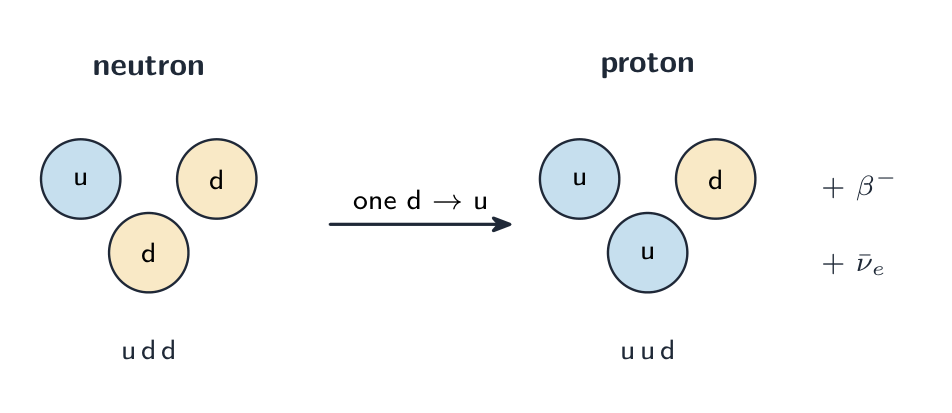
β⁻ decay up close: one down quark flips to an up quark, so a neutron becomes a proton
In β$^{-}$ decay, which quark change happens?
A neutron (u d d) becomes a proton (u u d): one down → up, emitting a $\beta^{-}$ and an antineutrino.
Leptons 轻子 and what's fundamental
- Leptons (electrons, neutrinos) are fundamental and are not made of quarks.
- Fundamental: quarks, electrons, positrons, neutrinos. Not fundamental: protons, neutrons, mesons (all hadrons).

Particles sort into hadrons (made of quarks) and leptons (fundamental, not made of quarks)
Select all the particles that are fundamental.
Quarks and leptons (electron, neutrino) are fundamental. Protons and mesons are hadrons — made of quarks.
An electron is a lepton and is not made of quarks.
Leptons (electrons and neutrinos) are fundamental particles, not built from quarks.
Worked example: a neutral meson
Particle Q is a meson with zero charge. It has a mass of $0.67\ \text{u}$ and a kinetic energy of $2.1 \times 10^{-16}\ \text{J}$.
- A possible composition: a quark with its own antiquark, for example $\text{u}\bar{\text{u}}$: $+\tfrac{2}{3} - \tfrac{2}{3} = 0$. ($\text{d}\bar{\text{d}}$ would also work.)
- Why not two quarks? A meson is always a quark and an antiquark; two quarks together are not a meson.
- Speed: $E_{\text{K}} = \tfrac{1}{2}mv^{2}$ with $m = 0.67 \times 1.66 \times 10^{-27} = 1.1 \times 10^{-27}\ \text{kg}$, so $v = \sqrt{\dfrac{2 \times 2.1 \times 10^{-16}}{1.1 \times 10^{-27}}} = 6.1 \times 10^{5}\ \dfrac{\text{m}}{\text{s}}$.
- Check: well below the speed of light, so the ordinary kinetic-energy formula is fine to use.
A meson is made of a quark and an ____.
Mesons are quark–antiquark pairs; baryons are three quarks. A neutral meson pairs a quark with an antiquark of the opposite charge, such as up with anti-up.
"Fundamental" means not made of anything smaller: quarks and leptons are; protons, neutrons and every other hadron are not. Antiquarks carry the opposite charge, so a neutral meson pairs a quark with the matching antiquark. In β$^{-}$ decay the quark change is d → u — a charge rise of $+1$ that the emitted electron's $-1$ balances — and the electron is created in the decay, not released from an orbit.
You've got it
- quarks are fundamental (up-type $+\tfrac{2}{3}e$, down-type $-\tfrac{1}{3}e$; antiquarks opposite)
- baryons = 3 quarks (proton uud, neutron udd); mesons = quark + antiquark; a nucleus's quarks are just its protons' and neutrons' added up
- in β$^{-}$ decay a down quark → up quark; leptons (electron, neutrino) are fundamental