Circular motion and angular speed
| English | Chinese | Pinyin |
|---|---|---|
| radians | 弧度 | hú dù |
| arc length | 弧长 | hú zhǎng |
| angular speed | 角速度 | jiǎo sù dù |
| period | 周期 | zhōu qī |
| frequency | 频率 | pín lǜ |
| tangential | 切向 | qiè xiàng |
| linear speed | 线速度 | xiàn sù dù |
The merry-go-round
- Two horses on a merry-go-round both go round once together.
- Yet the outer horse clearly moves faster than the inner one.
- The link between "going round" and "speed" is what we set up here.
Angles in radians 弧度
- A radian is the angle whose arc length 弧长 equals the radius: $\theta = \dfrac{s}{r}$.
- A full circle is $2\pi\ \text{rad}$. (Set your calculator to radians for this topic.)

A Ferris wheel: each car moves in a circle at a steady angular speed 角速度
Angular speed
s = rθ
Angular speed turns angle per time; arc length s = rθ.
One radian is the angle for which the arc length equals the:
$\theta = \dfrac{s}{r}$, so when the arc $s$ equals the radius $r$, the angle is exactly one radian.
How many radians are there in a complete circle?
A full circle has arc $s = 2\pi r$, so $\theta = \dfrac{2\pi r}{r} = 2\pi \approx 6.28\ \text{rad}$.
Angular speed
- Angular speed $\omega$ is how fast the angle changes: $\omega = \dfrac{\theta}{t}$.
- Unit: $\dfrac{\text{rad}}{\text{s}}$.

One radian is the angle whose arc length equals the radius
Period 周期 and frequency 频率
- One turn takes the period $T$, so $\omega = \dfrac{2\pi}{T} = 2\pi f$.
- $f = \dfrac{1}{T}$ is the number of turns per second (Hz).

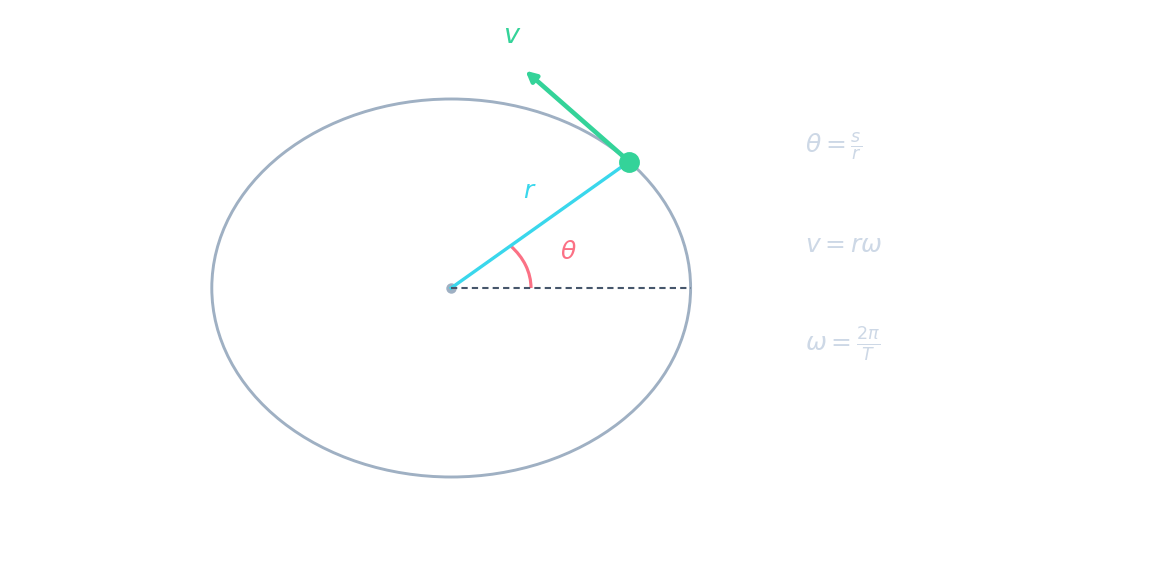
As the radius turns through the angle the object moves an arc at speed v
An object goes once round every $2.0\ \text{s}$. What is its angular speed?
$\omega = \dfrac{2\pi}{T} = \dfrac{2\pi}{2.0} = \pi \approx 3.14\ \dfrac{\text{rad}}{\text{s}}$.
Angular speed equals $2\pi$ divided by the ____.
$\omega = \dfrac{2\pi}{T}$ — the whole turn ($2\pi$) divided by the time for one turn.
Linear and angular speed
- The actual (tangential 切向) speed is $v = r\omega$.
- Same $\omega$, bigger $r$ → bigger $v$ — which is why the outer horse is faster.
A point at radius $0.50\ \text{m}$ turns at $\omega = 4.0\ \dfrac{\text{rad}}{\text{s}}$. What is its linear speed?
$v = r\omega = 0.50 \times 4.0 = 2.0\ \dfrac{\text{m}}{\text{s}}$.
On a merry-go-round, a horse further from the centre moves at a higher linear speed.
Same angular speed $\omega$, but $v = r\omega$, so a larger radius gives a larger linear speed.
Describing uniform circular motion
- The exam asks for it "in terms of velocity and acceleration". Say all three things:
- the speed is constant, but the velocity is not — it is along the tangent and its direction changes continuously;
- the acceleration has constant magnitude and is always directed towards the centre, perpendicular to the velocity.
Which statements correctly describe an object in uniform circular motion? Select all that apply.
The speed is constant but the velocity keeps changing direction, so there is an acceleration — of constant size, always towards the centre.
Worked example: standing still, moving fast
Cambridge is at latitude $52.2^\circ$ on an Earth of radius $6.37 \times 10^{6}\ \text{m}$ that turns once a day. Find the radius of the circle Cambridge moves round, its speed, and the resultant force on a $60\ \text{kg}$ student needed for this motion.
- Radius of the circle: the city circles the Earth's axis, not its centre, so $r = R\cos 52.2^\circ = 6.37 \times 10^{6} \times 0.613 = 3.90 \times 10^{6}\ \text{m}$.
- Angular speed: $\omega = \dfrac{2\pi}{T} = \dfrac{2\pi}{86\,400} = 7.27 \times 10^{-5}\ \dfrac{\text{rad}}{\text{s}}$.
- Speed: $v = r\omega = 3.90 \times 10^{6} \times 7.27 \times 10^{-5} = 284\ \dfrac{\text{m}}{\text{s}}$.
- Resultant force: $F = mr\omega^{2} = 60 \times 3.90 \times 10^{6} \times (7.27 \times 10^{-5})^{2} = 1.2\ \text{N}$, towards the axis.
- Check: a tiny force compared with the student's $590\ \text{N}$ weight — which is why we do not notice the spin, even though we are moving faster than a jet aircraft.
$\omega$ must be in radians per second. Revolutions per minute become $\dfrac{\text{rpm} \times 2\pi}{60}$; a full turn is $2\pi$ in every formula here, never $360$. $r$ in $v = r\omega$ is in metres. And the period is the time for one complete revolution, not for a half-turn or a swing.
A drill bit spins at $3000$ revolutions per minute. What is its angular speed, in rad/s?
$3000$ turns per minute is $50$ per second; each turn is $2\pi$ rad, so $\omega = 50 \times 2\pi = 314\ \dfrac{\text{rad}}{\text{s}}$.
Numbers to get a feel for
- A CD at $500$ revolutions per minute: $\omega = \dfrac{500 \times 2\pi}{60} = 52\ \dfrac{\text{rad}}{\text{s}}$.
- A car wheel of radius $0.30\ \text{m}$ at $20\ \dfrac{\text{m}}{\text{s}}$: $\omega = \dfrac{v}{r} = 67\ \dfrac{\text{rad}}{\text{s}}$, about $11$ turns a second.
- The Earth: one turn in $86\,400\ \text{s}$, so $\omega = 7.3 \times 10^{-5}\ \dfrac{\text{rad}}{\text{s}}$ — slow in angle, fast at the rim.
You've got it
- a radian: $\theta = \dfrac{s}{r}$; a full circle is $2\pi\ \text{rad}$
- angular speed $\omega = \dfrac{\theta}{t} = \dfrac{2\pi}{T} = 2\pi f$ (rad/s — convert rpm)
- linear speed 线速度 $v = r\omega$ (bigger radius → faster); uniform circular motion: constant speed, changing velocity, acceleration towards the centre