Radioactive decay
| English | Chinese | Pinyin |
|---|---|---|
| radiation | 辐射 | fú shè |
| positron | 正电子 | zhèng diàn zi |
| photon | 光子 | guāng zi |
| penetration | 穿透 | chuān tòu |
| ionising | 电离 | diàn lí |
| deflected | 偏转 | piān zhuǎn |
| antiparticles | 反粒子 | fǎn lì zi |
| neutrinos | 中微子 | zhōng wēi zi |
Three kinds of radiation 辐射
- An unstable nucleus settles down by throwing out radiation.
- There are three kinds — alpha, beta and gamma — and they behave very differently.
- Telling them apart is the heart of this topic.
What each one is
- α: a helium nucleus ($^{4}_{2}\alpha$), charge $+2e$, mass $\approx 4\ \text{u}$.
- β: a fast electron ($\beta^{-}$) or positron 正电子 ($\beta^{+}$), charge $\mp e$, tiny mass.
- γ: a high-energy photon 光子, no charge, no mass.
Radioactive decay
A = A₀·bᵗ
Activity decays exponentially — set the base b below 1.
An α-particle is:
An α-particle is $^{4}_{2}\alpha$ — a helium-4 nucleus with charge $+2e$.
Penetration 穿透 and ionising 电离
- α: stopped by paper; strongly ionising.
- β: stopped by a few mm of aluminium.
- γ: only reduced by thick lead; weakly ionising.
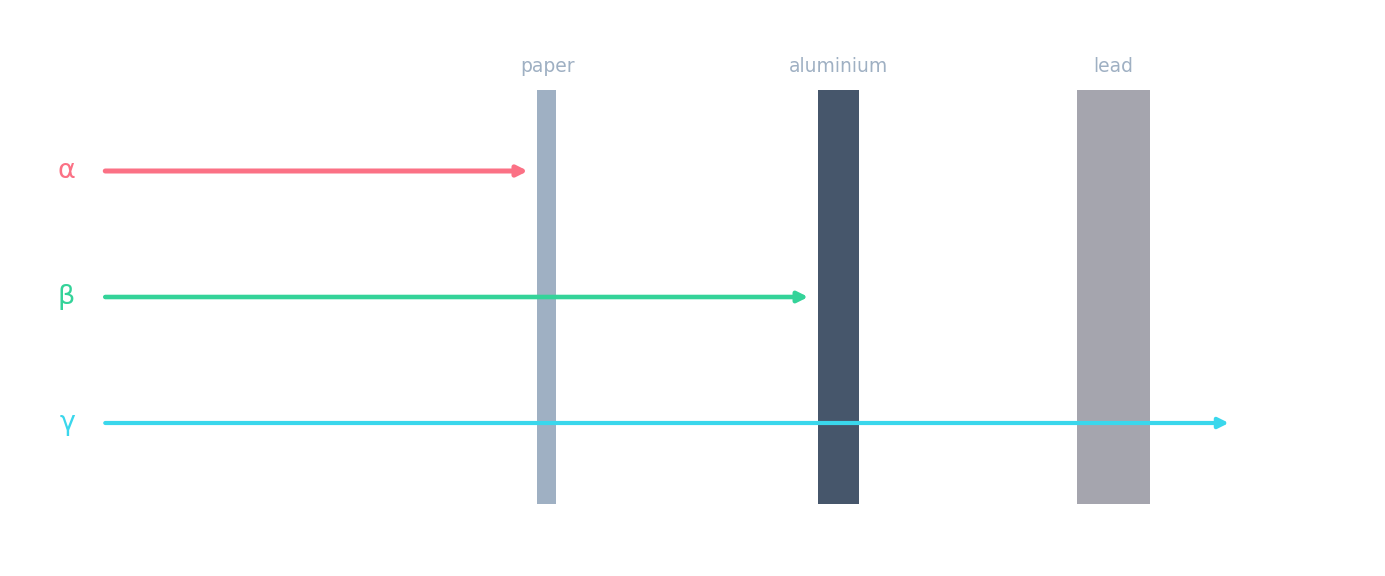
Match each radiation to what stops it.
Penetration goes α < β < γ; ionising power goes the other way (α is the strongest ioniser).
Of the three, α radiation is the most strongly ionising.
Yes — α is the strongest ioniser (and so the least penetrating); γ is the weakest ioniser (and most penetrating).
In an electric field
- The field pushes charges: α is deflected 偏转 towards the negative plate, β$^{-}$ the opposite way, γ not at all.
- The force is $F = Eq$, so the α feels twice the force of a β — but its mass is thousands of times larger, so it curves far less.
- Same rule for any two charged particles in the same field: compare the forces by charge, the accelerations by $\dfrac{q}{m}$.
An α-particle, a β⁻ particle and a γ-ray enter the same uniform electric field side by side. Which statement is correct?
Opposite charges are pushed opposite ways. The β⁻ has a far larger charge-to-mass ratio, so it accelerates far more; the uncharged γ feels no force.
Antiparticles 反粒子 and neutrinos 中微子
- Every particle has an antiparticle — same mass, opposite charge (the positron is the electron's).
- β-decay always emits a (anti)neutrino too: nearly massless, no charge, very hard to detect.
The positron is the ____ of the electron.
An antiparticle has the same mass but opposite charge — the positron is $+e$ to the electron's $-e$.
Why β is continuous
- α-decay shares energy between two particles → the α has one fixed energy (discrete).
- β-decay shares energy between three (with the neutrino) → β energies range from zero up to a maximum (continuous).
β-particles come out with a continuous range of energies because the energy is shared among:
With three particles sharing, the β can take any share up to a maximum. α-decay shares between two, fixing the α energy.
Decay equations
- α: $^{A}_{Z}\text{X} \to {}^{A-4}_{Z-2}\text{Y} + {}^{4}_{2}\alpha$.
- β$^{-}$: $^{A}_{Z}\text{X} \to {}^{A}_{Z+1}\text{Y} + {}^{0}_{-1}\beta + \bar{\nu}_{e}$ (a neutron becomes a proton).
- β$^{+}$: $^{A}_{Z}\text{X} \to {}^{A}_{Z-1}\text{Y} + {}^{0}_{+1}\beta + \nu_{e}$ (a proton becomes a neutron).
In α-decay, by how much does the nucleon number $A$ decrease?
The α carries away 4 nucleons (2 protons + 2 neutrons), so $A$ falls by 4 (and $Z$ by 2).
In β$^{-}$ decay, the proton number $Z$:
A neutron turns into a proton, so $Z$ rises by 1 while $A$ stays the same.
Worked example: nitrogen-12 and a field
Nitrogen-12, $^{12}_{7}\text{N}$, decays by emitting a positron. The emitted positron and an α-particle then pass through the same uniform electric field.
- Equation: $^{12}_{7}\text{N} \to {}^{12}_{6}\text{C} + {}^{0}_{+1}\beta + \nu_{e}$. Check: $12 = 12 + 0$ and $7 = 6 + 1$.
- Charge on the positron: $+e$ — the electron's antiparticle.
- Forces in the field: $F = Eq$, so $\dfrac{F_{\alpha}}{F_{\beta}} = \dfrac{2e}{e} = 2$.
- Accelerations: $a = \dfrac{Eq}{m}$, so $\dfrac{a_{\alpha}}{a_{\beta}} = \dfrac{2e / 4\,\text{u}}{e / (\text{u}/1840)} \approx \dfrac{1}{3700}$ — the positron accelerates thousands of times more.
- Check: twice the force but four thousand times the mass: the α barely bends. Both are pushed the same way, because both are positive.
Nucleus X (charge $+2e$, mass $4\ \text{u}$) and nucleus Y (charge $+e$, mass $3\ \text{u}$) are in the same uniform electric field. What is the ratio acceleration of X : acceleration of Y?
$a = \dfrac{Eq}{m}$, so the ratio is $\dfrac{2/4}{1/3} = \dfrac{0.5}{0.333} = 1.5$. The force ratio alone would be $2$; the masses change it.
A β$^{-}$ particle comes from the nucleus — a neutron turns into a proton — not from the orbiting electrons. A γ-ray changes neither $A$ nor $Z$; it only carries away energy. And the reason β energies are continuous is the (anti)neutrino sharing the energy — that is the exam's favourite "explain" question in this topic.
You've got it
- α = He nucleus, $+2e$, $4\ \text{u}$ (paper-stopped, strong ioniser); β = electron/positron (Al-stopped); γ = photon (lead)
- in a field: force $\propto q$, acceleration $\propto \dfrac{q}{m}$; α and β$^{-}$ bend opposite ways, γ does not bend
- β-decay emits a (anti)neutrino, which is why its energy spectrum is continuous; α: $A{-}4, Z{-}2$; β$^{-}$: $Z{+}1$; β$^{+}$: $Z{-}1$