Probability
Introduced| English | Meaning |
|---|---|
| independent/ˌɪndɪˈpendənt/ | Describing quantities, events or choices that do not depend on one another in the relationship being considered. |
| mutually exclusive/ˈmjuːtʃuːəli eksˈkluːsɪv/ | Describing events that cannot occur together in the same trial. |
| conditional probability/kənˈdɪʃənl ˌprɒbəˈbɪlɪti/ | The probability of an event given that another event has occurred. |
| tree diagram/triː ˈdaɪəɡræm/ | A branching diagram showing possible stages, outcomes or classifications and their relationships. |
| without replacement/wɪˈðaʊt rɪˈpleɪsmənt/ | without replacement |
| Venn diagram/ven ˈdaɪəɡræm/ | A diagram using overlapping regions to represent sets and their relationships. |
| two-way table/tuː weɪ ˈteɪbl/ | A table showing frequencies or other data classified by two categorical variables. |
The birthday paradox
- In a room of just 23 people, there's a greater than 50% chance that two share a birthday.
- Probability is counterintuitive. The rules are simple, but the results can surprise you.
Combining probabilities
- Addition ("or"): $P(A \cup B) = P(A) + P(B) - P(A \cap B)$.
- Multiplication ("and", if independent 独立): $P(A \cap B) = P(A)\,P(B)$.
- Mutually exclusive 互斥 events can't both happen; independent events don't affect each other.
Worked example. P(rain) = 0.3, P(bus late) = 0.2, independent. P(rain or bus late) = 0.3 + 0.2 − 0.3 × 0.2 = 0.44.
Mutually exclusive ≠ independent. Mutually exclusive means they can't both happen (so $P(A \cap B) = 0$). Independent means one doesn't affect the other (so $P(A \cap B) = P(A) \times P(B)$). These are completely different concepts.

Dice: a starting point for probability
Conditional probability
P(A ∩ B) = P(A)·P(B|A)
The area model shows how conditional probabilities combine — and how Bayes finds P(A | B).
P(A) = 0.5, P(B) = 0.4 and P(A∩B) = 0.2. Are A and B independent?
Difficulty 1/5 · 100 coins + a small bonus on first completion today
P(A)×P(B) = 0.5 × 0.4 = 0.2, which equals P(A∩B), so they are independent.
P(A) = 0.5, P(B) = 0.4, P(A∩B) = 0.2. What is P(A∪B)?
Difficulty 2/5 · 140 coins + a small bonus on first completion today
P(A∪B) = 0.5 + 0.4 − 0.2 = 0.7.
If A and B are mutually exclusive, then P(A∩B) = 0.
Difficulty 1/5 · 100 coins + a small bonus on first completion today
Mutually exclusive events cannot both happen, so their intersection has probability 0.
Mutually exclusive events are always independent.
Difficulty 1/5 · 100 coins + a small bonus on first completion today
If A and B are mutually exclusive (and both have P > 0), then P(A∩B) = 0 ≠ P(A)×P(B), so they are NOT independent.
Conditional probability 条件概率
- Conditional: the chance of $A$ given $B$ has happened:
- Independence test: check whether $P(A \cap B) = P(A)\times P(B)$.
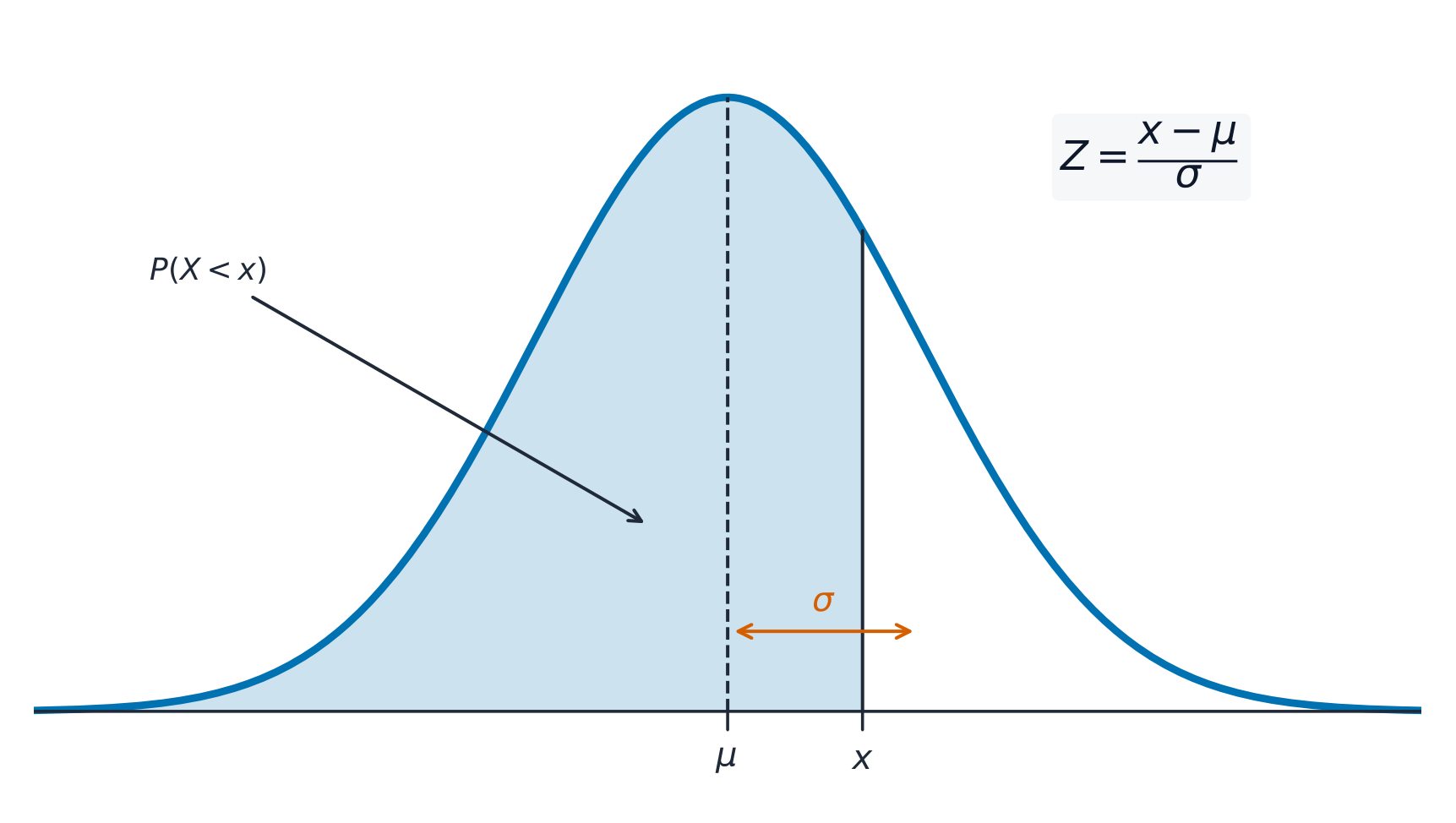
The normal curve: a probability is the area under it, centred on the mean
P(A∩B) = 0.2 and P(B) = 0.4. What is P(A | B)?
Difficulty 2/5 · 140 coins + a small bonus on first completion today
P(A|B) = P(A∩B)/P(B) = 0.2/0.4 = 0.5.
Worked example — tree diagrams 树状图
- A bag has 3 red and 2 blue balls. Two are drawn without replacement 不放回.
- P(both red) = $\dfrac{3}{5} \times \dfrac{2}{4} = \dfrac{6}{20} = 0.3$.
- P(one of each) = $\dfrac{3}{5} \times \dfrac{2}{4} + \dfrac{2}{5} \times \dfrac{3}{4} = \dfrac{6}{20} + \dfrac{6}{20} = 0.6$.
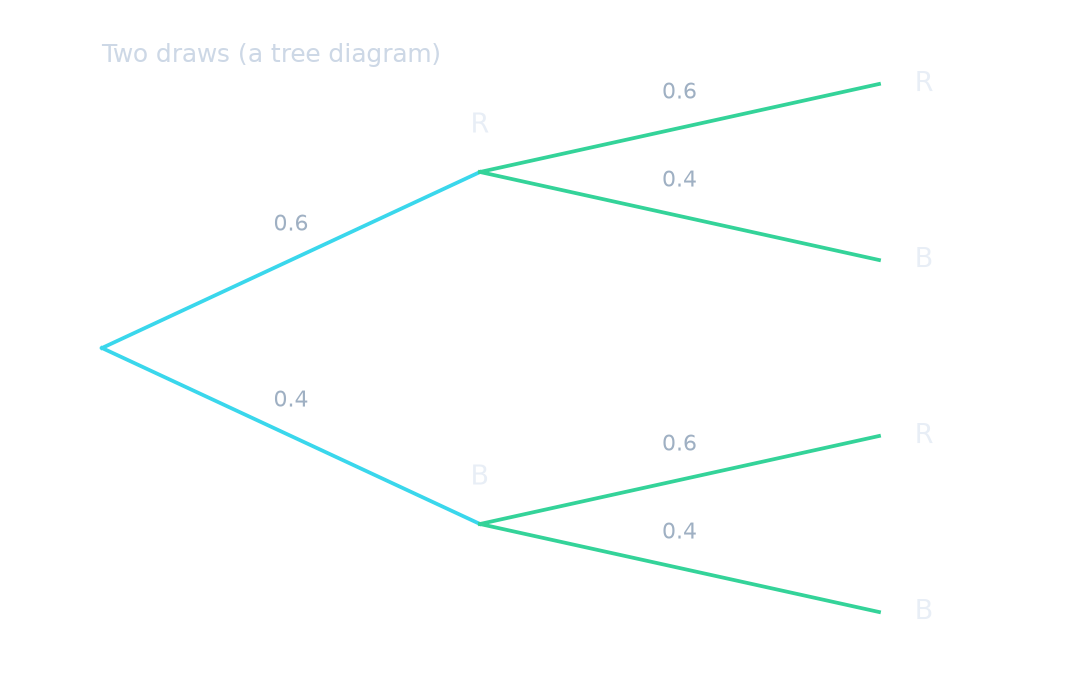
On a tree diagram, multiply probabilities along the branches, then add the paths you want.
A bag has 3 red and 2 blue. Two drawn without replacement. P(both red) = (3/5)(2/4). Find it.
Difficulty 2/5 · 140 coins + a small bonus on first completion today
(3/5) × (2/4) = 6/20 = 0.3.
A bag has 3 red and 2 blue, drawn without replacement. Put the steps for P(both red) in order.
Difficulty 3/5 · 200 coins + a small bonus on first completion today
On a tree, multiply the probabilities along the chosen branch, then simplify.
Venn diagrams 韦恩图 and two-way tables 双向表
- Venn diagrams show overlapping events visually — the intersection is $A \cap B$.
- Two-way tables organise data by two categories — read conditional probabilities from the relevant row or column.
- Count arrangements with permutations (order matters) and combinations (order does not).
You've got it
- addition (or): $P(A\cup B) = P(A) + P(B) - P(A\cap B)$
- multiplication (and, independent): $P(A\cap B) = P(A)P(B)$
- conditional: $P(A\mid B) = \dfrac{P(A\cap B)}{P(B)}$; test independence with $P(A\cap B) = P(A)P(B)$
Write from a probability of 0.55
- P(A) = 0.4 and P(B) = 0.25, and the events are independent.
- Find P(A or B).
P(A) is 0.4, P(B) is 0.25, and the events are independent. What is P(A or B)?
0.65 minus 0.1 is 0.55.
What is P(A or B)?
Difficulty 1/5 · 100 coins + a small bonus on first completion today
0.4 plus 0.25 minus 0.1 is 0.55.